Why in news
The mid year climate talks at Bonn, held from 8 to 18 June 2026, ended in gridlock over finance and trade. India used the session to press three demands before COP31 at Antalya.
Background
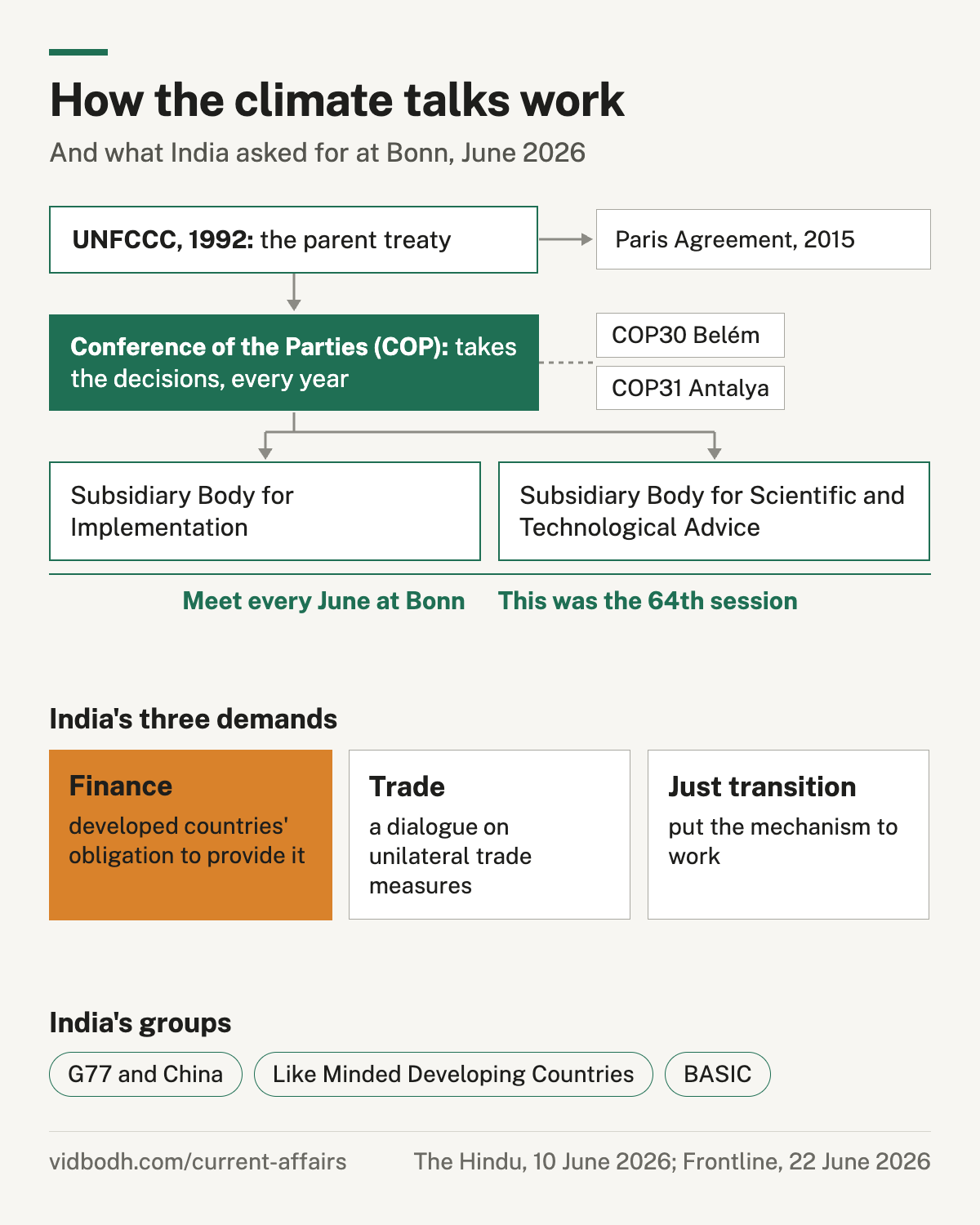
- The United Nations Framework Convention on Climate Change (UNFCCC) of 1992 is the parent treaty; the Paris Agreement of 2015 sits under it.
- Its yearly Conference of the Parties (COP) takes the decisions. Two subsidiary bodies prepare them: one on implementation, one on scientific and technological advice.
- These bodies meet every June at Bonn, the seat of the UNFCCC secretariat. This was their 64th session, SB64.
- COP30 was at Belém in Brazil; COP31 is at Antalya in Turkey, with Australia presiding over the negotiations.
India's three demands
- Finance: dedicated agenda space for the obligation of developed countries, under the Paris Agreement, to provide finance to developing ones, on the principle of common but differentiated responsibilities.
- Trade: a dialogue on unilateral trade measures such as the European Union's carbon border charge, which India anchors in Article 3.5 of the Convention.
- Just transition: putting the Just Transition Mechanism to work.
The groups India works through
- The G77 and China, the largest bloc of developing countries.
- The Like Minded Developing Countries.
- BASIC: Brazil, South Africa, India and China.
The electrification gap
- Turkey proposed that electricity meet at least a third of world energy needs by 2035.
- Electricity is about a fifth of the energy the world finally uses, and less than half of that comes from non fossil sources.
- So only about 8 per cent of the world's energy is clean. Renewables must first become electricity, which means electrifying transport, heating and industry.
Why the talks stalled
- The session ended in gridlock over finance and the European Union's carbon border charge, the recurring sticking points for developing countries.
- The same division has run through the talks since they began: who pays, and who cuts first.
The way forward
- Tie any new mitigation target to finance actually delivered.
- Settle trade measures inside the multilateral process, not by unilateral rules.
- Measure the transition by the share of energy that is electrified, not by renewable capacity alone.
Prelims facts
- The Bonn session is of the UNFCCC's subsidiary bodies; this was SB64.
- COP31 is at Antalya, Turkey, with Australia presiding over negotiations.
- BASIC is Brazil, South Africa, India and China.
- The UNFCCC secretariat is at Bonn.
See also: Carbon Border Adjustment Mechanism · COP31, Antalya
Sources: The Hindu, 10 Jun 2026: India pushes for dialogue on climate finance, adaptation at Bonn climate talks (opens in a new tab) · The Indian Express, 20 Jun 2026: The world must electrify rapidly to meet climate goals. The challenge is bigger than you think (opens in a new tab) · Frontline, 22 Jun 2026: Why Bonn climate talks ended where they began (opens in a new tab)
Earlier coverage: Bonn climate talks, SB64 · The monthly magazine, June 2026