Why in news
On 5 June 2026 the Centre and the Reserve Bank announced a joint package to draw foreign money into India. Foreign portfolio investors no longer pay income tax on government bonds, and banks were given an incentive to raise foreign currency deposits from non residents.
Background
- India imports more than it exports in goods. Services exports and remittances cover much of the gap; the rest is the current account deficit, which must be paid for by capital coming in.
- In 2026 costlier oil widened the import bill, and foreign portfolio investors pulled money out. The rupee fell.
- The rupee's rate has been market determined since March 1993. The Reserve Bank steps in to curb sharp swings, not to defend a level.
- India has done this before: in 2013, during the "taper tantrum", a similar window brought in about 34 billion dollars.
The three parts of the package
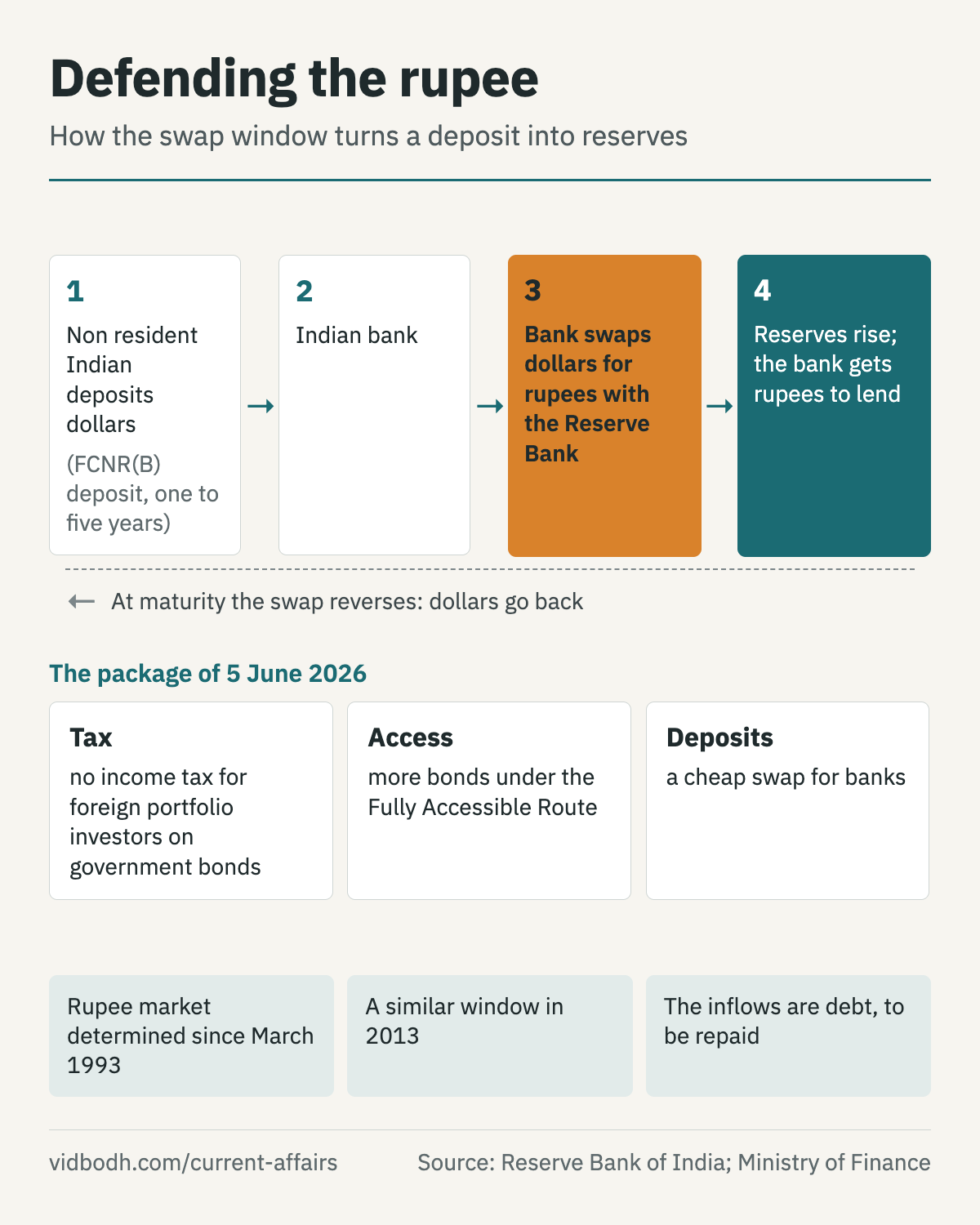
- Tax: an ordinance exempted foreign portfolio investors from tax on interest and capital gains from government securities.
- Access: more government bonds were opened to foreigners without limit under the Fully Accessible Route.
- Deposits: the Reserve Bank offered banks a cheap swap for dollars raised through Foreign Currency Non Resident (FCNR) deposits with banks, FCNR(B), and overseas borrowing.
How the swap window works
- A non resident Indian places dollars with an Indian bank for three to five years.
- The bank hands the dollars to the Reserve Bank and takes rupees, with a promise to reverse the deal later at a rate fixed today.
- The Reserve Bank's reserves rise, and the rupee is supported without the Reserve Bank selling dollars. The bank is covered against a fall in the rupee on the principal.
- The cheap swap is a subsidy: it lets the bank offer the depositor an attractive rate.
What it buys, and what it costs
- It steadied the rupee. By late July the Governor could say the rupee was undervalued on fundamentals.
- But these inflows are debt. They must be repaid, with interest, in three to five years.
- Hot money: bond investors can leave as quickly as they came.
- The tax exemption costs revenue, and it was made by ordinance, which Parliament had to approve later.
- Stable capital is foreign direct investment, and net inflows of it were low in 2025-26.
The way forward
- Treat the package as a bridge. The lasting cure is a smaller oil bill and larger exports.
- Draw equity and direct investment, which do not have to be repaid.
- Keep the share of short term debt low, since that is what turns pressure into a crisis.
Prelims facts
- FCNR(B) deposits are in foreign currency; Non Resident External (NRE) deposits are in rupees and fully repatriable.
- The Fully Accessible Route was introduced in 2020.
- The Reserve Bank's main effective exchange rate index uses a basket of 40 currencies.
- Export proceeds must now be brought home within nine months.
- The rupee has been market determined since March 1993.
Sources: The Hindu, 5 Jun 2026: Government exempts capital gains tax on FPI investment in G-Secs (opens in a new tab) · The Hindu, 5 Jun 2026: RBI announces host of measures to attract foreign capital (opens in a new tab) · Reserve Bank of India, 8 Jun 2026: Circular on the swap facility for ECBs and OFCBs (opens in a new tab) · Governance Now, 5 Jun 2026: Govt, RBI announce major reforms to attract FPI (opens in a new tab) · The Indian Express, 6 Jun 2026 · The Indian Express, 18 Jun 2026 · The Indian Express, 26 Jun 2026 · Reserve Bank of India, 8 Jun 2026: Developments in India's balance of payments, January to March 2026 (opens in a new tab) · The Hindu, 15 Jun 2026: Goods exports hit record high of $45.2 billion in May 2026; trade deficit widens on higher import growth (opens in a new tab) · The Tribune, 15 Jun 2026: Despite significant growth in exports, India's trade deficit widens in May on rising imports (opens in a new tab) · The Indian Express, 30 Jun 2026
Earlier coverage: Defending the rupee · The monthly magazine, June 2026