Climate science in 2026: new scenarios, tipping points and the next IPCC report
LeadPrelims and MainsJune 2026
Why in news
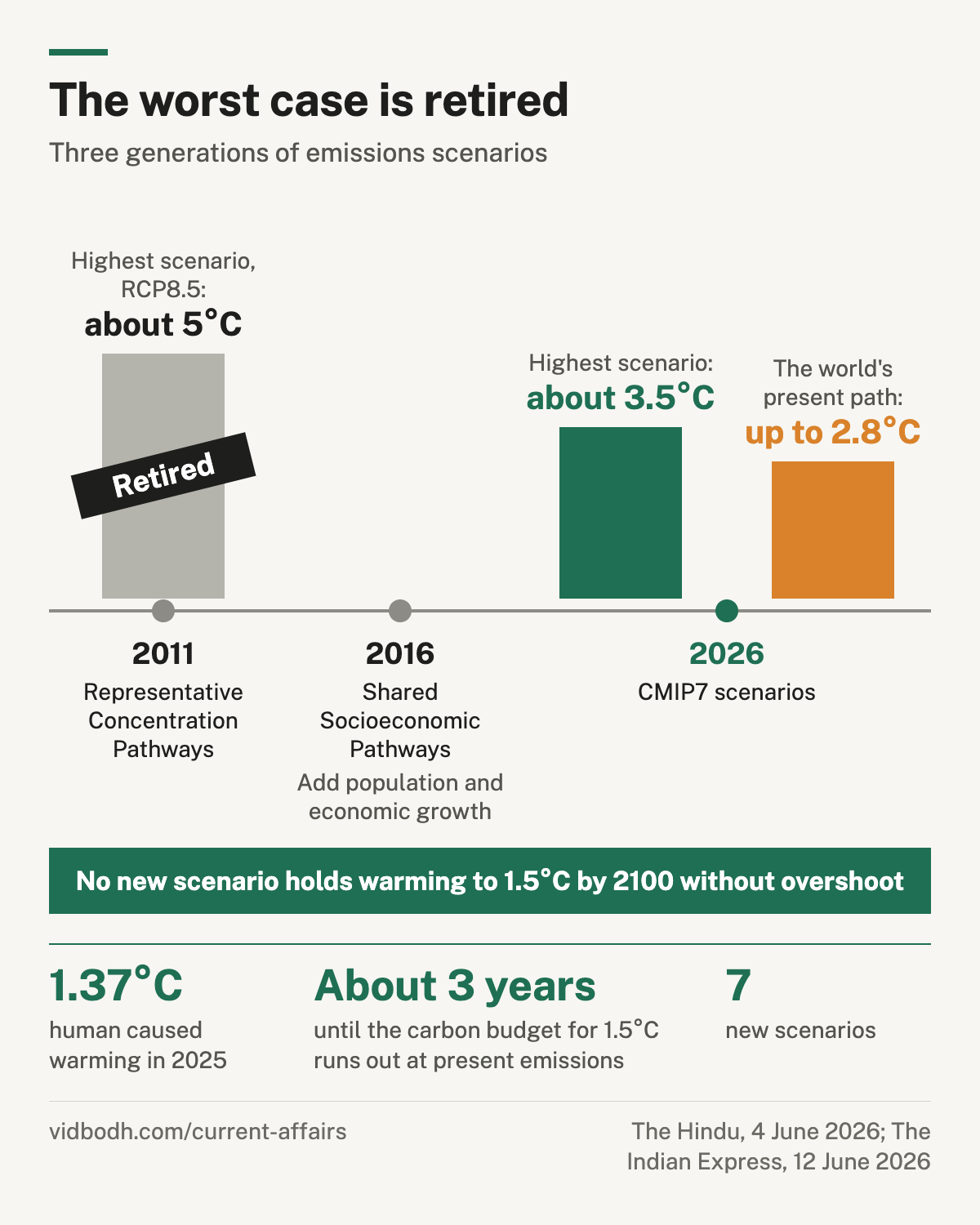
The new emissions scenarios for the next assessment of the Intergovernmental Panel on Climate Change (IPCC), published in April 2026, retire the worst case scenario, known as RCP8.5. In June a global report put human caused warming at 1.37°C in 2025, with the carbon budget for 1.5°C nearly spent.
Background
- The IPCC is an intergovernmental body of 195 members. It does no research of its own; scientists assess published studies for it.
- It reports in cycles through three Working Groups: I on the physical science, II on impacts and adaptation, III on mitigation, joined by a Synthesis Report.
- An emissions scenario is a storyline of how greenhouse gas emissions may run this century, which climate models turn into projected warming.
- The 2011 scenarios were the Representative Concentration Pathways (RCPs); in 2016 the Shared Socioeconomic Pathways added population and economic growth.
What changed in the scenarios
- RCP8.5 assumed coal use rising four to five times. It was meant as an edge case but came to be treated as "business as usual".
- The seven new scenarios, prepared under CMIP7, drop it as implausible.
- The new highest scenario gives about 3.5°C by 2100, against about 5°C under RCP8.5.
- The world's present path is near the middle scenario, up to 2.8°C.
- No new scenario holds warming to 1.5°C by 2100 without overshoot.
The carbon budget
- The carbon budget is the carbon dioxide that can still be emitted if warming is to stay below a limit.
- The Indicators of Global Climate Change report put human caused warming at 1.37°C in 2025.
- At present emissions, the budget for 1.5°C runs out in about three years.
Tipping points
- A tipping point is a threshold beyond which part of the climate system shifts to a new state that is hard to reverse, even if the cause is removed.
- Candidates include the Greenland ice sheet, the Amazon forest, coral reefs and the Atlantic Meridional Overturning Circulation (AMOC).
- At the Bonn talks India asked for care and clarity in using the term, cautioning against oversimplifying uncertain science.
The dispute over the next IPCC report
- The Global Stocktake under the Paris Agreement runs every five years; an IPCC cycle takes six to seven. The second stocktake concludes in 2028.
- Many developed countries want all the reports except the Synthesis Report ready before then.
- India, with China, Saudi Arabia and Kenya, opposes advancing them; experts who share this view argue that haste would leave out research from the Global South.
The way forward
- Plan adaptation against the middle scenario, not the retired worst case, so that money is not spent on the wrong risk.
- Keep pressing for deep cuts by developed countries, under common but differentiated responsibilities.
- Build India's own climate models and data, so that its science is represented in the assessments.
Prelims facts
- The IPCC does no research of its own; it assesses published studies.
- Working Group I is physical science, II impacts and adaptation, III mitigation.
- RCP8.5 was the highest of the 2011 scenarios and is now retired.
- CMIP is the Coupled Model Intercomparison Project.
- The Global Stocktake is held every five years.
See also: Climate tipping points · The IPCC's seventh assessment and the Global Stocktake · The 1.5°C goal and overshoot · Extreme event attribution
Sources: The Hindu, 4 Jun 2026: Scientists have ruled out the worst-case climate scenario, but it isn't all good news for India (opens in a new tab) · The Indian Express, 12 Jun 2026: Green energy can't yet bend climate curve (opens in a new tab) · The Hindu, 26 Jun 2026: India urges clarity as 'tipping points' rock Bonn climate talks (opens in a new tab) · Frontline, 15 Jun 2026: The IPCC's role is larger than informing one Global Stocktake: Climate policy experts (opens in a new tab)
Earlier coverage: Emission scenarios: from RCP8.5 to CMIP7 · The monthly magazine, June 2026