Why in news
Studies published in June 2026 found that humid heat is spreading in India beyond the summer into the monsoon, and that India has more cities among the world's most heat vulnerable than any other country. India's peak power demand reached a record in May, much of it for cooling.
Background
- Heat stress is the net heat load on the body. It depends on temperature, humidity, wind and radiation, and not on temperature alone.
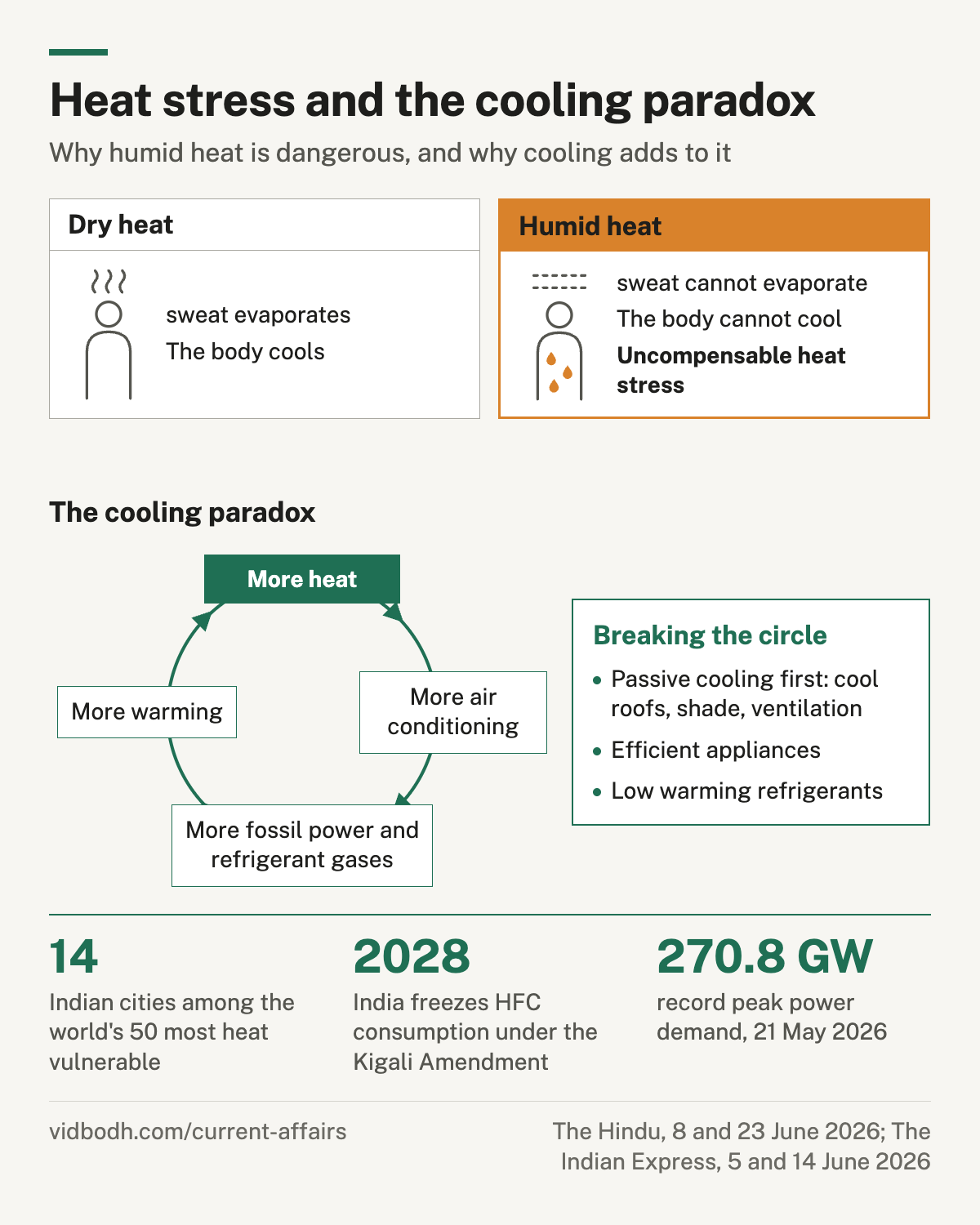
- The body cools itself by sweating. When the air is humid, sweat does not evaporate and the cooling fails.
- A heatwave is declared by the India Meteorological Department on temperature. Humid heat can be dangerous at temperatures well below that threshold.
- Heat risk has three parts: exposure to the hazard, the vulnerability of the people exposed, and their capacity to cope.
What the studies found
- Uncompensable heat stress, in which the body cannot cool itself at all, now affects about 8 per cent of India in summer.
- At 2°C of global warming it could affect more than half the country, in the monsoon as well as the summer.
- The northwest and the Gangetic plain will see humid heat in the monsoon months.
- Fourteen Indian cities are among the world's fifty most heat vulnerable; Ahmedabad is second.
- Across the world the warmest nights are warming faster than the warmest days, which denies the body its recovery.
Who is most exposed
- Outdoor workers, and people in slum housing without ventilation, power or water.
- Children: a United Nations Children's Fund report gives India the highest score for children's exposure to extreme heat.
The cooling paradox
- Cooling protects people from heat, but air conditioners draw fossil power and use hydrofluorocarbons (HFCs), gases with a high global warming potential.
- So cooling a room warms the planet, and the city outside the room.
- Under the Kigali Amendment to the Montreal Protocol, India freezes its HFC consumption in 2028 and cuts it in phases until 2047.
- The India Cooling Action Plan of 2019 aims to cut cooling demand and refrigerant demand over two decades.
The way forward
- Put passive cooling first: cool roofs, shade, ventilation and building design.
- Make efficient appliances and low warming refrigerants the default.
- Extend Heat Action Plans to cover humid heat and warm nights, and not only daytime temperature.
- Protect outdoor workers through changed working hours, water and shade.
Prelims facts
- The Kigali Amendment is to the Montreal Protocol, and deals with HFCs.
- HFCs do not deplete ozone but have high global warming potential.
- India freezes HFC consumption in 2028.
- The India Cooling Action Plan dates from 2019.
See also: Cooling and the Kigali Amendment · Heat Action Plans · Summer air pollution: PM10 and ozone
Sources: The Hindu, 8 Jun 2026: Heat, humidity of India's monsoon could extend summer heat stress as climate warms: study (opens in a new tab) · The Indian Express, 5 Jun 2026: India has more cities in the world's 50 most heat-vulnerable list than any other country (opens in a new tab) · The Hindu, 23 Jun 2026: One billion more people face at least one day of extreme heat stress, compared to 1970s: Study (opens in a new tab) · The Indian Express, 14 Jun 2026: Can India cool down without heating up? Experts Explain why sustainability is key (opens in a new tab)
Earlier coverage: Heat stress in India · The monthly magazine, June 2026