Why in news
In three tests on 10 and 11 June 2026 the Defence Research and Development Organisation (DRDO) demonstrated multi layered ballistic missile defence against long range ballistic missiles. In the same week the Defence Minister set out Mission Sudarshan Chakra, India's plan for a layered missile shield.
Background
- A ballistic missile is powered only at launch; it then follows a high arc and falls on its target at great speed.
- A cruise missile flies low under power all the way, like a pilotless aircraft.
- Ballistic missile defence destroys an incoming missile in flight with an interceptor missile.
- India's existing ballistic missile defence programme has two layers: one that intercepts outside the atmosphere (exo atmospheric) and one inside it (endo atmospheric).
- Mission Sudarshan Chakra was announced on Independence Day 2025.
What the Mission is
- A multi level, three layered defence to protect military, critical and civil infrastructure.
- It joins sensors, command systems and interceptors of different ranges, so that what one layer misses the next can stop.
- Separately, Sudarshan Kavach, a multi layered air defence system that uses artificial intelligence, is under development.
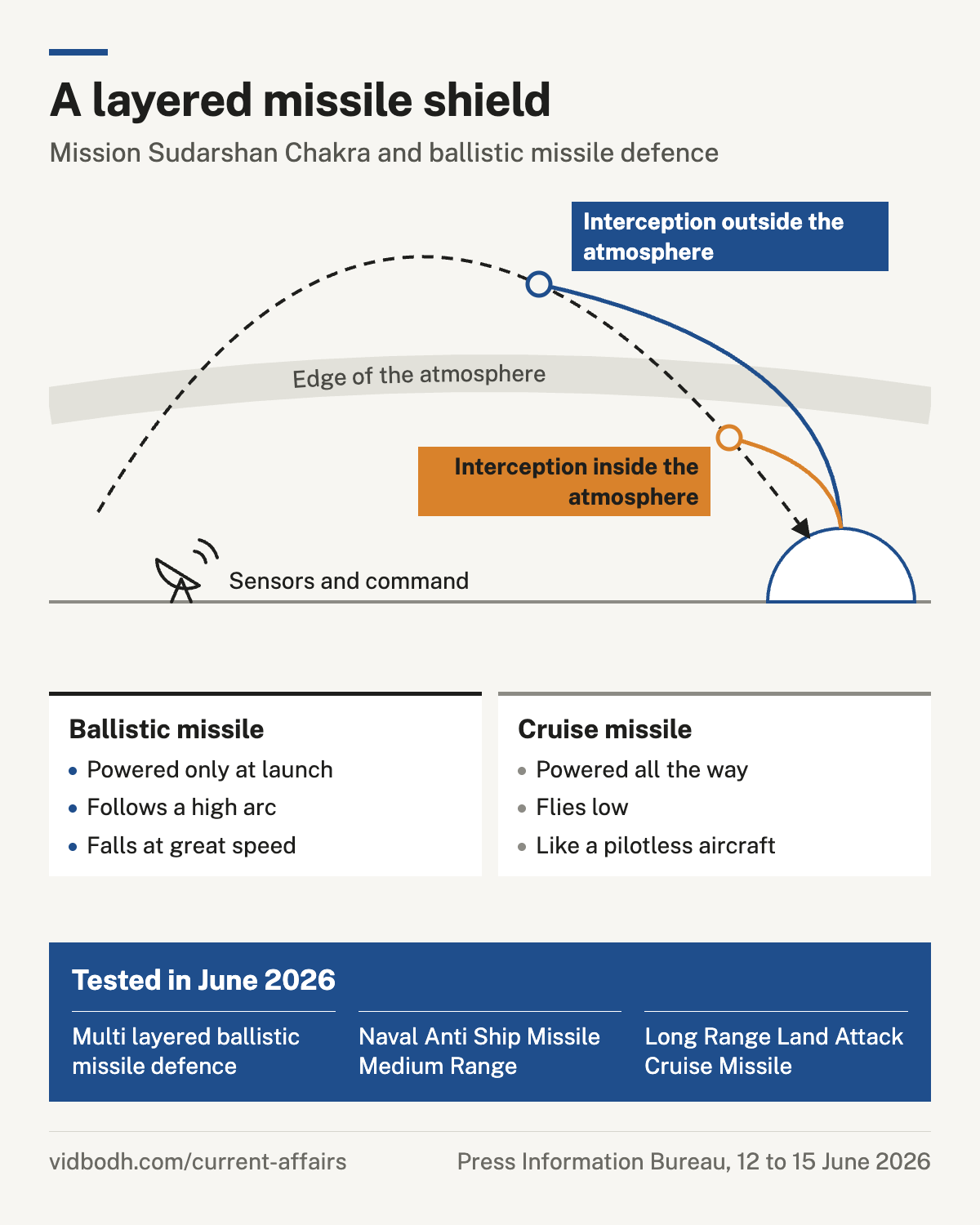
The June tests
- DRDO says the tests place India among the nations able to engage targets of up to intercontinental range.
- In the same weeks it flew the Naval Anti Ship Missile Medium Range for the first time and tested the Long Range Land Attack Cruise Missile.
The plan behind it
- The Defence Forces Vision 2047 stresses integration of the three services and dedicated missile and drone forces.
- The Defence Minister's point at the time: production capacity must be built into development, so that systems are made in numbers and inducted in time.
- DRDO does most of its work in its own laboratories; the United States agency DARPA uses a small team of managers and outsources development.
The limits
- Cost: an interceptor costs far more than many of the weapons it stops.
- Saturation: no shield stops everything if enough missiles and drones arrive together.
- Stability: a shield may lead an adversary to build more missiles.
The way forward
- Bring private industry into production, as DRDO has committed to do.
- Join the shield to cheaper layers against drones: jamming, guns and directed energy.
- Integrate the three services' air defence under one command and control system.
Prelims facts
- Mission Sudarshan Chakra was announced on Independence Day 2025.
- The tests were conducted by DRDO.
- An intercontinental ballistic missile has a range above 5,500 km.
- RudraM is an air to surface missile.
See also: Defence Forces Vision 2047 and the DRDO model · AI, drones and autonomy in warfare
Sources: PIB, 13 Jun 2026: DRDO demonstrates the nation’s next-gen defence capabilities (opens in a new tab) · PIB, 12 Jun 2026: Raksha Mantri inaugurates an Advanced Weapon System Complex at DRDL, Hyderabad (opens in a new tab) · PIB, 15 Jun 2026: DRDO conducts successful flight-test of Long Range Land Attack Cruise Missile (opens in a new tab) · PIB, 2 Jun 2026: DRDO & IAF conduct successful flight-tests of RudraM-II Air-to-Surface Missile (opens in a new tab) · The Indian Express, 27 Jun 2026: Expert Explains | As modern warfare transforms, the lessons now for Indian defence (opens in a new tab)
Earlier coverage: Mission Sudarshan Chakra · The monthly magazine, June 2026