Monetary policy in an oil shock: why the Reserve Bank held
LeadPrelims and MainsJune 2026
Why in news
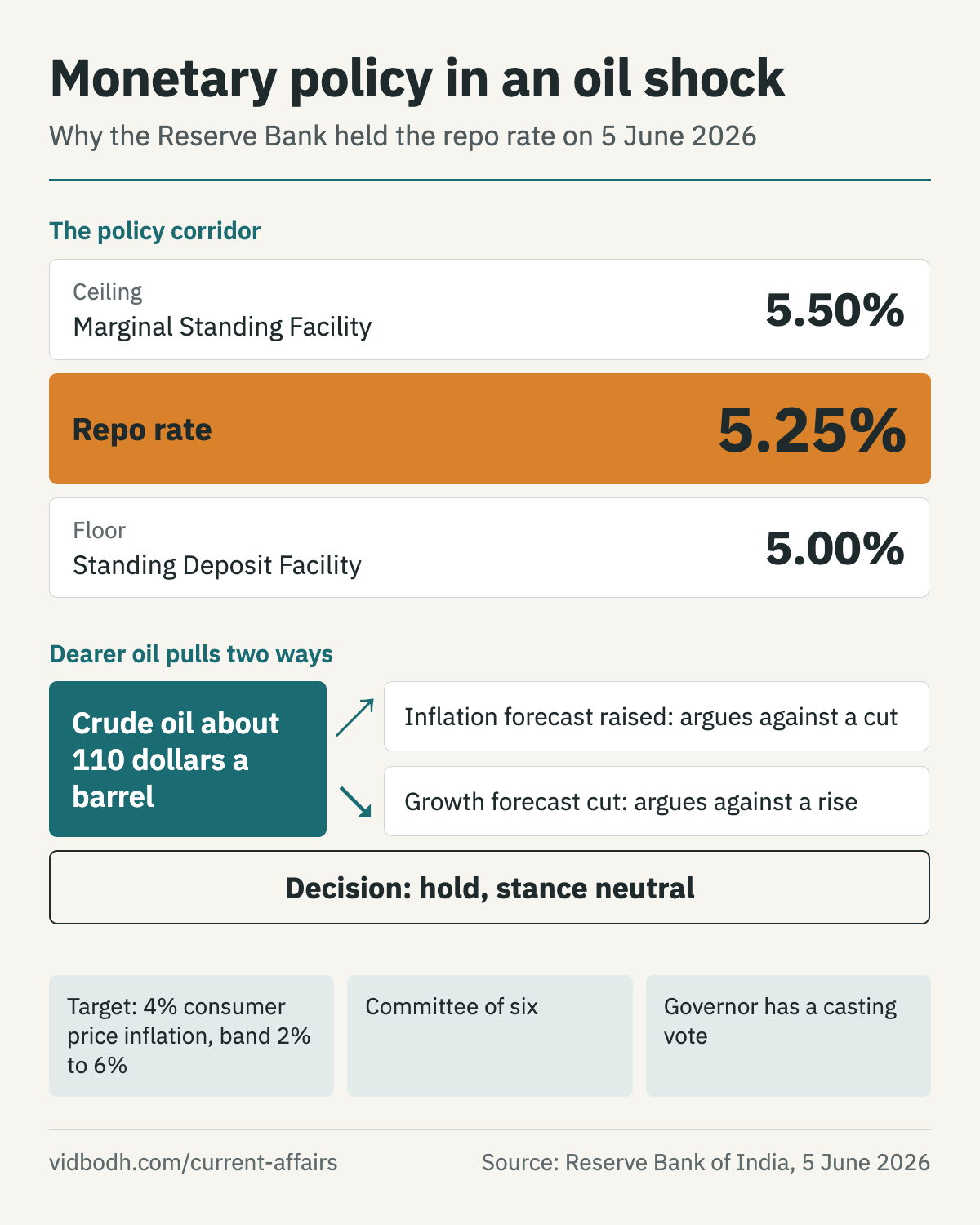
On 5 June 2026 the Monetary Policy Committee kept the repo rate at 5.25 per cent with a neutral stance. It cut its growth forecast for 2026-27 and raised its inflation forecast, as the conflict in West Asia pushed up the price of crude oil.
Background
- Since 2016 the Reserve Bank of India has followed flexible inflation targeting: consumer price inflation of 4 per cent, within a band of 2 to 6 per cent.
- A committee of six sets the repo rate, the rate at which the Reserve Bank lends to banks overnight.
- The committee had cut the rate through 2025 to 5.25 per cent, and then held it.
- In spring 2026 the conflict in West Asia and the disruption in the Strait of Hormuz took the Indian crude basket to about 110 dollars a barrel.
A supply shock, not a demand surge
- Inflation in May was still below 4 per cent. Yet the committee raised its forecast for the year to 5.1 per cent, because it assumed dearer crude.
- A rise in prices caused by costlier oil is a supply shock. Raising interest rates does not produce more oil; it only cuts demand.
- So a central bank looks through the first round of such a shock.
- It acts if the shock spreads into wages and into what people expect prices to be. These are the second round effects.
Why not cut, and why not raise
- Growth was slowing: the forecast fell to 6.6 per cent, with a weak monsoon expected. That argued for a cut.
- The rupee was falling and foreign investors were leaving. A cut would have narrowed India's interest advantage over rates abroad and added to the outflow.
- A rise would have hurt a slowing economy to fight an inflation that money cannot cure.
- So the committee held, and the Reserve Bank used other tools to draw in foreign money (see the lead on defending the rupee).
The limits of inflation targeting
- Food and fuel make up a large part of the consumer price basket, and both are driven by supply.
- This revives an old question: should the target be headline inflation or core inflation, which leaves out food and fuel?
- The first line of defence against a fuel shock is often fiscal: a cut in fuel taxes acts on the price directly.
The way forward
- Keep the stance neutral until the paths of oil and the monsoon are clear.
- Use fuel tax and buffer stocks against the first round, and monetary policy against the second.
- Communicate clearly, since expectations are anchored by what the central bank is believed to do.
Prelims facts
- The committee has six members: three from the Reserve Bank and three appointed by the Centre. The Governor has a casting vote.
- The target is set by the Centre in consultation with the Reserve Bank, for five years at a time.
- The corridor: Standing Deposit Facility 5.00, repo 5.25, Marginal Standing Facility 5.50 per cent.
- The Bank Rate moves with the Marginal Standing Facility rate.
- The Standing Deposit Facility was introduced in 2022.
Sources: The Hindu, 5 Jun 2026: RBI MPC holds repo rate at 5.25%, lowers growth forecast to 6.6% (opens in a new tab) · The Hindu, 6 Feb 2026: Top news of the day, 6 February 2026 (opens in a new tab) · News On AIR, 5 Jun 2026: RBI keeps repo rate unchanged at 5.25%, retains neutral stance (opens in a new tab) · The Tax Corp, 5 Jun 2026: RBI keeps repo rate steady at 5.25% amid global headwinds: key takeaways from June (opens in a new tab) · The Indian Express, 20 Jun 2026 · The Hindu, 15 Jun 2026: Wholesale inflation jumps to 9.7% in May 2026 on surging fuel prices (opens in a new tab) · Press Information Bureau, 12 Jun 2026: Consumer Price Index, May 2026 (opens in a new tab) · The Week, 15 Jun 2026: India's wholesale inflation in May 2026 (opens in a new tab)
Earlier coverage: Monetary policy in an oil shock · The monthly magazine, June 2026