The oil shock of 2026: who pays for dearer crude
LeadPrelims and MainsJune 2026
Why in news
Through June 2026 the government used taxes, export duties and budget support to manage the rise in crude oil prices caused by the conflict in West Asia. It set up a ₹10,000 crore fund to steady the price of aviation fuel, raised export duties on diesel, and waived excise on petrol with a higher ethanol blend.
Background
- India imports over 85 per cent of its crude oil. About two fifths of it normally comes through the Strait of Hormuz.
- So a conflict in the Gulf hits India three ways at once: prices, the rupee and the Budget.
- Petrol and diesel prices are in principle set by the market, but the three public sector oil companies hold them steady when crude swings.
Who can bear the cost
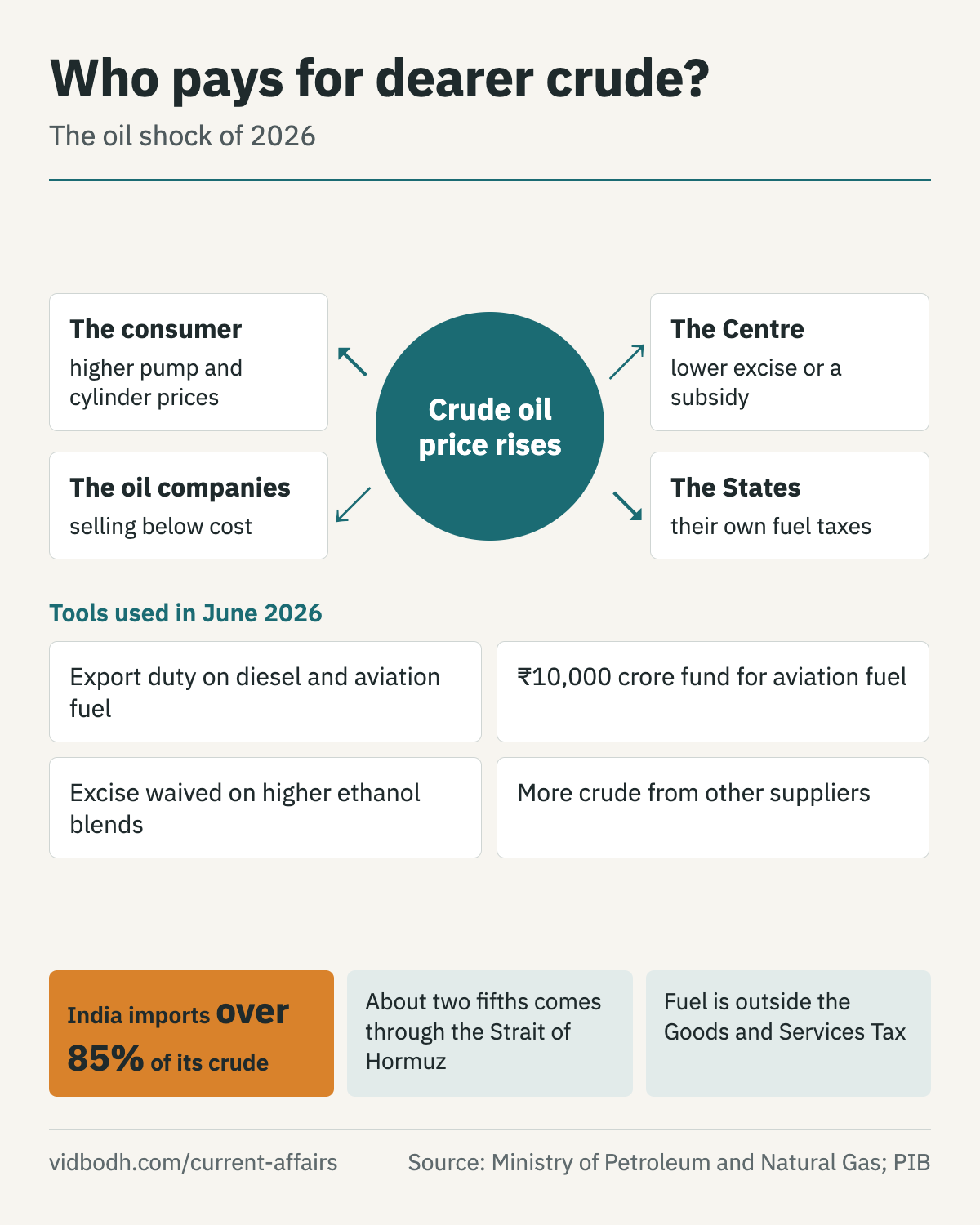
- The consumer, through higher pump and cylinder prices. This feeds inflation.
- The oil companies, by selling below cost. This erodes their capacity to invest.
- The Centre, by cutting excise duty or paying a subsidy. This widens the fiscal deficit.
- The States, which also tax fuel.
- Every choice in June was a choice among these four.
The tools used
- Export duty on diesel and aviation fuel, reviewed every fortnight, to keep fuel at home and tax the refiner's windfall.
- Budget support for aviation fuel, given as an interest free advance to the oil companies.
- A higher cylinder price, with the Ujjwala subsidy protecting poor households.
- Ethanol: excise waived on blends above 20 per cent.
- Other suppliers: Russia remained India's largest source of crude.
What the shock shows
- Import dependence is the root; it has risen, not fallen.
- Energy security and foreign policy are tied: the largest supplier was one under Western sanctions.
- Fuel is outside the Goods and Services Tax, so the Centre and the States tax it separately and heavily.
- Natural gas was rationed too, with households protected and industry cut, until supplies recovered in July.
The way forward
- Fill and enlarge the strategic petroleum reserves.
- Diversify suppliers and routes; ports outside the Strait, such as those of Oman, matter.
- Cut demand: electric mobility, ethanol and gas.
- A price stabilisation fund, built in good years, to smooth prices without ad hoc tax changes.
Prelims facts
- India imports over 85 per cent of its crude.
- The Strait of Hormuz lies between Iran and Oman and joins the Persian Gulf to the Gulf of Oman.
- Petrol, diesel, crude, natural gas and aviation fuel are outside the Goods and Services Tax for now.
- India's strategic reserves are at Visakhapatnam, Mangaluru and Padur.
- The Ujjwala scheme gives free cooking gas connections to women of poor households.
Sources: The Hindu, 3 Jun 2026: Cabinet approves ₹10,000 crore ATF price stabilisation fund to shield airlines from jet fuel prices (opens in a new tab) · The Hindu, 7 Jun 2026: LPG price hike: government says rates in India among world's lowest (opens in a new tab) · The Hindu, 11 Jun 2026: Higher ethanol blended petrol between 22-30% exempted from central excise duty (opens in a new tab) · The Hindu, 16 Jun 2026: Export duty on diesel, ATF hiked with petrol unchanged (opens in a new tab) · The Hindu, 21 Jun 2026: India boosts Russian, UAE oil purchases in June ahead of full Hormuz recovery (opens in a new tab) · The Indian Express, 5 Jun 2026
Earlier coverage: The oil shock and fuel pricing · The monthly magazine, June 2026