VidBodh · Current affairs
The monthly magazine, June 2026 · Global Affairs and International Relations › West Asia
Printed on · vidbodh.com/current-affairs
The war in West Asia and the Strait of Hormuz: what India has at stake
LeadPrelims and MainsJune 2026
Why in news
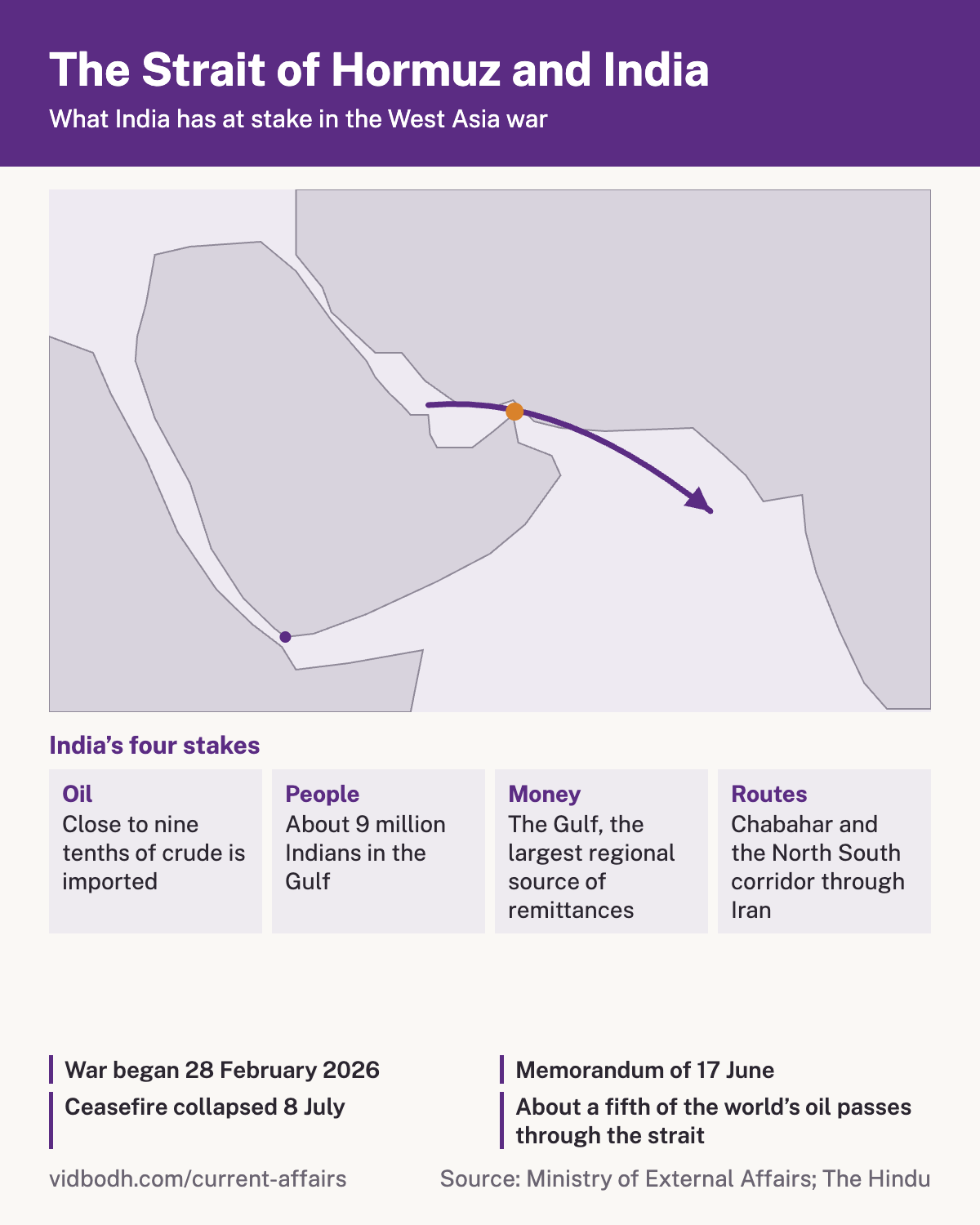
On 17 June 2026 the United States and Iran signed a 14 point memorandum, mediated by Pakistan, that halted almost four months of war and opened a 60 day window to negotiate a settlement, including the reopening of the Strait of Hormuz. The pause did not hold: the ceasefire collapsed on 8 July and the strait was closed again.
Background
- The war began on 28 February 2026, when the United States and Israel struck Iran and Iran answered with missiles and drones across the region.
- In late March Iran closed the Strait of Hormuz, through which about a fifth of the world's oil and liquefied natural gas passes.
- The strait lies between Iran and Oman. It joins the Persian Gulf to the Gulf of Oman and the Arabian Sea, and is the only sea route out of the Gulf.
- Iran has signed but not ratified the United Nations Convention on the Law of the Sea, and disputes the right of transit passage through the strait.
India's stakes
- Energy: India imports close to nine tenths of its crude oil, and about two fifths of it came through Hormuz before the war, as did about half its liquefied natural gas.
- People: about 9 million Indians work in the Gulf, and India is among the largest suppliers of the world's seafarers. Indian sailors were killed on tankers struck off Oman in June and July.
- Money: the Gulf states together are the largest regional source of the roughly 130 billion dollars India received in remittances in 2024.
- Connectivity: Chabahar port and the North South corridor depend on Iran; the India Middle East Europe corridor depends on calm around Israel. The war stalled both.
India's response
- It has kept channels open to every side: Israel, the Gulf monarchies, the United States and Iran. The External Affairs Minister toured four Gulf states in July and spoke to Iran's Foreign Minister three times by early August.
- It has asked for freedom of navigation and the safety of seafarers at every forum. It protested to Washington in June, when three Indians died on a tanker struck by an American strike, and summoned Iran's deputy envoy in July, when an Iranian missile killed an Indian sailor.
- It spread its oil buying across more suppliers, including Venezuela and Russia. Its standing escort mission in the Gulf of Oman, Operation Sankalp, has run since 2019.
- It welcomed the June memorandum without comment on the Pakistani channel through which it came.
The difficulty
- A middle power cannot protect its shipping in a chokepoint it does not control, and India has not joined either side's naval coalition.
- Pakistan's role as mediator, backed by China, Qatar and Oman, raised its standing in Washington and Tehran while India's ties with it are frozen.
- The strategic petroleum reserve covers under ten days of demand.
The way forward
- Press for a toll free right of passage as a principle, at the United Nations and through BRICS, rather than leave it to the parties.
- Build oil stocks towards the International Energy Agency's norm of ninety days of net imports.
- Build a standing plan for evacuation of the Gulf diaspora, on the model of earlier operations.
- Support an Oman led arrangement for managing the strait, since Oman holds its southern shore.
Prelims facts
- The Strait of Hormuz lies between Iran and Oman's Musandam peninsula.
- About a fifth of the world's oil passes through it.
- Bab el Mandeb joins the Red Sea to the Gulf of Aden; the Houthis of Yemen threatened it in July.
- Iran has signed but not ratified the law of the sea convention.
- India's strategic reserves are at Visakhapatnam, Mangaluru and Padur.
See also: The oil shock and fuel pricing
Sources: The Hindu, 18 Jun 2026: Trump, Iran's President sign deal to end West Asia war (opens in a new tab) · The Hindu, 18 Jun 2026: Full text of MoU between the United States and Iran (opens in a new tab) · The Hindu, 19 Jun 2026: U.S.-Iran peace talks postponed (opens in a new tab) · The Hindu, 23 Jun 2026: Opening of Strait of Hormuz welcome move: NSA Doval (opens in a new tab) · ThePrint, 27 Jul 2026: India's crude import dependence rises to record 88.7% as domestic output continues to decline (opens in a new tab) · Reuters, 2 Jun 2026: About 40% of India's oil supply passed through Hormuz before the war
Earlier coverage: The war in West Asia and the Strait of Hormuz · The monthly magazine, June 2026