Why in news
Reports in July 2026 on the conflict between the United States and Iran showed that about nine in ten attack drones were shot down, yet each interceptor cost far more than the drone it destroyed. In the same month the Defence Acquisition Council cleared drone and counter drone systems for the Indian forces.
Background
- A drone, or unmanned aerial vehicle, flies without a pilot on board. A one way attack drone flies to its target and destroys itself.
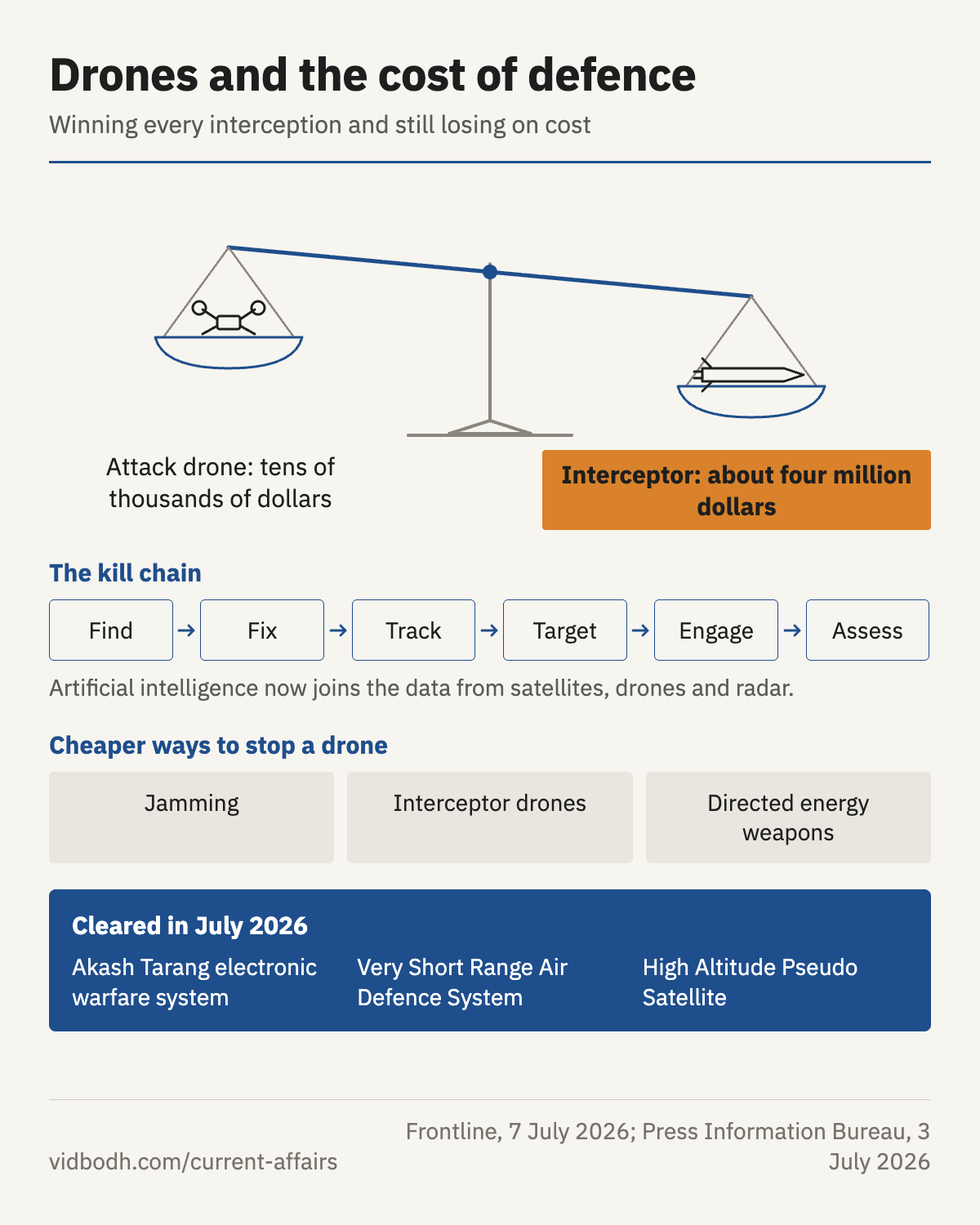
- The kill chain is the sequence find, fix, track, target, engage and assess.
- Its slow point was always the human work of joining imagery, signals and other intelligence. Artificial intelligence now does that joining.
- During Operation Sindoor, Pakistan launched 300 to 400 drones at 36 Indian locations in one night.
What has changed in warfare
- Sensor fusion: data from satellites, drones and radar is merged into one picture, and targets are passed to weapons within minutes.
- Mass: cheap drones are used in hundreds, to exhaust a defence.
- Autonomy: a system that narrows thousands of possibilities to a short ranked list has shaped the decision, even when a human approves it.
The cost problem
- A drone costs tens of thousands of dollars; an interceptor missile about four million.
- A defender who shoots down nearly every drone can still lose the exchange on cost.
- The answer is cheap ways to stop drones: jamming, interceptor drones and directed energy weapons such as lasers.
India's response
- Akashteer is India's indigenous automated air defence control and reporting system.
- The Defence Acquisition Council gave Acceptance of Necessity in July 2026 to the Akash Tarang electronic warfare system against drones, a Very Short Range Air Defence System and jet powered kamikaze drones.
- It also cleared a High Altitude Pseudo Satellite, a solar powered aircraft that loiters in the stratosphere and does a satellite's work at lower cost.
The ethical question
- If a machine selects targets, who is accountable for a wrong strike?
- International humanitarian law requires distinction between combatants and civilians, which an algorithm may not make reliably.
- There is no treaty on lethal autonomous weapons; talks continue at the United Nations.
The way forward
- Build cheap drones in large numbers and cheap ways to stop them, and not only costly platforms.
- Invest in software and data integration across the three services.
- Keep meaningful human control over the decision to use force.
- Take part in framing international rules on autonomous weapons.
Prelims facts
- Akashteer is an air defence control and reporting system; Akash Tarang is an electronic warfare system against drones.
- The Defence Acquisition Council is chaired by the Defence Minister.
- Acceptance of Necessity is an in principle approval of the need, given before tenders, and is not a contract.
- A High Altitude Pseudo Satellite flies in the stratosphere.
See also: Defence Acquisition Council
Sources: Frontline, 7 Jul 2026: The drone exchanges of the United States and Iran conflict showed that a defender can intercept nine drones in ten and still lose on cost, which is the lesson India's own drone and counter drone programmes have to absorb. (opens in a new tab) · The Indian Express, 6 Jul 2026: Drones, autonomy and algorithms are reshaping warfare, and India is being urged to treat it as a turning point (opens in a new tab) · Frontline, 1 Jul 2026: How AI is changing modern warfare (opens in a new tab) · PIB, 3 Jul 2026: DAC approves capital acquisition proposals worth Rs 52,000 crore to enhance combat readiness of Defence Forces (opens in a new tab)
Earlier coverage: AI, drones and autonomy in warfare · The monthly magazine, July 2026