VidBodh · Current affairs
The monthly magazine, July 2026 · Global Affairs and International Relations › Japan, Australia and South Korea
Printed on · vidbodh.com/current-affairs
India and Australia: a defence declaration, uranium at last and a technology partnership
LeadPrelims and MainsJuly 2026
Why in news
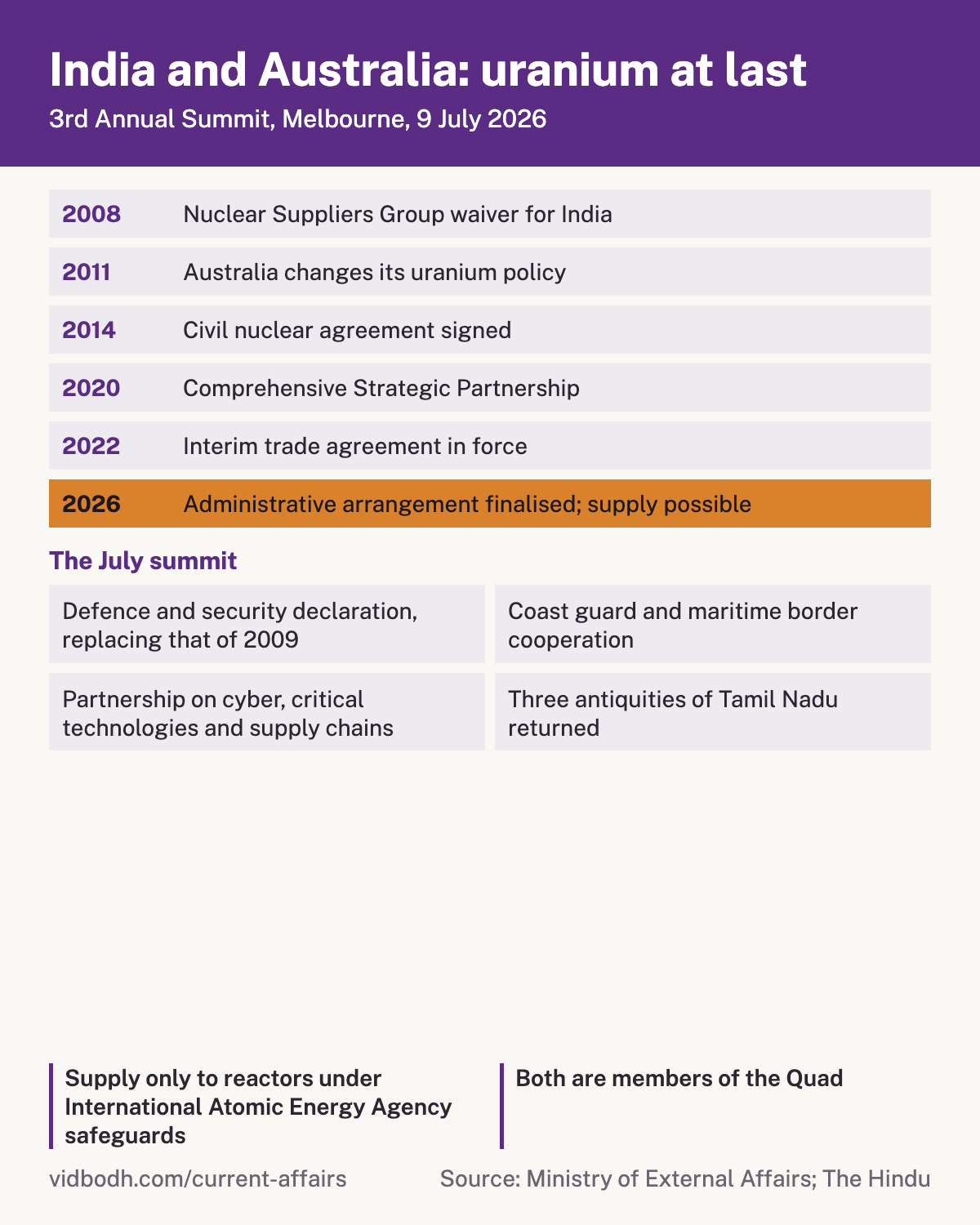
The two Prime Ministers held the third India and Australia Annual Summit in Melbourne on 9 July 2026. They adopted a new defence and security declaration, finalised the arrangement that lets Australian uranium reach Indian reactors, and launched a partnership on cyber, critical technologies and supply chains.
Background
- The relationship became a Comprehensive Strategic Partnership in June 2020, and an interim trade agreement has been in force since December 2022; a fuller agreement is still under negotiation.
- Australia long refused uranium to any state outside the Nuclear Non Proliferation Treaty. After the 2008 Nuclear Suppliers Group waiver it changed that policy for India in 2011, signed a civil nuclear agreement in 2014, and passed enabling legislation in 2016.
- Both are members of the Quad, with Japan and the United States.
What the summit agreed
- A Joint Declaration on Defence and Security Cooperation, building on the one of 2009: interoperability, maritime security, defence industry, cyber, and more aircraft deployments from each other's territory.
- A roadmap and a coast guard pact that extend cooperation from navies to coast guards, which matters for illegal fishing and narcotics.
- The Administrative Arrangement that operationalises the 2014 nuclear agreement, twelve years after signature.
- A Partnership on Cyber, Critical Technologies and Supply Chains, from undersea cables to critical minerals, co chaired by deputy national security advisers.
- Return of three antiquities of Tamil Nadu origin; more Australian campuses in India.
Uranium: why it took twelve years
- Australia holds about a third of the world's known uranium and is an early member of the Nuclear Suppliers Group.
- Its policy barred supply to a state outside the treaty; India will not sign the treaty as a non weapon state.
- The 2014 agreement needed an administrative arrangement on safeguards and accounting for every shipment, and that is what was finalised.
- Supply goes only to reactors under International Atomic Energy Agency safeguards.
India's stakes
- Fuel for a nuclear programme that the new nuclear law means to expand.
- A partner in the Indian Ocean whose navy and coast guard reach where India's do not.
- Critical minerals, of which Australia is a leading producer, for batteries and electronics.
- The gap is trade: the full agreement is stuck on farm goods and dairy.
The way forward
- Sign uranium contracts, so that the arrangement is more than paper.
- Close the full trade agreement with dairy kept out, as India did with New Zealand.
- Make the technology partnership deliver one joint project in minerals processing or undersea cables.
Prelims facts
- Third annual summit: Melbourne, 9 July 2026.
- Civil nuclear agreement 2014; interim trade agreement in force December 2022; strategic partnership June 2020.
- Australia changed its uranium policy for India in 2011, after the 2008 Nuclear Suppliers Group waiver.
- The Indian Coast Guard, which is under the Ministry of Defence, signed a pact with Australia's Maritime Border Command.
- Exercise Pitch Black is an Australian air exercise in which the Indian Air Force took part in 2026.
Sources: The Hindu, 9 Jul 2026: Symbol of our shared confidence: PM Modi calls for deeper India-Australia strategic ties (opens in a new tab) · The Hindu, 9 Jul 2026: India, Australia strike deal on uranium exports (opens in a new tab) · The Hindu, 9 Jul 2026: India, Australia unveil new defence declaration (opens in a new tab) · PMIndia, 9 Jul 2026: PM meets the Prime Minister of Australia at the 3rd India-Australia Annual Summit (opens in a new tab) · The Hindu, 14 Jul 2026: What is the India-Australia uranium supplies agreement? (opens in a new tab) · The Indian Express, 15 Jul 2026: Australia agrees to supply uranium to India, reversing its long-standing non-proliferation objection (opens in a new tab)
Earlier coverage: India and Australia · The monthly magazine, July 2026