VidBodh · Current affairs
The monthly magazine, July 2026 · Global Affairs and International Relations › Japan, Australia and South Korea
Printed on · vidbodh.com/current-affairs
Why in news
Japan's Prime Minister made her first official visit to India from 1 to 3 July 2026 for the 16th Annual Summit. It produced sixteen outcome documents, led by a Joint Declaration on Economic Security, and an agreement in principle on the remaining technical details of the Unified Complex Radio Antenna (UNICORN) mast project.
Background
- India and Japan have a Special Strategic and Global Partnership, run through an annual summit that alternates between the capitals and a 2+2 dialogue of foreign and defence ministers.
- Japan is the largest lender for Indian infrastructure, including the Mumbai to Ahmedabad high speed rail.
- At the 2025 summit Japan set a target of 10 trillion yen of private investment in India over a decade.
- Diplomatic relations date from 1952; 2027 is the 75th anniversary.
Economic security as the new frame
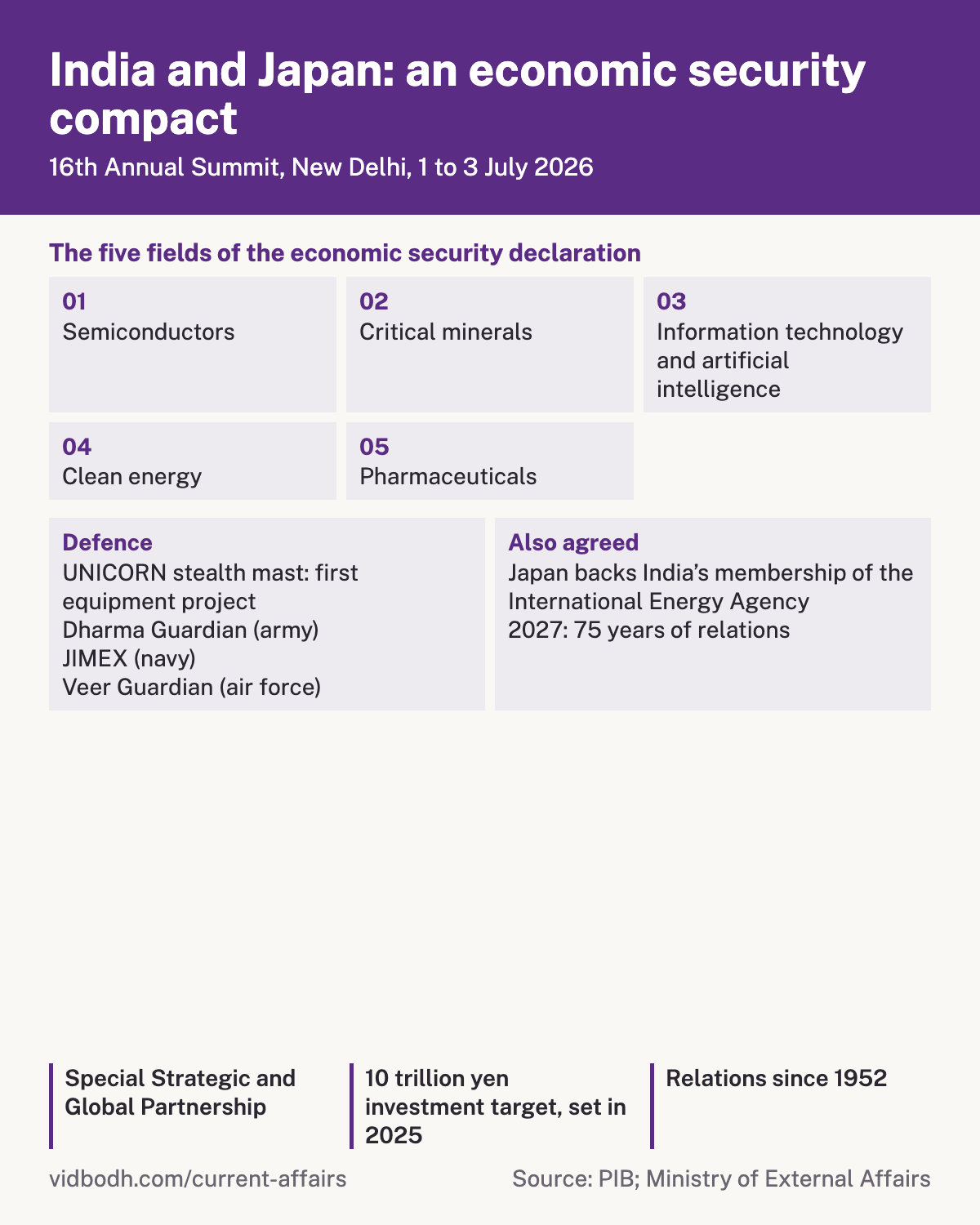
- The declaration names semiconductors, critical minerals, information technology with artificial intelligence, clean energy and pharmaceuticals as the areas where both will reduce dependence on a single supplier.
- Both economies are exposed to concentrated sourcing from China; this is the shared interest beneath the partnership.
- A goal of 500 skilled Indian professionals in artificial intelligence in Japan by 2030 matches Japan's ageing workforce with India's surplus of talent.
- Japan backed India's membership of the International Energy Agency, and the two agreed to work on oil stockpiling and the safety of energy shipping.
Defence
- Agreement in principle on the UNICORN mast, a stealth antenna for warships, India's first defence equipment transfer from Japan. August named it the first such project.
- Exercises in all three services: Dharma Guardian (army), Japan India Maritime Exercise (JIMEX) (navy) and Veer Guardian (air force), which in 2026 brings Japanese fighters to India for the first time.
- In August a maritime security arrangement covered domain awareness, search and rescue and sea lane protection.
India's stakes
- Japan is the partner most likely to move factories and capital into India as supply chains shift.
- It shares India's caution about China yet is a United States treaty ally, so it can anchor India's Indo Pacific policy without the unpredictability of American trade policy.
- The limit: Japanese firms have been slow to invest beyond cars and infrastructure, and defence transfers are bound by Japan's own rules.
The way forward
- Turn the declaration into plants: a semiconductor or component unit in India under the ten trillion yen target.
- Conclude the mast project and move to co development, not just purchase.
- Use the 75th anniversary in 2027 for a people to people push: students, nurses and engineers.
Prelims facts
- The 16th India and Japan Annual Summit: New Delhi, 1 to 3 July 2026.
- UNICORN: Unified Complex Radio Antenna, a stealth mast for warships.
- Exercises: Dharma Guardian (army), JIMEX (navy), Veer Guardian (air force).
- Japan supports India's membership of the International Energy Agency.
- Diplomatic relations since 1952; the Comprehensive Economic Partnership Agreement since 2011.
Sources: The Hindu, 1 Jul 2026: Japan PM arrives in Delhi (opens in a new tab) · The Hindu, 2 Jul 2026: Free and rules-based Indo-Pacific a shared priority for India and Japan (opens in a new tab) · PIB, 2 Jul 2026: List of Outcomes: 16th India-Japan Annual Summit (opens in a new tab) · PMIndia, 2 Jul 2026: 16th India-Japan Annual Summit Joint Statement (opens in a new tab) · PMIndia, 2 Jul 2026: Joint Statement on cooperation in AI (opens in a new tab) · News On AIR, 1 Jul 2026: Japanese PM Sanae Takaichi to arrive in New Delhi on a three-day visit (opens in a new tab) · News On AIR, 2 Jul 2026: India, Japan will continue to advance peace, stability and prosperity in Indo-Pacific: PM Modi (opens in a new tab)
Earlier coverage: India and Japan · The monthly magazine, July 2026