India's new trade agreements: the pact with the United Kingdom comes into force
LeadPrelims and MainsJuly 2026
Why in news
The Comprehensive Economic and Trade Agreement between India and the United Kingdom came into force on 15 July 2026, with a separate convention on social security. The pact with Oman had come into force on 1 June.
Background
- In 2019 India stayed out of the Regional Comprehensive Economic Partnership, fearing a flood of imports.
- Since 2022 it has changed course, signing with the United Arab Emirates, Australia, the European Free Trade Association, the United Kingdom, Oman and New Zealand, and concluding talks with the European Union.
- The new partners are mostly developed economies whose exports do not compete with India's labour intensive goods.
What India gets
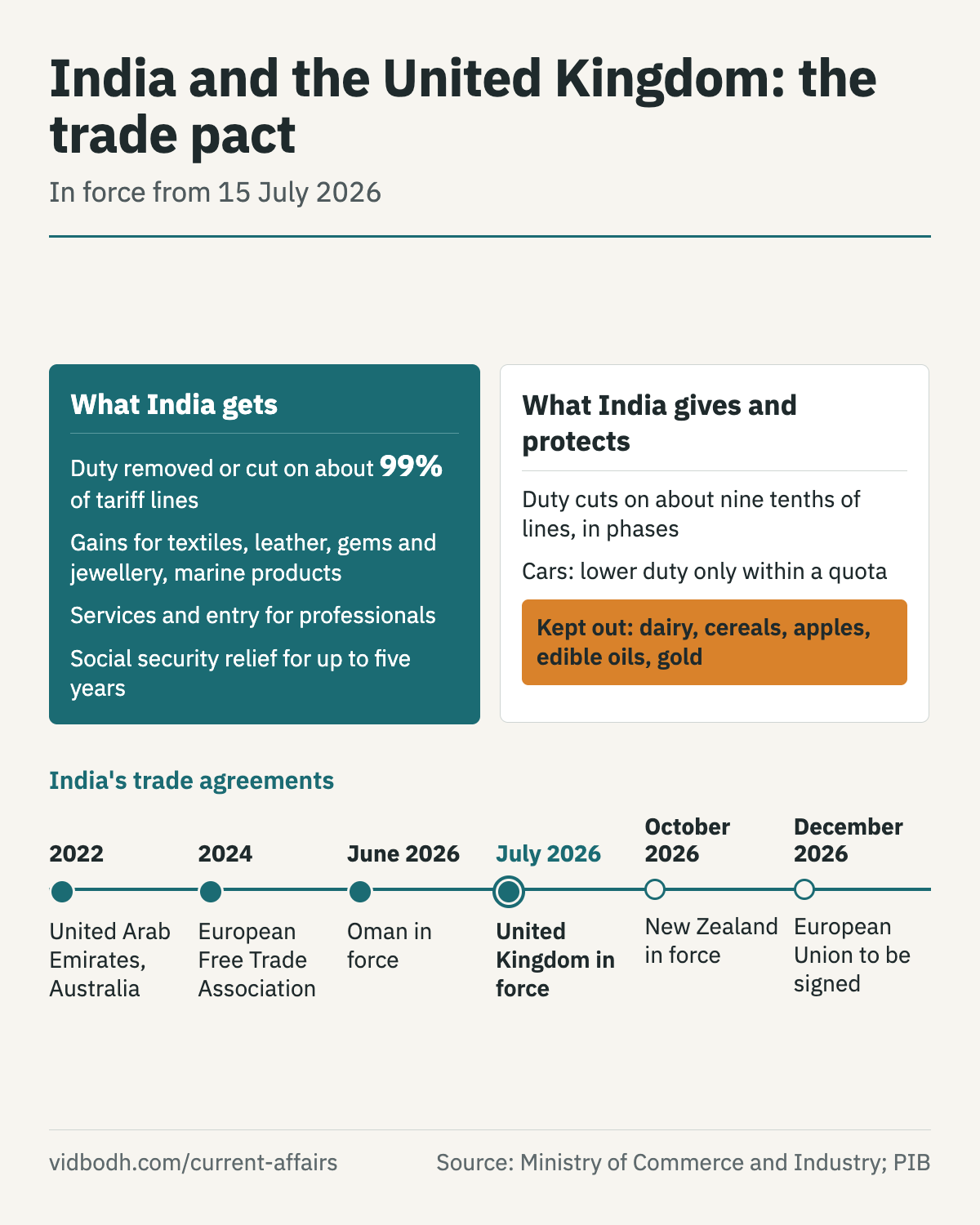
- The United Kingdom removed or cut duties on about 99 per cent of its tariff lines for Indian goods, most of them at once.
- The gain is largest for textiles, leather, gems and jewellery, and marine products.
- Services: commitments in all major sectors, and entry for some Indian professionals.
- Social security: Indian workers posted to the United Kingdom for up to five years do not pay into its social security as well as India's.
What India gives, and what it protects
- India cuts duties on about nine tenths of its lines, but in phases.
- Kept out: dairy, cereals, apples, edible oils and gold.
- Cars: lower duty only within a quota. This is the first time India has cut car tariffs in a trade pact.
- British firms may bid for central government purchases.
Do such agreements work?
- India's earlier pacts in Asia widened its deficits, and exporters made little use of the lower duties.
- The reason: rules of origin and paperwork cost more than the duty saved, above all for small firms.
- Tariffs are no longer the main barrier. Standards, and measures such as Europe's carbon border tax, now matter more.
- A signed pact can be undercut from outside it: the United Kingdom put new duties on steel weeks before the start.
The way forward
- Help small exporters claim the preference: simple certificates of origin, and help desks.
- Raise quality and standards at home, since that is what the buyer tests.
- Fix inverted duties, where the input is taxed more than the finished good.
- Review each pact after a few years against its promises.
Prelims facts
- India and United Kingdom pact: signed 24 July 2025, in force 15 July 2026.
- India and Oman pact: signed in Muscat in December 2025, in force 1 June 2026. Oman is India's second such partner in the Gulf, after the United Arab Emirates.
- Dairy is kept out of India's offers.
- A trade agreement is approved by the Union Cabinet; it does not need ratification by Parliament.
- The European Free Trade Association has four members: Switzerland, Norway, Iceland and Liechtenstein.
Sources: The Hindu, 15 Jul 2026: India-U.K. trade deal explained: What gets cheaper, who stands to gain? (opens in a new tab) · The Hindu, 15 Jul 2026: India-U.K. DCC not applicable to Indians working in the U.K. before July 15 (opens in a new tab) · Press Information Bureau, 15 Jul 2026: Backgrounder on the entry into force of the India and United Kingdom CETA (opens in a new tab) · Press Information Bureau, 15 Jul 2026: CETA shipments flagged off in Mumbai (opens in a new tab) · Press Information Bureau, 15 Jul 2026: Prime Minister on CETA and the social security agreement (opens in a new tab) · The Hindu, 1 Jun 2026: India, Oman free trade pact comes into force (opens in a new tab) · Onmanorama, 2 Jun 2026: India and Oman CEPA comes into force (opens in a new tab) · IANS, 17 Jun 2026: India-UK trade pact operational from July 15, PM Modi calls it historic milestone (opens in a new tab) · Organiser, 19 Jun 2026: India eyes historic trade milestones in 2026 (opens in a new tab) · The Hindu, 9 Jun 2026 · SteelOrbis, 1 Jun 2026: India-Oman FTA to come into effect from June 1, 2026 (opens in a new tab)
Earlier coverage: India's trade agreements · The monthly magazine, July 2026