Why in news
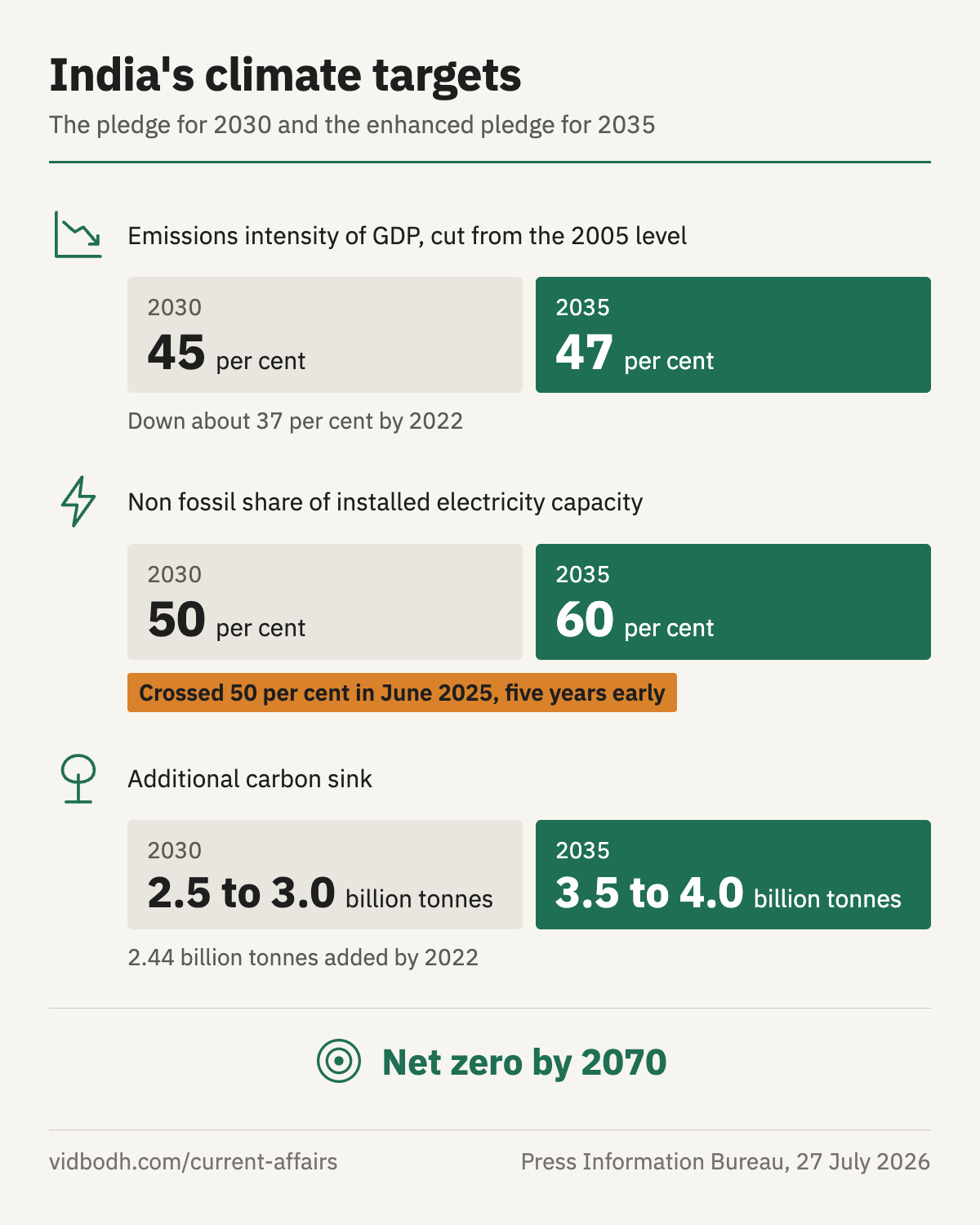
The government restated in July 2026 India's enhanced climate targets for 2035, filed earlier in the year: a 47 per cent cut in the emissions intensity of GDP, 60 per cent of installed electricity capacity from non fossil sources, and a larger carbon sink.
Background
- A Nationally Determined Contribution (NDC) is the climate pledge that each country files under the Paris Agreement of 2015.
- Each country sets its own pledge, and must file a stronger one every five years.
- India's first pledge, of 2015, was updated in 2022; the 2035 targets are the next round.
- India has also pledged net zero emissions by 2070.
India's climate targets for 2030 and 2035
| Target | For 2030 | For 2035 |
|---|---|---|
| Cut in emissions intensity of GDP, from the 2005 level | 45 per cent | 47 per cent |
| Share of non fossil sources in installed electricity capacity | 50 per cent | 60 per cent |
| Additional carbon sink, in tonnes of carbon dioxide equivalent | 2.5 to 3.0 billion | 3.5 to 4.0 billion |
What the three targets mean
- Emissions intensity is the greenhouse gas emitted per unit of GDP. It can fall while total emissions rise, so it is not a cut in absolute emissions.
- The non fossil share counts installed capacity, which includes solar, wind, hydro, bio power and nuclear. It does not count the electricity actually generated, where the share is lower.
- The carbon sink is the additional carbon stored in forest and tree cover, counted from 2005.
How India stands on the 2030 targets
- Capacity: the non fossil share crossed 50 per cent in June 2025, five years early.
- Intensity: it had fallen by about 37 per cent by 2022, against the goal of 45.
- Sink: 2.44 billion tonnes had been added by 2022, close to the lower end of the goal.
- The capacity target is running ahead; the sink is the hardest to measure and to show.
How the pledge is carried out
- Implementation runs through the nine missions of the National Action Plan on Climate Change, and through the State Action Plans.
- Progress is reported through Biennial Transparency Reports under Article 13 of the Paris Agreement.
- Gram panchayats, which take the decisions on water, land and forests, have no defined role or funds in climate planning.
The way forward
- Match capacity with transmission and storage, so that non fossil capacity becomes non fossil electricity.
- Build a record of land for the sink, so that the same plantation is not counted under several schemes.
- Give panchayats a role, funds and technical support in adaptation.
- Press for climate finance, since the pledge assumes support from developed countries.
Prelims facts
- The base year for the intensity target is 2005.
- The 2035 targets: 47 per cent, 60 per cent and 3.5 to 4.0 billion tonnes.
- The capacity target counts installed capacity, not generation.
- Transparency reporting falls under Article 13 of the Paris Agreement.
- India's net zero year is 2070.
See also: The forest carbon sink · Curtailment
Sources: PIB, 27 Jul 2026: PARLIAMENT QUESTION: INDIA’s NDC TARGETS (opens in a new tab) · The Indian Express, 6 Jul 2026: Gram panchayats remain outside climate planning even as India's revised climate targets need local delivery (opens in a new tab) · Frontline, 13 Aug 2026: India's NDC for 2031-35 commits to a forest and tree cover carbon sink of 3.5 to 4 billion tonnes of carbon dioxide equivalent by 2035, while the data needed to verify it does not yet exist. (opens in a new tab)
Earlier coverage: India's Nationally Determined Contribution · The monthly magazine, July 2026