Ladakh: an Article 371 model in place of the Sixth Schedule
LeadPrelims and MainsJuly 2026
Why in news
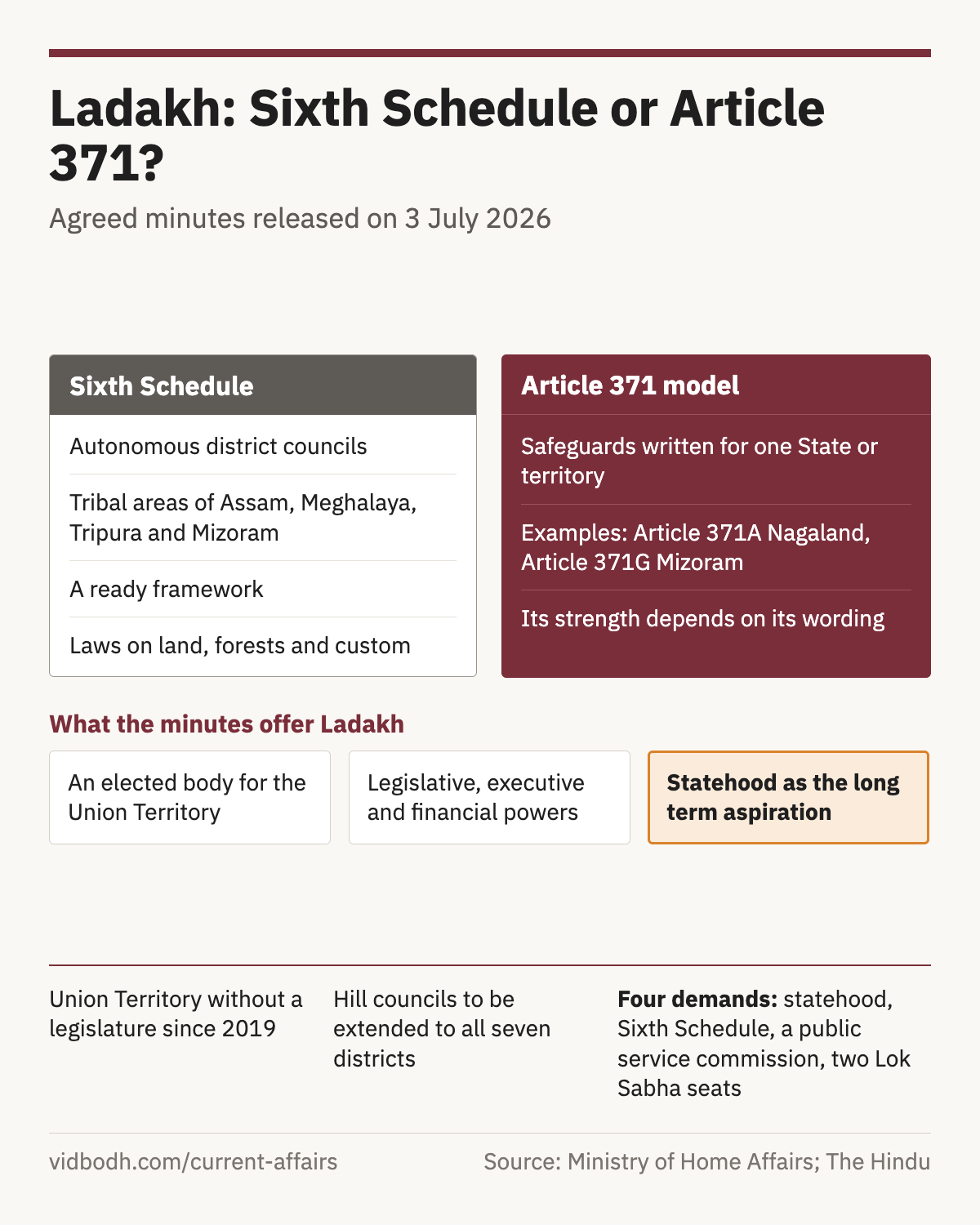
On 3 July 2026 the Home Ministry released the agreed minutes of its talks with Ladakh's two civil society alliances. They propose a customised model under Article 371 for the Union Territory: an elected body with legislative, executive and financial powers.
Background
- Ladakh became a Union Territory without a legislature in 2019, under the Jammu and Kashmir Reorganisation Act. A Lieutenant Governor administers it.
- Local self government is through the Ladakh Autonomous Hill Development Councils of Leh and Kargil.
- The Leh Apex Body and the Kargil Democratic Alliance have asked for four things: statehood, inclusion in the Sixth Schedule, a public service commission, and two Lok Sabha seats.
- Most of Ladakh's people belong to Scheduled Tribes, which is the basis of the Sixth Schedule demand.
The Sixth Schedule and Article 371 compared
- The Sixth Schedule creates autonomous district councils in the tribal areas of Assam, Meghalaya, Tripura and Mizoram, with power to make laws on land, forests and custom.
- Article 371 and its lettered variants give particular States safeguards written for them, such as Article 371A for Nagaland and 371G for Mizoram, which protect customary law and land.
- The Sixth Schedule is a ready framework; an Article 371 provision is drafted afresh for each case, so its strength depends on its wording.
What the minutes provide
- An elected body at the level of the Union Territory, with executive, financial and legislative powers.
- Control by the elected executive over the civil servants who handle its subjects.
- Statehood recorded as the long term aspiration, and the elected body as a first step.
- Separately, on 13 July the Ladakh administration said the hill councils would be extended to all seven districts.
The analysis
- Why Ladakh asks for protection: a fragile ecology, a small population and the fear of losing land and jobs to outsiders.
- Why the Centre prefers Article 371: it allows a design fitted to a border territory, without the fixed structure of the Sixth Schedule.
- The open points: whether the new body's laws need the Centre's assent, and how land will be protected.
- Security: Ladakh borders both China and Pakistan, which shapes how much autonomy the Centre will give.
Cases to cite
- Samatha v. State of Andhra Pradesh (1997): land in a Scheduled Area cannot be transferred to non tribals, even by the State.
- Pu Myllai Hlychho v. State of Mizoram (2005): the Sixth Schedule is a 'Constitution within the Constitution'.
- In re Article 370 of the Constitution (2023): upheld the creation of the Union Territory of Ladakh under Article 3.
The way forward
- Put the model into the Constitution, since an executive arrangement can be withdrawn.
- Protect land, jobs and culture in clear words, as Article 371A does.
- Keep statehood on the table, with a timeline.
- Involve both Leh and Kargil, whose interests differ.
Prelims facts
- The Sixth Schedule applies to Assam, Meghalaya, Tripura and Mizoram.
- The Fifth Schedule applies to Scheduled Areas in other States.
- Article 371A: Nagaland. Article 371G: Mizoram. Article 371F: Sikkim.
- Ladakh has had no legislature since 2019.
Sources: The Hindu, 1 Jul 2026: Ladakh civil society groups to hold informal talks with visiting MHA team (opens in a new tab) · The Hindu, 3 Jul 2026: Customised model suitable for Ladakh will be adopted under Article 371, says Home Ministry draft (opens in a new tab) · The Hindu, 13 Jul 2026: Autonomous hill councils to be extended to all seven districts in Ladakh (opens in a new tab)
Earlier coverage: Ladakh: governance and constitutional safeguards · The monthly magazine, July 2026