Why in news
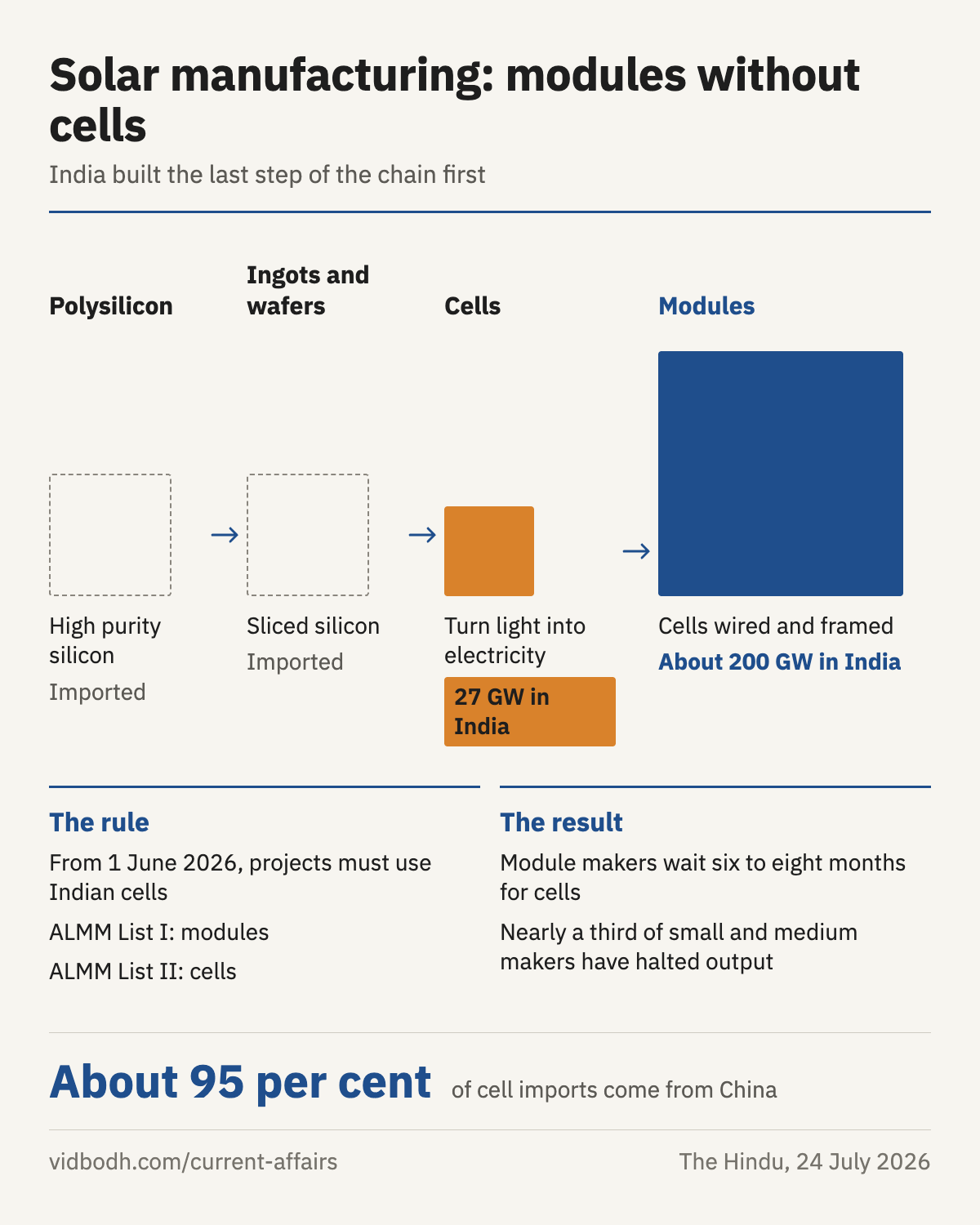
A rule in force from 1 June 2026 requires solar projects under government schemes, net metering and open access to use cells made in India. India makes far fewer cells than modules, so by July many module factories stood idle for want of cells.
- about 200 GWIndia's capacity to make solar modules
- 27 GWits capacity to make solar cells, on paper
- about 95 per centof India's cell imports that come from China
Background
- A solar panel is made in a chain: polysilicon, then ingots and wafers, then cells, then modules.
- The cell is the part that turns light into electricity. A module is cells wired together and framed, which is the easiest step.
- India built the last step first. The earlier steps need more capital, more power and technology that China controls.
- The Approved List of Models and Manufacturers (ALMM) names the equipment that government supported projects must buy: List I for modules and List II for cells.
What went wrong
- With List II in force, module makers must buy Indian cells, and they wait six to eight months for them.
- Nearly a third of small and medium module makers have halted output.
- Modules with Indian cells cost almost double those with Chinese cells.
- China has curbed exports of solar manufacturing equipment and technology, so new cell plants are slow to build.
What the government did
- It extended the exemption from List II to 31 December 2026, but only for net metering and open access projects.
- In August it began work on a subsidy scheme for polysilicon, the first link in the chain.
- The production linked incentive for solar manufacturing rewards integrated plants that make the earlier stages too.
The dilemma
- Self reliance: dependence on one country for an essential input is a risk, as the export curbs show.
- Deployment: costlier panels slow the addition of solar capacity, and the gap would be met by coal.
- A local content rule works only if local supply exists when the rule takes effect.
The way forward
- Phase in local content rules in step with capacity.
- Support the upstream stages, polysilicon and wafers, where dependence is deepest.
- Fund research on newer cell technologies, so that India is not always buying the last generation.
- Diversify import sources in the meantime.
Prelims facts
- ALMM List I covers modules; List II covers cells.
- The solar chain runs polysilicon, wafer, cell, module.
- India's cell capacity is a small fraction of its module capacity.
See also: Curtailment
Sources: The Hindu, 24 Jul 2026: India's solar push idles factories unable to shake reliance on China (opens in a new tab) · PIB, 18 Jul 2026: Ministry of New & Renewable Energy Extends Limited Exemption from ALMM List-II for Net-Metering and Open Access RE Projects till 31st December 2026 (opens in a new tab) · The Hindu, 22 Aug 2026: Centre plans support for polysilicon manufacturing (opens in a new tab)
Earlier coverage: Solar cell and module manufacturing · The monthly magazine, July 2026