Why in news
August 2026 brought three developments on one problem: twenty bids came in under India's scheme for rare earth magnets, two pilot plants in Odisha were set to recover rare earths from industrial waste, and fresh data showed how tightly the refining of critical minerals is held by a few countries.
Background
- A mineral is critical when the economy and the armed forces cannot do without it and its supply can be cut.
- India's list of 2023 names 30 critical minerals, among them lithium, cobalt, nickel, graphite and the rare earths.
- The rare earths are 17 metals: the 15 lanthanides with scandium and yttrium.
- They are not rare in the ground; what is scarce is the capacity to separate and refine them.
The problem is at the refinery
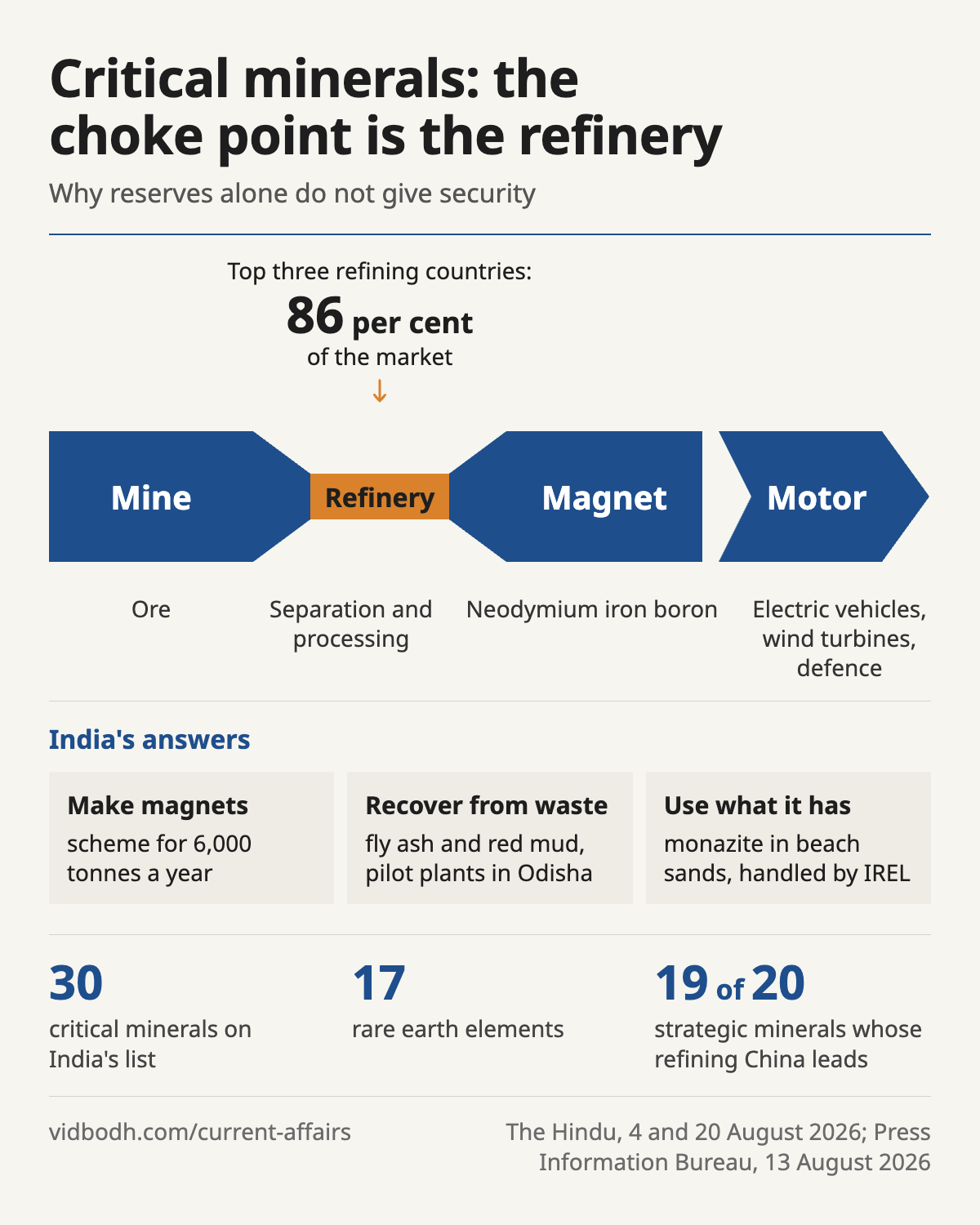
- For copper, lithium, nickel, cobalt, graphite and the rare earths, the top three refining countries held 86 per cent of the market in 2024.
- China leads the refining of 19 of 20 strategic minerals, and its 2025 export controls on rare earths reached industries from electric vehicles to defence.
- So midstream processing, and not reserves, decides whether a country is secure.
- In a supply shock a stockpile of processed material is the most useful, far more than a stockpile of ore.
Magnets: the finished product India cannot yet make
- A rare earth permanent magnet is what makes an electric vehicle motor small and efficient; wind turbines, electronics and defence use them too.
- Neodymium iron boron is the strongest permanent magnet in wide use.
- India's scheme, approved in November 2025, aims at 6,000 tonnes a year of integrated capacity, from rare earth oxide to finished magnet, shared among five firms chosen by global bidding.
Minerals from waste
- Fly ash, the residue of burning coal, and red mud, the residue of making alumina from bauxite, both carry rare earths.
- Two pilot plants in Odisha, with processes from the Institute of Minerals and Materials Technology and support from National Aluminium Company (NALCO), will recover them.
- Recovery from waste adds to supply and reduces the waste itself.
India's own rare earth source
- Monazite, found in the beach sands of Kerala, Tamil Nadu, Odisha and Andhra Pradesh, holds both rare earths and thorium.
- Because of the thorium, beach sand minerals are reserved for government companies, and exports go only through IREL (India) Limited.
The way forward
- Invest in processing and separation, since mining without refining only moves the dependence one step.
- Build stockpiles of processed material under the National Critical Mineral Mission.
- Scale up recycling and recovery from waste.
- Secure overseas supply through partnerships, while building capacity at home.
Prelims facts
- India's 2023 list has 30 critical minerals.
- Rare earths are 17 elements, including scandium and yttrium.
- Monazite yields thorium as well as rare earths; IREL handles it.
- Red mud comes from bauxite processing; fly ash from burning coal.
UPSC has asked
- Prelims 2015: uses and composition of fly ash from coal power plants
See also: Critical minerals from industrial waste · Sintered rare earth permanent magnets · Monazite and the beach sands · MMDR Amendment Act, 2026 and the States' power to tax minerals
Sources: The Hindu, 4 Aug 2026: Critical minerals as the basis of strategic power (opens in a new tab) · The Hindu, 5 Aug 2026: Essential stockpiling for a mineral driven future (opens in a new tab) · PIB, 13 Aug 2026: Scheme for sintered rare earth permanent magnets attracts 20 bids (opens in a new tab) · The Hindu, 20 Aug 2026: Extracting rare earths from fly ash and red mud (opens in a new tab) · PIB, 12 Aug 2026: Non-power uses of atomic energy: isotopes, crops, rare earths (opens in a new tab)
Earlier coverage: Critical minerals · The monthly magazine, August 2026