The European Union's AI Act comes into application
LeadPrelims and MainsAugust 2026
Why in news
The European Union's AI Act became applicable on 2 August 2026, two years after it came into force, and the European Union launched a team to enforce it. It is the first comprehensive law on artificial intelligence anywhere.
Background
- Most countries, India among them, govern artificial intelligence through existing laws on data, platforms and consumer protection.
- The European Union chose a single law for all uses of artificial intelligence.
- Its method is risk based regulation: the duties on a system grow with the harm its use could do.
- Because European rules bind any firm that sells into Europe, they tend to become the standard elsewhere, the so called Brussels effect.
The four levels of risk
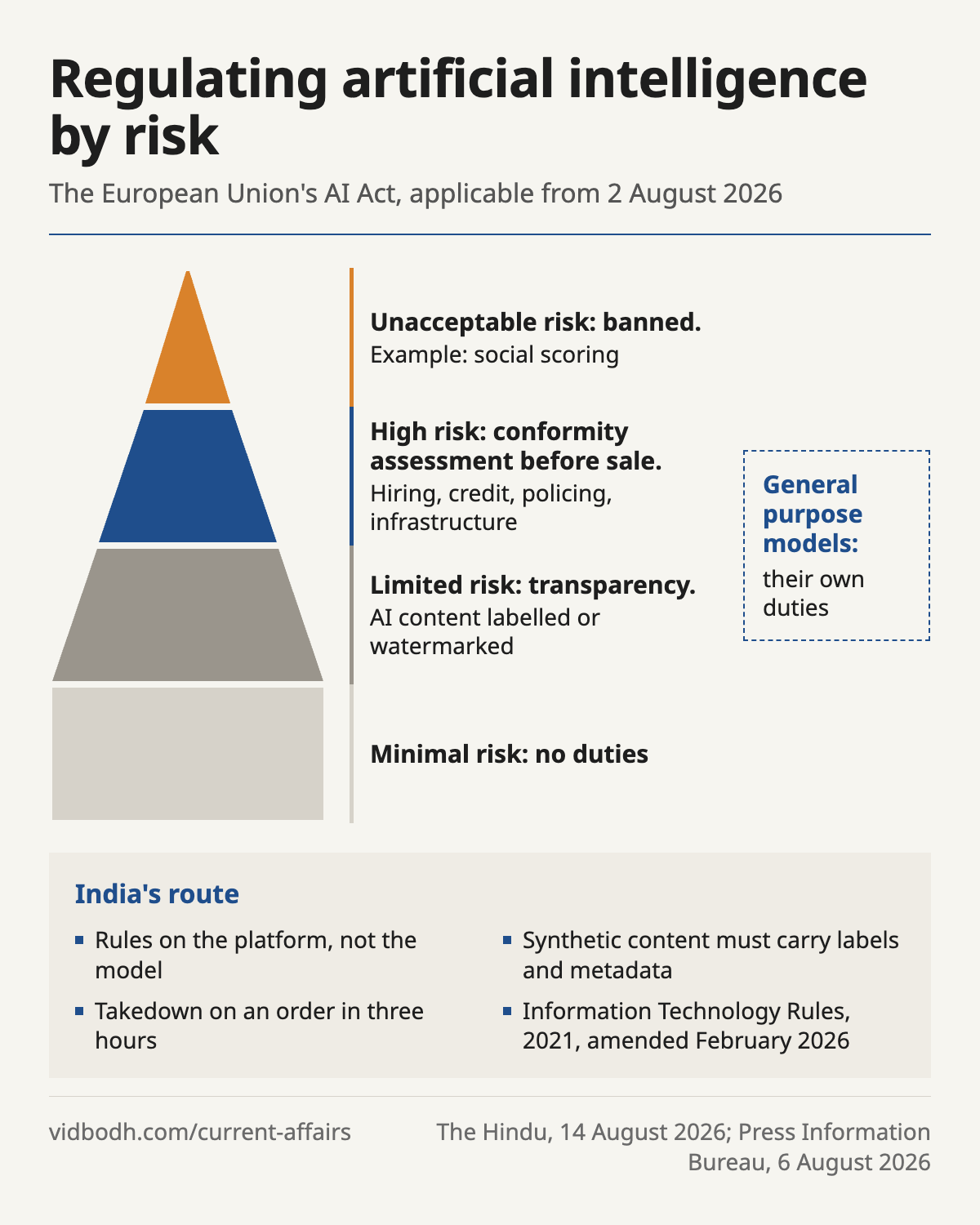
- Unacceptable risk: banned outright, for example social scoring.
- High risk: uses in hiring, credit, policing and infrastructure must pass a conformity assessment before they reach the market.
- Limited risk: transparency duties, so that content made by artificial intelligence is labelled or watermarked.
- Minimal risk: free of duties.
- General purpose models carry their own duties on documentation and copyright.
Already being softened
- Deadlines for standalone high risk systems were pushed to December 2027.
- An amending package, the AI Omnibus, extends deadlines and simplifies compliance.
- The lesson drawn is that a law on a fast moving technology has to be revised as it goes.
How India regulates instead
- India reaches artificial intelligence through the platform that carries the content, not the model that made it.
- The amendment of February 2026 to the Information Technology Rules, 2021 brought synthetically generated information under the rules.
- Such content must carry labels and traceable metadata, and takedown on an order falls from 36 hours to three hours.
- India is considering a law of its own, and has so far preferred sector by sector governance.
Why it matters to India
- Indian firms that sell software and services into Europe must comply.
- The Act is the template against which every other regulator, India's included, now argues.
The way forward
- Regulate by risk, so that small firms are not loaded with the duties meant for dangerous uses.
- Use regulatory sandboxes and periodic review, so that rules keep pace with the technology.
- Make labelling of synthetic content work in practice, through common technical standards for watermarks.
Prelims facts
- The AI Act came into force in August 2024 and became applicable on 2 August 2026.
- Social scoring is in the banned category.
- India's deepfake rules sit in the Information Technology Rules, 2021, as amended in February 2026.
- A significant social media intermediary is a platform with 50 lakh or more registered users in India.
See also: Deepfake labelling rules · Agentic AI: the 2026 incidents and "pacing the frontier" · Global governance of artificial intelligence
Sources: The Hindu, 1 Aug 2026 · The Hindu, 14 Aug 2026: EU AI Act becomes applicable (opens in a new tab) · The Hindu, 17 Aug 2026: Anthropic watermarking claude ai content explained (opens in a new tab) · The Indian Express, 24 Aug 2026: What India can learn from EU's AI reset (opens in a new tab) · PIB, 6 Aug 2026: Deepfakes: labelling rules and three-hour takedown (opens in a new tab)
Earlier coverage: The European Union's AI Act · The monthly magazine, August 2026