VidBodh · Current affairs
The monthly magazine, August 2026 · Global Affairs and International Relations › Bangladesh
Printed on · vidbodh.com/current-affairs
Renewing the Ganga Waters Treaty before it expires
LeadPrelims and MainsAugust 2026
Why in news
The Ganga Waters Treaty of 1996 expires in December 2026. Bangladesh asked in June for talks on a new agreement, and on 29 August 2026 India said the matter would be discussed in the bilateral Joint Rivers Commission.
Background
- The Farakka Barrage, commissioned in 1975, diverts Ganga water into the Hooghly to keep Kolkata port navigable. Downstream, Bangladesh depends on the same water in the dry months.
- Short term arrangements of 1977 and later memoranda lapsed, leaving years without any agreement.
- The treaty was signed on 12 December 1996 for thirty years. It covers only the lean season, 1 January to 31 May, and shares the flow at Farakka in ten day blocks.
- India and Bangladesh share 54 rivers; the Joint Rivers Commission dates from 1972.
How the treaty shares water
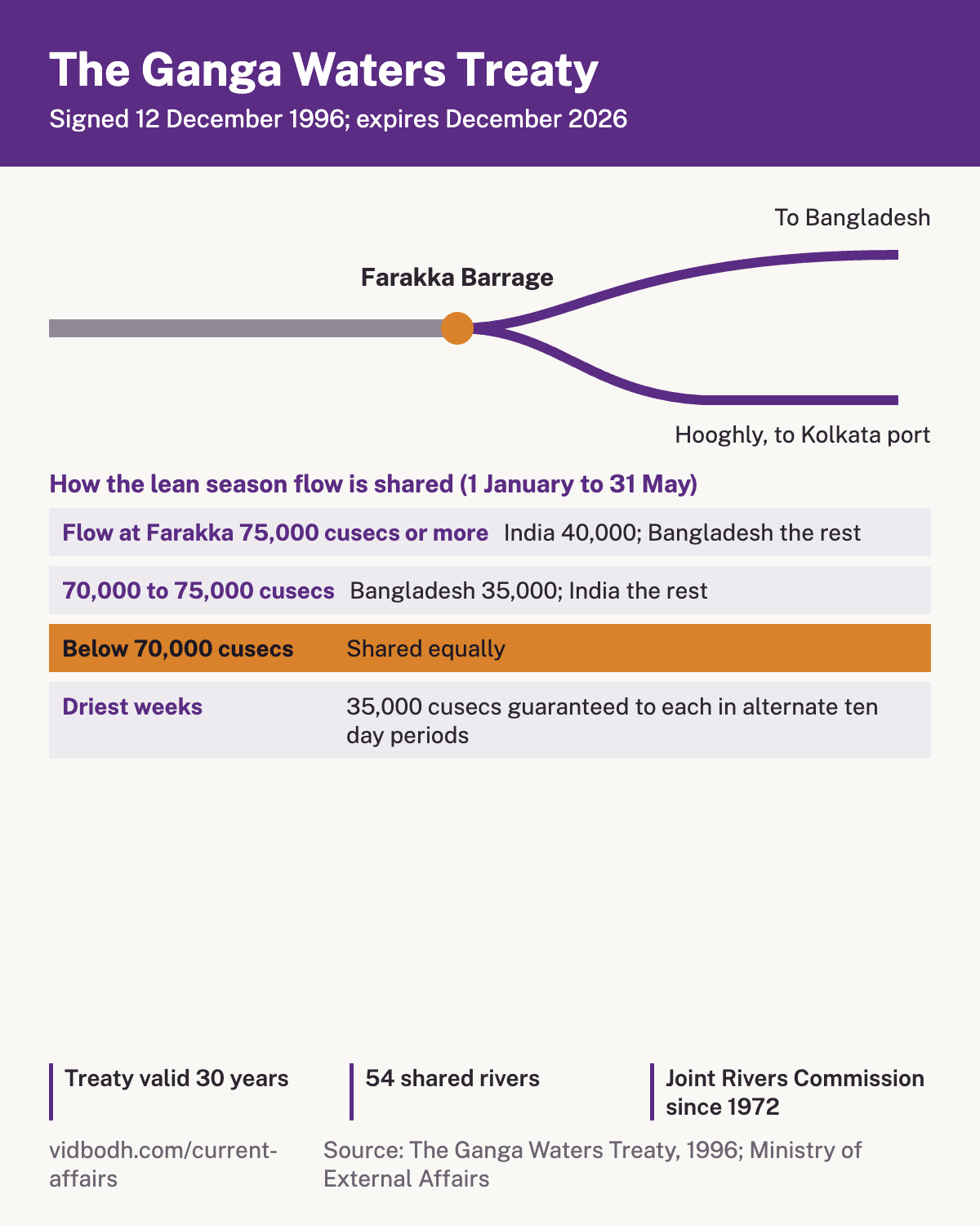
- Above 75,000 cusecs at Farakka, India takes 40,000 and Bangladesh the rest.
- Between 70,000 and 75,000 cusecs, Bangladesh gets 35,000 and India the rest.
- Below 70,000 cusecs, the two share equally.
- In the driest weeks each is guaranteed 35,000 cusecs in alternate ten day periods.
Why renewal is contested
- Hydrology has changed: upstream irrigation, silt and climate variability have cut lean season flows since the 1990s, so the bands may no longer match the river.
- Bangladesh has formed a team for a new agreement, and its experts argue for a revised treaty, with economists and environmental specialists at the table, not a rollover.
- Politics in Dhaka: a new government since February 2026 is still settling its relations with India.
- India's federal angle: West Bengal's objections blocked the Teesta agreement in 2011, and no Ganga arrangement works without the State.
India's stakes
- Kolkata port and the Hooghly's health on one side; a stable eastern neighbour on the other.
- A lapse would leave a legal vacuum in the 2027 dry season, the first since 1996.
- Water is among the most sensitive issues between the two publics; a fair renewal is India's best chance to rebuild trust.
The way forward
- A short extension of the present treaty while a revised one is negotiated, to avoid a vacuum.
- Widen the talks into basin cooperation: shared data, flood forecasting and the Teesta.
- Bring West Bengal into the process early, as the Constitution's division of water powers requires in practice.
- Build joint storage upstream, which both sides have discussed for decades.
Prelims facts
- Treaty signed 12 December 1996, valid 30 years, expires December 2026.
- Covers the lean season 1 January to 31 May, measured at Farakka.
- Below 70,000 cusecs the flow is shared equally.
- India and Bangladesh share 54 rivers; the Joint Rivers Commission dates from 1972.
- The Farakka Barrage feeds the Hooghly to keep Kolkata port navigable.
Sources: ThePrint, 29 Aug 2026: Dhaka requests talks, Delhi bides time as Ganges water treaty emerges as latest irritant in ties (opens in a new tab) · DD India, 4 Aug 2026: MEA briefing, 4 August 2026 (opens in a new tab)
Earlier coverage: The Ganga Waters Treaty and Farakka · The monthly magazine, August 2026