GOBARdhan becomes the National Circular Bioenergy Scheme
LeadPrelims and MainsAugust 2026
Why in news
The Cabinet on 6 August 2026 approved GOBARdhan as the National Circular Bioenergy Scheme, to run to 2035 to 2036. It brings the compressed biogas programmes of four ministries under one, and requires city gas distributors to blend compressed biogas into the gas they sell.
Background
- Biogas forms when organic waste decays without air; it is mostly methane and carbon dioxide.
- Compressed biogas (CBG) is biogas purified to a high methane content and compressed, so that it can be used like natural gas.
- GOBARdhan, Galvanizing Organic Bio Agro Resources Dhan, began in 2018 under the Swachh Bharat Mission (Grameen), to turn cattle dung and farm waste into biogas and manure.
- SATAT, Sustainable Alternative Towards Affordable Transportation, is the 2018 scheme under which oil companies buy CBG from private plants; more than 200 plants run under it.
What the scheme does
- It places all CBG programmes under the Ministry of Petroleum and Natural Gas.
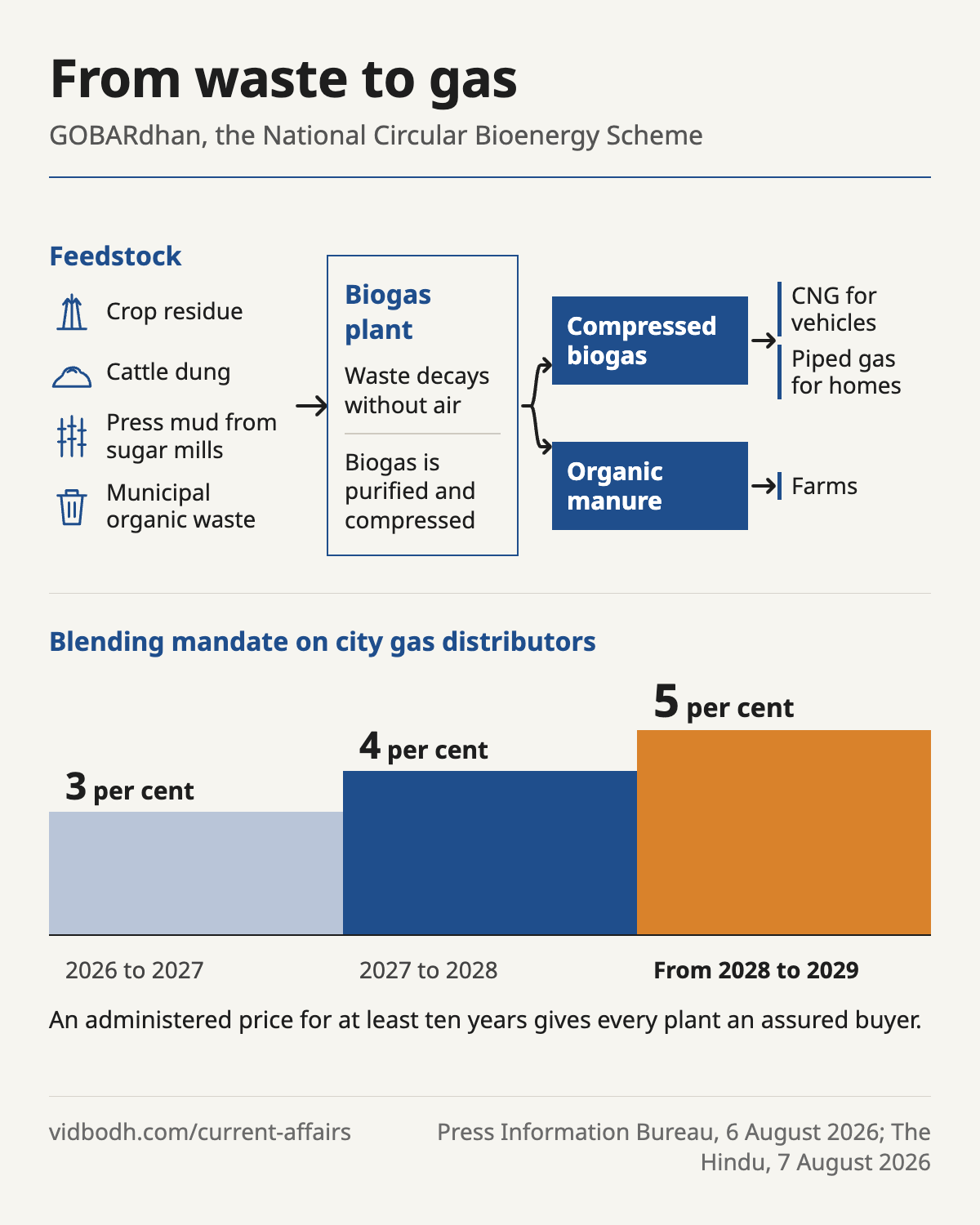
- City gas distributors must blend CBG into compressed natural gas for vehicles and piped gas for homes, starting at 3 per cent and rising to 5 per cent from 2028 to 2029.
- An administered price is fixed for at least ten years, so that a plant is sure of its buyer and its revenue.
- It adds capital subsidies and pipeline support, and aims at an almost tenfold rise in CBG output.
Why it matters
- Energy security: every unit of CBG blended is natural gas that India does not import.
- Waste: the feedstocks are crop residue, cattle dung, press mud from sugar mills and municipal organic waste.
- Air: crop residue sold to a plant is residue that is not burnt in the field.
- Soil: the slurry left after digestion is an organic manure.
The hard part
- A gas made from waste is worth making only if somebody must buy it at a price that covers the plant; the blending mandate and the administered price answer that.
- The next constraint is feedstock: residue is available in a short window after harvest, and must be collected, stored and carried to the plant.
The way forward
- Build feedstock supply chains with farmer groups, with storage near the plants.
- Develop a market for the manure, which decides whether a plant earns enough.
- Link plants to city gas pipelines, so that the gas does not have to travel by road.
Prelims facts
- GOBARdhan began in 2018 under the Swachh Bharat Mission (Grameen).
- The scheme is now run by the Ministry of Petroleum and Natural Gas.
- The blending duty falls on city gas distributors, 3 per cent rising to 5 per cent.
- SATAT concerns compressed biogas, not ethanol.
Sources: The Hindu, 7 Aug 2026: Revamped GOBARdhan scheme for compressed biogas (opens in a new tab) · PIB, 6 Aug 2026: Cabinet approves GOBARdhan, the National Circular Bioenergy Scheme (opens in a new tab) · PIB, 6 Aug 2026: Cabinet approves GOBARdhan, the National Circular Bioenergy Scheme (opens in a new tab) · PIB, 29 Aug 2026: Cabinet approves GOBARdhan, the National Circular Bioenergy Scheme (opens in a new tab)
Earlier coverage: GOBARdhan · The monthly magazine, August 2026