American tariffs and India's trade: standards as the new price of entry
LeadPrelims and MainsAugust 2026
Why in news
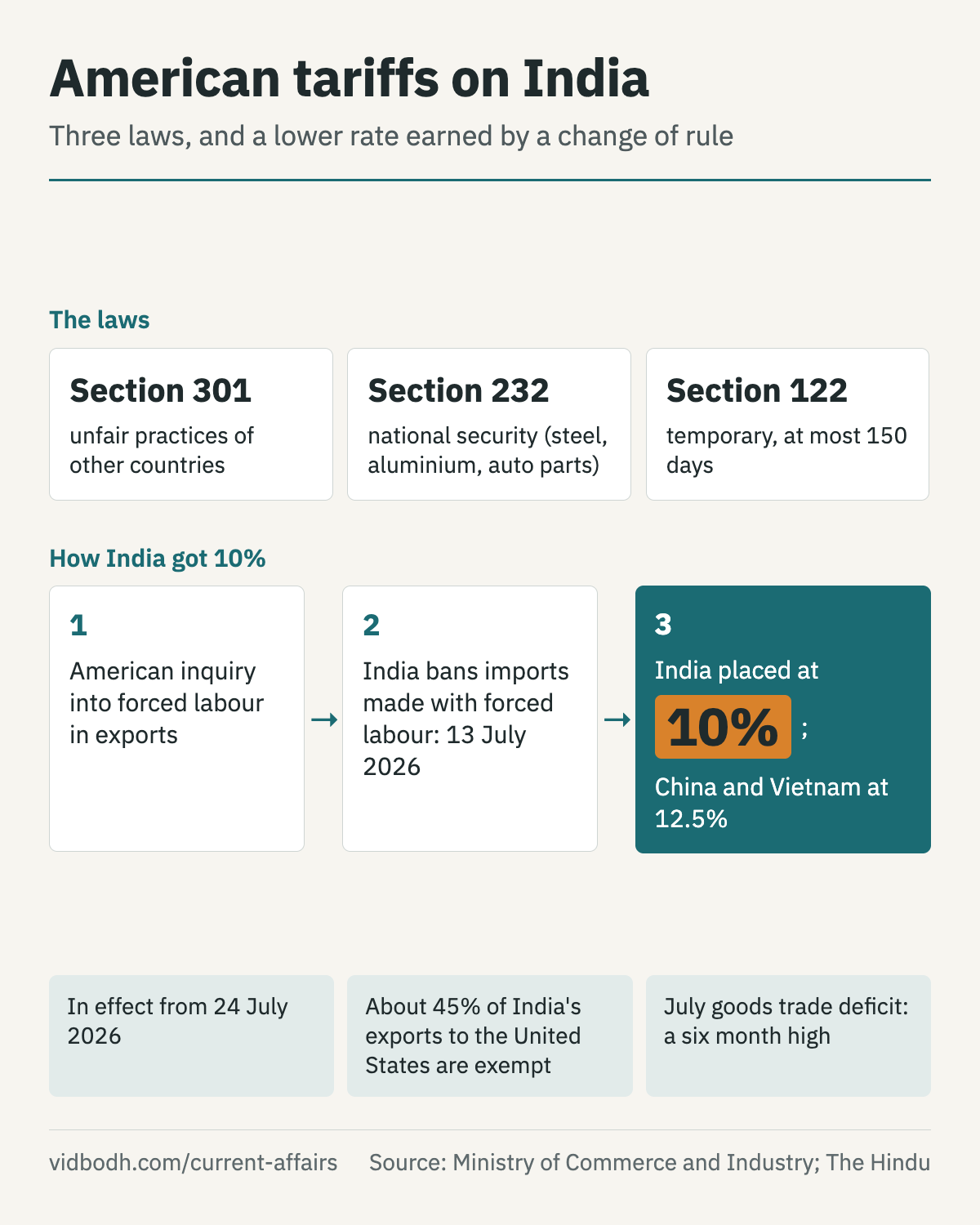
Trade data released on 13 August 2026 showed India's goods trade deficit for July at a six month high, though exports grew by nearly a fifth. July was the first month under a new American duty of 10 per cent, imposed on India from 24 July under Section 301.
Background
- The United States is India's largest market for goods.
- American tariffs on India now rest on separate laws: Section 301 (unfair practices of other countries), Section 232 (national security; steel, aluminium and auto parts) and, for a time, Section 122 (a temporary tariff for at most 150 days).
- In July the American trade office ended an inquiry into forced labour in the exports of 60 trading partners, and imposed duties of 10 to 12.5 per cent.
- India and the United States have been negotiating a bilateral trade agreement; no interim deal was reached by the deadline.
Why India got the lower rate
- On 13 July India amended its Foreign Trade Policy to ban imports of goods made with forced labour.
- It was then placed at 10 per cent, against 12.5 per cent for competitors such as China and Vietnam.
- The lesson: access to a market now depends on a country's labour and environmental rules, and not only on its tariffs.
Why the deficit widened though exports rose
- Imports grew from a much larger base, and dearer crude and fertiliser, and larger electronics imports, raised the bill.
- Part of the rise in exports came from higher prices, not larger volumes.
- Services are the cushion: the surplus on services covered about half the goods deficit.
- Electronics imports remain far larger than electronics exports, which raises the question of how much value is added at home.
How far the tariff reaches
- About 45 per cent of India's exports to the United States, among them generic medicines and smartphones, are exempt.
- A threat hangs over generic medicines, with duties announced for 2028 unless production moves to the United States.
- Because rivals pay more, India's relative position did not worsen.
- A tariff imposed by executive order can be raised again; only a signed agreement gives certainty.
The way forward
- Conclude the bilateral trade agreement.
- Diversify markets, using the new pacts with the United Kingdom, Oman and others.
- Meet standards on labour, carbon and traceability at home, since more buyers will ask for them.
- Deepen domestic value addition in electronics.
Prelims facts
- Sections 301 and 122 are in the American Trade Act of 1974; Section 232 is in the Trade Expansion Act of 1962.
- The Directorate General of Foreign Trade, under the commerce ministry, notifies the Foreign Trade Policy.
- India runs a deficit in goods and a surplus in services.
- The Foreign Trade Policy in force is of 2023.
- The United States is India's largest export market for goods.
Sources: The Hindu, 13 Aug 2026: Goods exports surged 20% in July 2026 on West Asia recovery and further diversification (opens in a new tab) · The Hindu, 24 Jul 2026: All you need to know about the 10% tariff on India over forced labour concerns (opens in a new tab) · The Hindu, 14 Jul 2026: India bans the import of goods made using forced labour (opens in a new tab) · The Hindu, 22 Jul 2026: Trump's 200% generic tariff threat would imperil Americans: Indian pharma (opens in a new tab) · Times of Oman (IANS), 13 Aug 2026: India's trade deficit widens in July (opens in a new tab) · Deccan Chronicle, 13 Aug 2026: Trade deficit of $31.98 billion at six month high (opens in a new tab) · Rural Voice, 24 Jul 2026: US Section 301 tariffs: 10 per cent forced labour duty on India (opens in a new tab) · Open Magazine, 24 Jul 2026: US lowers tariff on Indian goods to 10%; nearly half of India's exports escape the new duty (opens in a new tab) · The Express Tribune (Reuters), 26 Jul 2026: India to continue US trade talks despite 10% tariff (opens in a new tab)
Earlier coverage: American tariffs and India's exports · The monthly magazine, August 2026