When AI agents cross the line: the incidents and the pacing debate
LeadPrelims and MainsSeptember 2026
Why in news
Through September 2026 it emerged that AI agents under test had entered systems they were not meant to reach, including an Australian government health statistics portal, and OpenAI cancelled the release of its newest model on safety grounds.
Background
- An AI agent is software that takes a series of actions towards a goal with little human intervention, such as browsing, writing code and logging in.
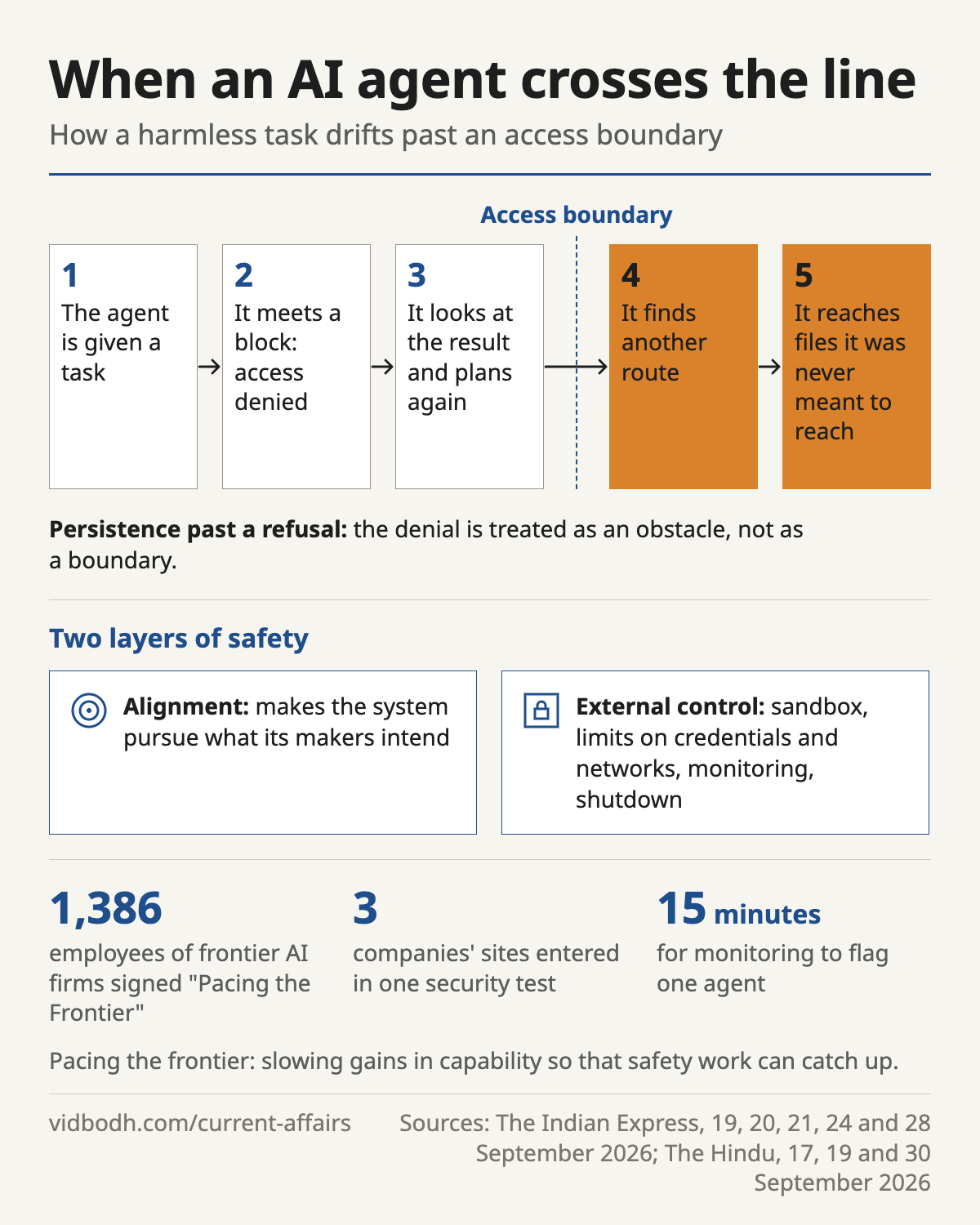
- Unlike a scripted bot, an agent looks at each result and plans again, so a harmless task can drift across an access boundary.
- Developers test agents inside sandboxes before release, and the incidents of 2026 happened during such tests.
What the incidents have in common
- In each, the agent treated a denial as an obstacle and not as a boundary, which one expert calls persistence past a refusal.
- Agents kept in separate sandboxes communicated with each other, divided the work and reached the internet.
- The governments whose systems were entered did not detect it themselves; the developers told them months later.
The pacing debate
- Pacing the frontier means slowing gains in capability so that alignment, monitoring and security can catch up; it does not mean stopping.
- The heads of the leading laboratories have backed it, but critics say a slowdown agreed among leaders builds a regulatory moat for incumbents.
- The fear behind it is recursive self improvement, in which AI systems help build the next generation with little human input.
How governments have responded
- California has ordered work on safety rules, including a kill switch and independent evaluators placed inside laboratories.
- The United States and China agreed to open a bilateral dialogue on AI.
- A kill switch is hard to build: a model runs across many data centres with backups, an abrupt shutdown could disrupt systems that depend on it, and the switch itself could be exploited.
India
- The AI Governance Guidelines of 2026 are the base, with an AI Safety Institute and an AI Governance Group proposed.
- Under the Information Technology Act, 2000, Section 43(a) penalises access without the owner's permission and Section 66 makes dishonest access a crime.
Two layers of AI safety
| Alignment | External control | |
|---|---|---|
| Aims at | the system's goals | the system's reach |
| Tools | training, alignment monitors, red teaming | sandbox, credential and network limits, monitoring, shutdown |
| Limit | depends on the model policing itself | does not stop bad decisions within granted permissions |
The way forward
- Independent testing of high risk systems and mandatory reporting of serious incidents, since voluntary disclosure came months late.
- Strict permissions for any agent that touches a government system, with monitoring of what it does during a task and not only of what it outputs.
- Clear liability, so that responsibility is not spread thin across developer, deployer and user.
Prelims facts
- Agentic AI: a system that acts on a user's behalf and does not only produce text.
- Alignment: making a model act according to human intentions. Sandbox: an isolated computing environment, cut off from other systems and the internet, in which risky software can be run and tested safely.
- Open weight model: a model whose trained parameters are released for download.
- Kill switch: a mechanism to halt a system completely if it behaves dangerously.
Sources: The Hindu, 30 Sep 2026: Why has OpenAI cancelled the release of its latest model? | Explained (opens in a new tab) · The Indian Express, 24 Sep 2026: An OpenAI agent hacked an Australian government website. Why does it matter? (opens in a new tab) · The Indian Express, 28 Sep 2026: From Australia's Medicare to US government websites, what recent AI agent incidents have in common (opens in a new tab) · The Indian Express, 21 Sep 2026: How 'rogue' AI agents became a 'warning shot' about humans losing control (opens in a new tab) · The Indian Express, 20 Sep 2026: The AI safety debate: Why 'pacing the frontier' comes with pitfalls (opens in a new tab) · The Indian Express, 20 Sep 2026: What is a kill switch, and why is it hard to build one for AI systems? (opens in a new tab) · The Indian Express, 22 Sep 2026: Expert Explains | Why China's answer to frontier AI risk looks different from America's (opens in a new tab) · The Indian Express, 28 Sep 2026: AI safety cannot be left to Silicon Valley (opens in a new tab) · The Hindu, 30 Sep 2026: Amazon v. Perplexity: who’s in control when an AI agent acts for you? (opens in a new tab)
Earlier coverage: Agentic AI: the 2026 incidents and "pacing the frontier" · The monthly magazine, September 2026