Delhi's winter air: the revised GRAP and a fixed calendar of curbs
LeadPrelims and MainsSeptember 2026
Why in news
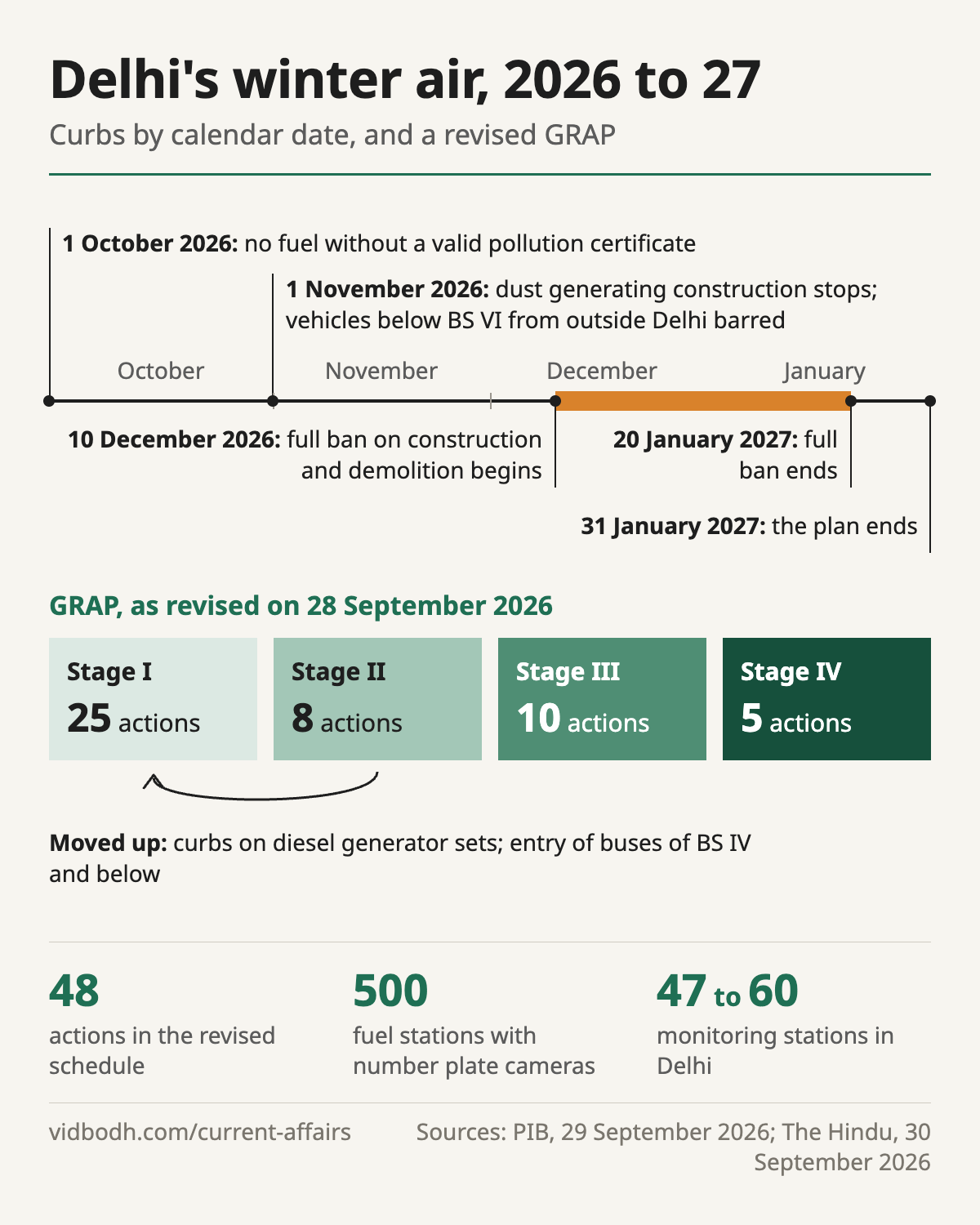
On 28 September 2026 CAQM approved a revised GRAP schedule, and Delhi announced a winter plan with curbs fixed by date from 1 November 2026 to 31 January 2027.
Background
- GRAP has four stages tied to the Air Quality Index: Stage I at 201 to 300 (poor), Stage II at 301 to 400 (very poor), Stage III at 401 to 450 (severe) and Stage IV above 450 (severe plus).
- Each stage adds to the one below, and a stage can be invoked on a forecast, before the reading crosses its band.
- In winter, falling temperatures trap vehicle exhaust, industrial emissions and crop residue smoke close to the ground.
What changed in GRAP
- Curbs on diesel generator sets and on the entry of buses of BS IV and below moved up from Stage II to Stage I.
- The exemption for goods vehicles of BS IV and below carrying essential commodities in Stages III and IV was removed.
- Dust monitoring of construction sites was extended beyond municipal limits to industrial and highway corridor zones.
Delhi's fixed calendar
- From 1 November to 31 January dust generating construction stops, parking charges double, offices stagger their hours and up to half the staff work from home.
- All construction and demolition is banned from 10 December to 20 January.
- From 1 November vehicles below BS VI registered outside Delhi are barred, with compressed natural gas and electric vehicles exempt.
- From 1 October a vehicle without a valid Pollution Under Control Certificate gets no fuel in the region.
The farm fire side
- CAQM has directed Punjab, Haryana and Uttar Pradesh to eliminate paddy stubble burning in 2026.
- A strong El Niño is expected to bring fewer rain bearing Western Disturbances, so the air will clear less often this winter.
GRAP stages, as revised in September 2026
| Stage | Air Quality Index | Air quality | Actions |
|---|---|---|---|
| I | 201 to 300 | poor | 25 |
| II | 301 to 400 | very poor | 8 |
| III | 401 to 450 | severe | 10 |
| IV | above 450 | severe plus | 5 |
The way forward
- A fixed calendar gives residents and businesses notice, which graded curbs never did, but it treats the season and not the sources.
- Vehicles are the largest primary source of Delhi's winter pollution, at about 23 per cent, so cleaner transport matters more than seasonal bans.
- Municipal and even regional boundaries are too small for the problem, which is the case for managing the whole airshed.
Prelims facts
- GRAP stages follow the Air Quality Index: 201, 301, 401 and above 450.
- CAQM is a statutory body and acts through directions that the States must enforce.
- The airshed approach manages air quality across a shared geographic area and not within administrative boundaries.
- BS VI norms, in force nationwide since 2020, set stricter limits on nitrogen oxides and particulate matter.
See also: Stubble burning and crop residue management · National Clean Air Programme
Sources: PIB, 29 Sep 2026: CAQM Approves Revised GRAP Schedule; Tightens Measures for Vehicles, Dust and Pollution Control (opens in a new tab) · The Hindu, 30 Sep 2026: WFH, construction curbs, doubled parking charges: Delhi’s winter action plan explained (opens in a new tab) · PIB, 28 Sep 2026: Union Environment Minister reviews Delhi’s Air Pollution Mitigation Plan with CM Smt. Rekha Gupta; Calls for Time-bound, Coordinated Action and Public Participation (opens in a new tab) · PIB, 30 Sep 2026: CAQM Reviews Preparedness for Stubble-Burning Prevention, Vehicular and Industrial Emission Control (opens in a new tab) · The Indian Express, 30 Sep 2026: Delhi has a winter plan, but clean air needs more than bans (opens in a new tab) · The Indian Express, 17 Sep 2026: Delhi CM Rekha Gupta writes: An EV roadmap for a sustainable city (opens in a new tab)
Earlier coverage: GRAP and Delhi's winter plan, 2026 · The monthly magazine, September 2026