VidBodh · Current affairs
The monthly magazine, September 2026 · Global Affairs and International Relations › China and the boundary
Printed on · vidbodh.com/current-affairs
India and China: the boundary talks and Xi Jinping's visit
LeadPrelims and MainsSeptember 2026
Why in news
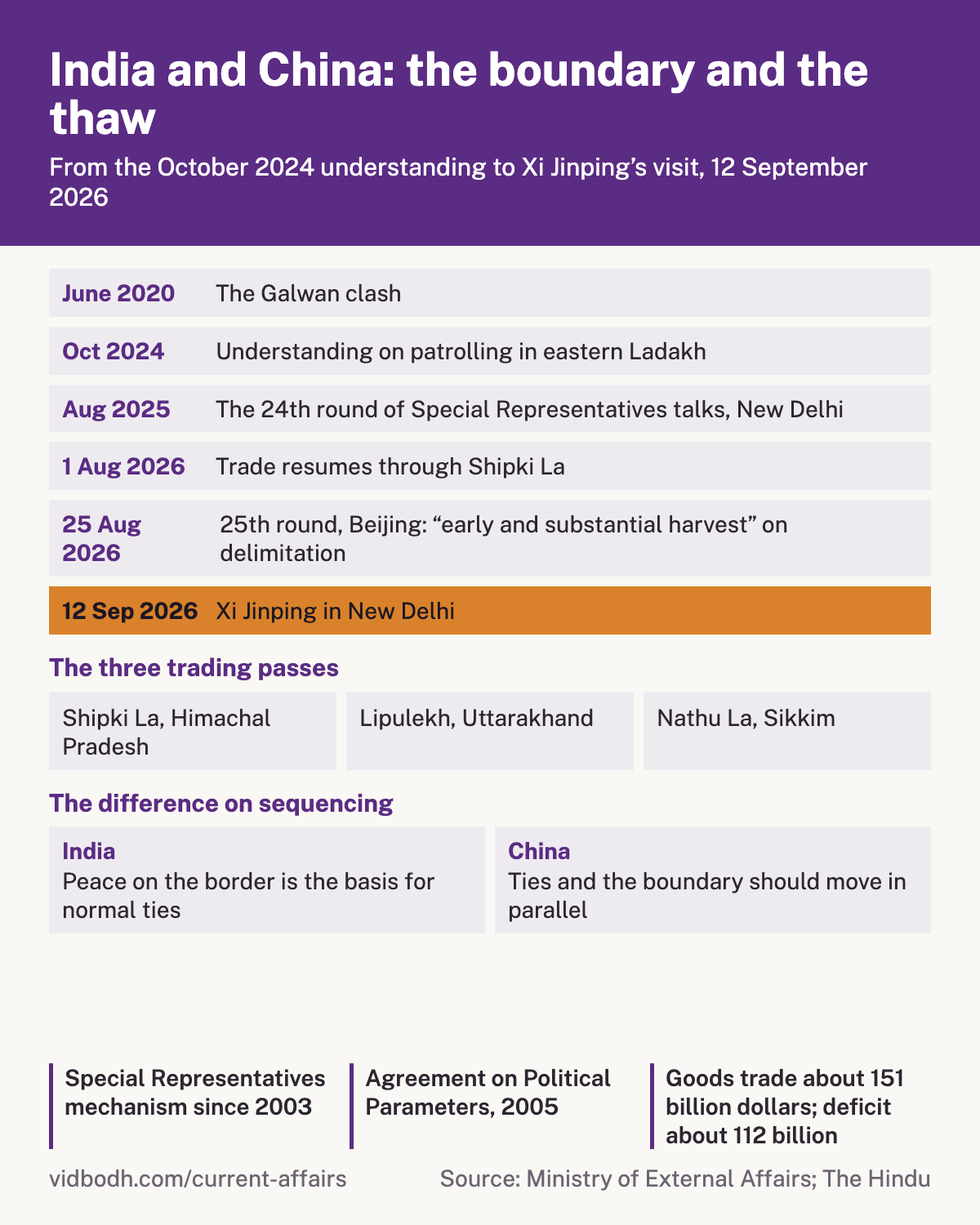
On 12 September 2026, on the margins of the BRICS Summit, the Prime Minister and President Xi Jinping held talks in New Delhi, Xi's first visit to India in almost seven years and the first since the Galwan clash of 2020. On 25 August the Special Representatives had agreed to pursue an "early and substantial harvest" in delimiting the boundary.
Background
- The clash in the Galwan valley in June 2020 broke relations. Recovery began with the October 2024 understanding on patrolling in eastern Ladakh, then flights, visas and the revival of the boundary talks.
- The Special Representatives mechanism, created in 2003, seeks a political settlement; its chief product is the 2005 Agreement on Political Parameters and Guiding Principles, which both still call the basis for a package solution.
- The boundary is about 3,488 kilometres long and undemarcated; the Line of Actual Control is where the two armies stand.
- Xi last visited for the Mamallapuram informal summit in 2019.
What the August talks agreed
- An Expert Group on Boundary Delimitation and a Working Group on Border Management, to settle the less contested stretches first.
- Two new General Level Mechanism meeting points and two new hotlines in the eastern and middle sectors.
- Reopening of the three border trading points, Shipki La, Lipulekh and Nathu La; trade through Shipki La resumed on 1 August.
- More batches of pilgrims to Kailash and Mansarovar; the river data mechanism to meet.
What the September meeting showed
- Sequencing is the core difference. India: peace on the border is the basis for normal ties. China: ties and the boundary should move in parallel. The two readouts left it unresolved.
- Both agreed differences should not become disputes; India restated its three mutuals: respect, sensitivity and interest.
- No new mechanism; the thaw rests on existing channels.
- The first Corps Commander meeting in the eastern sector, in Arunachal Pradesh, extended military talks beyond Ladakh.
India's stakes
- Predictability on the border, which frees resources and attention.
- Trade: about 151 billion dollars in 2025-26, with a record deficit of about 112 billion. Dependence in electronics, drug ingredients and rare earths gives Beijing leverage.
- India has eased curbs on Chinese investment since March 2026 while keeping security screening.
- The limits: China's infrastructure build up on its side continues, and it still renames places in Arunachal Pradesh, which India rejected again in August.
The way forward
- Test the expert group on the middle sector, where the dispute is smallest, before the harder sectors.
- De escalate: pull back the large deployments on both sides, which disengagement did not do.
- Widen economic engagement only under screening, and cut dependence in the three sensitive sectors.
- Keep the river data memoranda renewed, since floods do not wait for diplomacy.
Prelims facts
- The Special Representatives mechanism dates from 2003; the Agreement on Political Parameters from 2005.
- The 25th round: Beijing, 25 August 2026; the 26th will be in India in 2027.
- Border trading points: Shipki La (Himachal Pradesh), Lipulekh (Uttarakhand), Nathu La (Sikkim).
- Xi's previous visit: Mamallapuram, October 2019.
- China is India's largest source of imports and largest trade deficit partner.
See also: The Brahmaputra and China
Sources: The Hindu, 10 Sep 2026: China confirms Xi to visit India after 7 year gap (opens in a new tab) · The Hindu, 12 Sep 2026: BRICS Summit updates: India, China stress need for peace and tranquillity in border areas (opens in a new tab) · ThePrint, 12 Sep 2026: Differences should not become disputes: Modi, Xi welcome progress in India-China ties (opens in a new tab) · Reuters, 12 Sep 2026: India and China bilateral goods trade and deficit, 2025-26 · The Hindu, 25 Aug 2026: NSA Doval, Wang Yi hold border talks in Beijing (opens in a new tab) · The Hindu, 26 Aug 2026: India, China to push for 'early and substantial harvest' of border delimitation (opens in a new tab) · ThePrint, 26 Aug 2026: India, China agree to push for early harvest deal on boundary question after Doval-Wang talks (opens in a new tab) · News On AIR, 1 Aug 2026: India-China cross border trade resumes through Shipki La after six years (opens in a new tab) · DD India, 11 Aug 2026: MEA briefing, 11 August 2026 (opens in a new tab) · The Hindu, 8 Aug 2026: India counters China, formally names 27 places in Arunachal Pradesh (opens in a new tab) · News On AIR, 20 Jun 2026: Kailash Mansarovar Yatra: first batch crosses Nathu La (opens in a new tab) · News On AIR, 28 Jul 2026: Foreign Secretary Vikram Misri reviews India-China ties during Beijing visit (opens in a new tab)
Earlier coverage: India and China: the boundary and the thaw · The monthly magazine, September 2026