The new GDP series: growth of 7.8 per cent and the debate on the deflator
LeadPrelims and MainsSeptember 2026
Why in news
On 31 August 2026 the National Statistics Office estimated real GDP growth of 7.8 per cent for April to June, on the new base of 2022-23. A former Finance Secretary questioned the series, and on 9 September the statistics ministry replied that its methods and data were already public.
Background
- GDP is the value of all final goods and services produced in a country in a period.
- Nominal GDP is at the prices of the day. Real GDP removes the effect of prices, and it is real GDP whose growth is reported.
- In February 2026 the base year moved from 2011-12 to 2022-23, with new sources: tax records, the labour force survey, and a yearly survey of unincorporated enterprises.
- On the new series, growth for 2025-26 is 7.8 per cent.
What the quarter showed
- Services and manufacturing led. Agriculture grew slowly and mining shrank.
- Investment grew faster than consumption, which points to public capital spending.
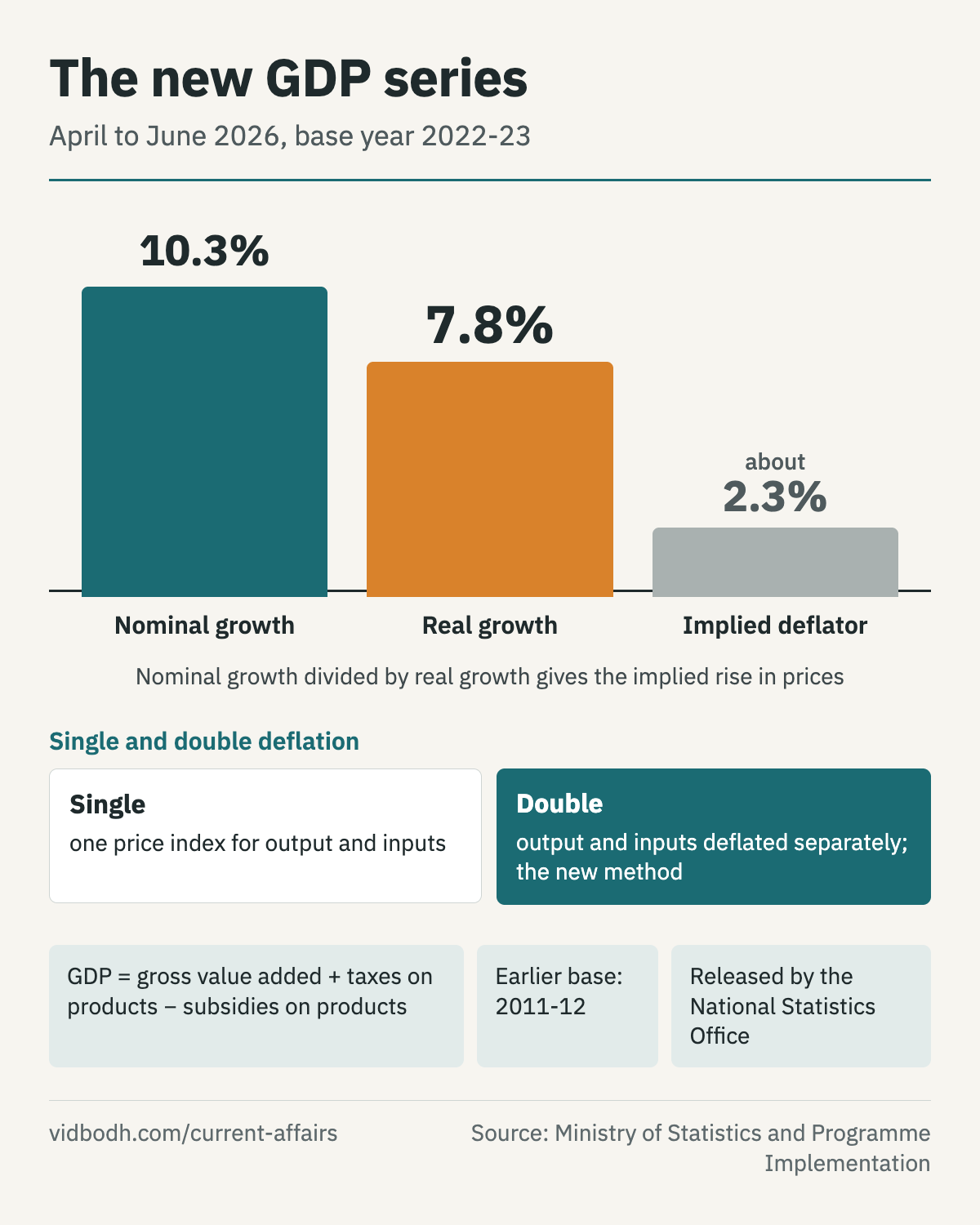
- Nominal growth was 10.3 per cent and real growth 7.8 per cent. Dividing one by the other gives the implied rise in prices, about 2.3 per cent.
- Growth beat the Reserve Bank's forecast, which weakens the case for a cut in interest rates.
The debate on the deflator
- The implied 2.3 per cent sits beside retail inflation of about 4 per cent in the same quarter.
- The critics: if prices are understated, real growth is overstated.
- The ministry: output should be deflated by producer prices, not by what consumers pay.
- A low deflator matters for the Budget too: taxes and the deficit ratio follow nominal GDP.
What changed in the method
- Double deflation: an industry's output and its inputs are now deflated separately. Earlier one index was used for both, which distorts the result when the two prices move apart.
- Producer prices in place of wholesale prices.
- The informal sector is measured each year by survey, not projected from an old benchmark.
Why trust matters
- Growth numbers guide interest rates, the Budget and investors.
- Doubt arises when strong growth sits beside weak signals on jobs and wages.
- The cure is openness: methods, back series and deflators in the public domain.
The way forward
- Publish the deflator for each sector and the full back series.
- Reconcile the production and expenditure estimates in the open.
- An independent statistical commission with statutory backing.
- Read GDP with employment and consumption data, not alone.
Prelims facts
- Base year of GDP: 2022-23; before that, 2011-12.
- GDP = gross value added + taxes on products − subsidies on products.
- Quarterly estimates come from the National Statistics Office, about two months after the quarter.
- The deflator is not published separately; it is implied by nominal and real GDP.
- The survey of unincorporated enterprises covers the non farm informal sector.
See also: The Producer Price Index and the new statistical series
Sources: The Hindu, 11 Sep 2026: Why do GDP figures face a controversy in India? (opens in a new tab) · The Federal, 31 Aug 2026: India's real GDP growth hits 7.8 per cent in Q1 FY27 (opens in a new tab) · Ministry of Statistics and Programme Implementation, 31 Aug 2026: Press note on GDP estimates for Q1 2026-27 (opens in a new tab) · Press Information Bureau, 31 Aug 2026: Factsheet on GDP performance (opens in a new tab) · News On AIR, 31 Aug 2026: India's real GDP growth rate rises to 7.8% in first quarter of FY 2026-27 (opens in a new tab) · PRS Legislative Research, 31 Aug 2026: Monthly Policy Review, August 2026 (opens in a new tab)
Earlier coverage: The new GDP series · The monthly magazine, September 2026