Why in news
On 14 September 2026 the United States Air Force Secretary said the country has "space control" weapons in Earth orbit, the first public admission of this kind by any country.
- 1967the Outer Space Treaty enters into force
- 4countries that have demonstrated an anti satellite test
- over 70signatories of the Artemis Accords, India among them
- November 2026third substantive session of the UN process on an arms race in outer space
Background
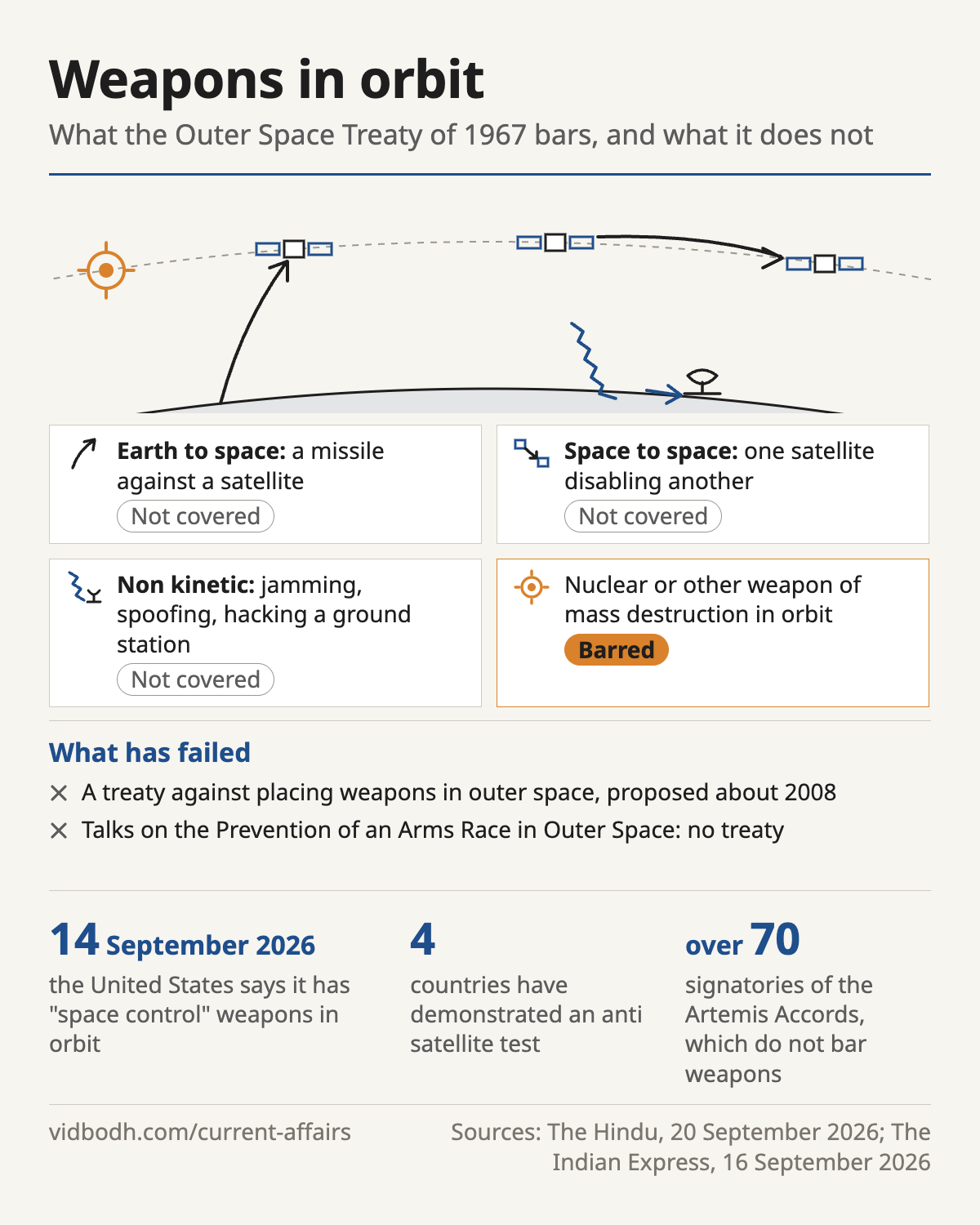
- Military use of space takes four forms: weapons fired from Earth at satellites, weapons in space aimed at Earth, weapons in space aimed at other objects in space, and non kinetic means such as jamming.
- The Outer Space Treaty of 1967 is the basic law of space, and it bars nuclear and other weapons of mass destruction in orbit.
- The United States, Russia, China and India have each demonstrated an anti satellite test.
What was said and what was not
- The weapons are described as defence against "hostile adversary action", but their type, number, orbit and rules of engagement were not disclosed.
- Russia and China objected and called for space to be kept free of weapons.
What the law covers
- Article IV of the Outer Space Treaty bars stationing nuclear weapons and other weapons of mass destruction in orbit; it does not bar conventional weapons.
- Article III applies international law to space, and Article IX requires "due regard" for the interests of other States.
- The Artemis Accords are voluntary and do not bar weapons.
What has failed
- A China and Russia proposal of about 2008 for a treaty against placing weapons in outer space never came about.
- Talks at the Conference on Disarmament on the Prevention of an Arms Race in Outer Space (PAROS) have produced no treaty.
- The treaty and the Liability Convention are too coarse for satellites that are autonomous and dual use.
- The BRICS New Delhi Declaration recorded progress on a BRICS Space Council and backed preventing an arms race in outer space.
Space weapons and what the law says
| Kind | Example | Outer Space Treaty |
|---|---|---|
| Earth to space | a missile against a satellite | silent |
| Space to space, conventional | a satellite that disables another | silent |
| Space to Earth, conventional | silent | |
| Nuclear or other weapon of mass destruction in orbit | barred | |
| Non kinetic | jamming, spoofing, hacking a ground station | silent |
The way forward
- One argument is that India should use the Council to shape norms on proximity operations, so that defensive measures are read as lawful self defence.
- Another is for multilateral thresholds of action, agreed through the UN's open ended working group.
Prelims facts
- Space control: military activity to protect one's own freedom of action in space while limiting an adversary's.
- Kinetic means physically damage a satellite; non kinetic means jam, spoof or blind it.
- The Outer Space Treaty bans weapons of mass destruction in orbit, not all weapons.
- The Artemis Accords are not a treaty; they are voluntary principles.
See also: The Artemis Accords
Sources: The Hindu, 20 Sep 2026: Why has the U.S. deployed ‘weapons’ in space? | Explained (opens in a new tab) · The Indian Express, 16 Sep 2026: US deploys space weapons: Is the weaponisation of space legal? (opens in a new tab) · The Hindu, 17 Sep 2026: Weapons in orbit are forcing old space laws into new struggles for power (opens in a new tab) · The Hindu, 22 Sep 2026: Unsafe space: On the U.S. and ‘on-orbit space control weapons‘ (opens in a new tab)
Earlier coverage: Weaponisation of outer space · The monthly magazine, September 2026