The Aravallis: a definition before the Supreme Court
LeadPrelims and MainsJune 2026
Why in news
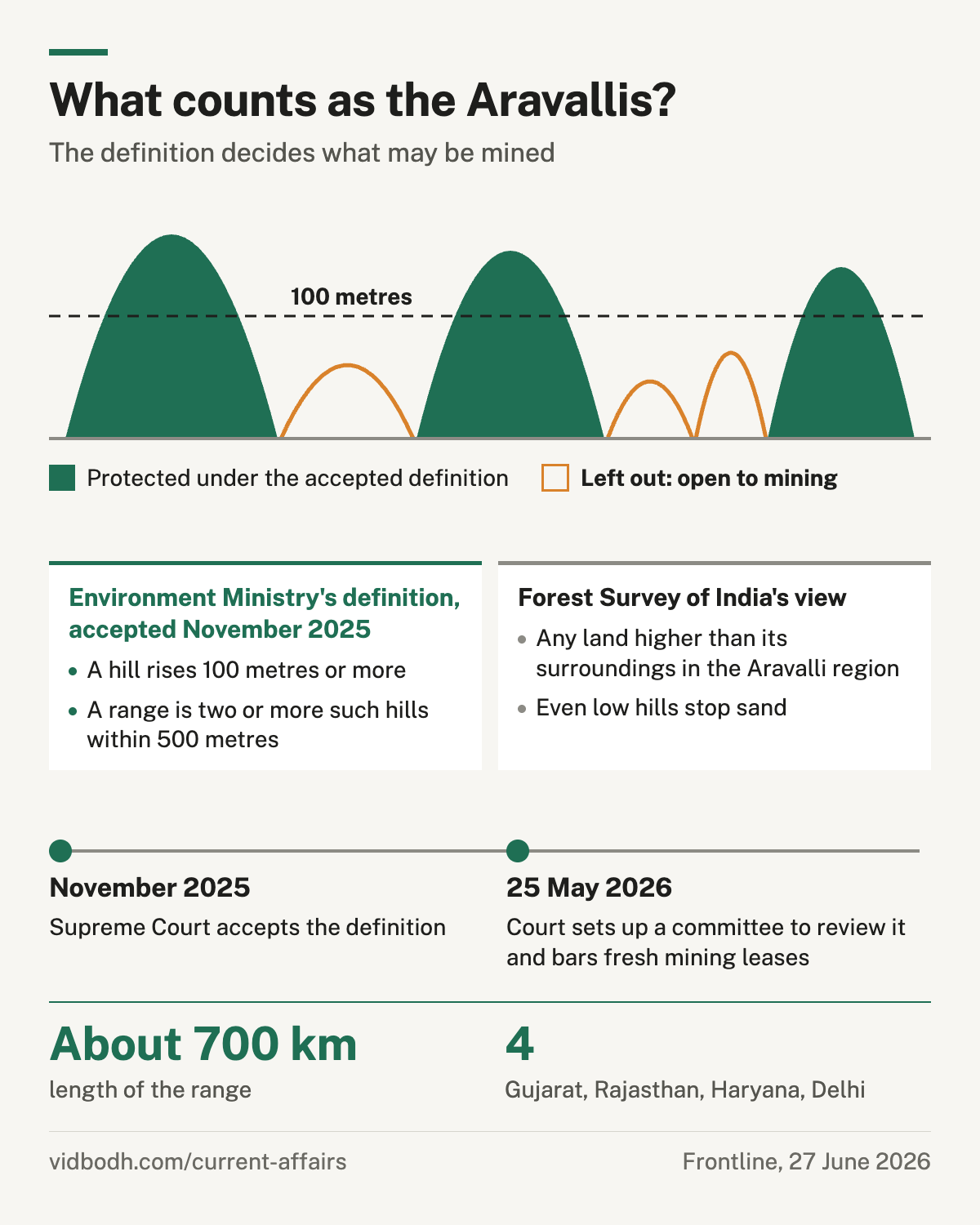
By an order of 25 May 2026 the Supreme Court set up a High Powered Committee to review the definition of the Aravalli hills that it had accepted in November 2025, and barred fresh mining leases until a management plan is ready.
Background
- The Aravallis are among the oldest fold mountains in the world. They run about 700 km across Gujarat, Rajasthan, Haryana and Delhi.
- They stand between the Thar desert and the northern plains, slowing the eastward spread of sand.
- Their fractured rock lets rain soak in, so they recharge groundwater for the region around Delhi.
- They hold building stone and minerals, which is why mining has eaten into them for decades.
The definition and why it matters
- What the law protects depends on what counts as Aravalli.
- In November 2025 the Court accepted the Environment Ministry's definition: a hill is one that rises 100 metres or more, and a range is two or more such hills within 500 metres.
- The Forest Survey of India takes a wider view: any land higher than its surroundings in the Aravalli region, since even low hills stop sand.
- A height test leaves the low hills and the gaps between them open to mining.
What the Court has now ordered
- A committee under the Director General of the Indian Council of Forestry Research and Education (ICFRE) will review the definition.
- ICFRE will prepare a management plan for sustainable mining, on the model of the plan for the Saranda forest.
- No fresh mining lease may be granted until then.
- The plan is to cover the whole range, across the States.
The larger argument
- Campaigners say a definition is not a precondition for conservation: the Western Ghats were protected through administrative units, without first defining a hill.
- They ask for the whole range to be treated as a critical ecological zone, with miners liable under the polluter pays principle.
- States point to the livelihoods and revenue that mining brings.
The way forward
- Define the Aravallis by ecological function, not by height alone.
- Map and protect the low hills and gaps, which do the work of stopping sand.
- Restore mined land, as the Aravalli Green Wall initiative aims to do.
Prelims facts
- The Aravallis run through Gujarat, Rajasthan, Haryana and Delhi.
- The accepted definition uses a height of 100 metres.
- The review committee is headed by the Director General of ICFRE.
- The Saranda forest, the model for the mining plan, is in Jharkhand.
Sources: Frontline, 27 Jun 2026: The Aravallis bleed while committees argue over definitions (opens in a new tab) · PIB, 17 Jun 2026: HMEFCC Shri Bhupender Yadav Presides over Event to Mark World Day to Combat Desertification and Drought in New Delhi (opens in a new tab)
Earlier coverage: Aravalli High Powered Committee · The monthly magazine, June 2026