Regulating medicines: cough syrups, fixed dose combinations and QR codes
LeadPrelims and MainsJune 2026
Why in news
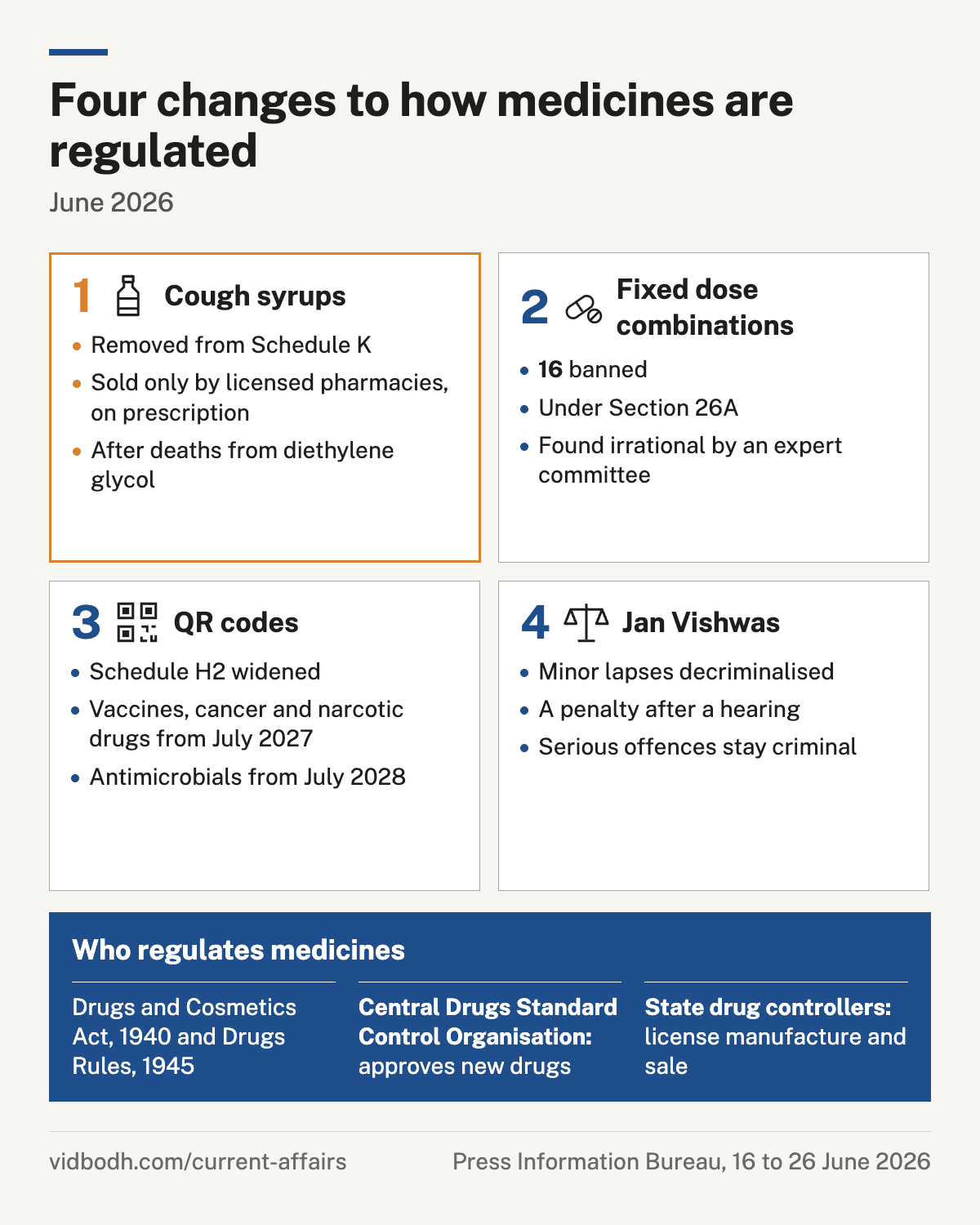
In June 2026 the Health Ministry announced four changes to how medicines are regulated: cough syrups may be sold only by licensed pharmacies, sixteen fixed dose combinations were banned, QR codes were notified for vaccines, antimicrobials and cancer drugs from 2027 and 2028, and minor offences under the health laws were decriminalised.
Background
- Medicines are regulated under the Drugs and Cosmetics Act, 1940 and the Drugs Rules, 1945.
- The Central Drugs Standard Control Organisation (CDSCO) approves new drugs; State drug controllers license manufacture and sale.
- The Drugs Technical Advisory Board (DTAB) advises the government on technical matters.
- The Rules carry Schedules that sort drugs: Schedule H drugs need a prescription; Schedule K lists exemptions.
- In October 2025 at least 20 children in Madhya Pradesh died after taking a cough syrup adulterated with diethylene glycol, an industrial solvent.
1. Cough syrups: Schedule K
- Schedule K exempts named classes of drugs from parts of the Act. One entry had let cough syrups be sold in small villages without a retail licence.
- The word "syrup" has been removed from that entry, so cough syrups may be sold only through licensed pharmacies, on a doctor's prescription; lozenges, pills and tablets stay exempt.
- Critics call it defensive: the deaths came from failures in manufacturing and in testing raw material, not from where the syrup was sold.
2. Fixed dose combinations
- A fixed dose combination (FDC) holds two or more active drugs in fixed proportions in one dose.
- It is rational only if each drug adds to the effect. An irrational FDC exposes the patient to needless drugs, and in antibiotics it breeds resistance.
- Sixteen FDCs were banned under Section 26A of the Act, after an expert committee found them irrational.
3. QR codes: Schedule H2
- Schedule H2 requires a bar code or QR code on the label, so that each pack can be traced from factory to shop.
- It first covered the top 300 brands. It now covers all vaccines, anti cancer drugs and narcotic and psychotropic drugs from July 2027, and antimicrobials from July 2028.
- The shift is from regulating by sales to regulating by risk.
4. Jan Vishwas: decriminalising minor lapses
- The Jan Vishwas (Amendment of Provisions) Act, 2026 turns minor procedural offences in many laws into administrative penalties.
- In the health laws, lapses in paperwork now draw a penalty after a hearing, while offences that endanger health stay criminal.
The way forward
- Strengthen State drug controllers, who are understaffed, since rules made at the Centre are enforced in the States.
- Test raw materials and finished batches, which is where the cough syrup deaths began.
- Make traceability work through real time State databases that work across States, and habitual scanning by pharmacists.
- Enforce bans at the pharmacy counter, where banned stocks have kept selling in the past.
Prelims facts
- A drug can be banned in the public interest under Section 26A of the Drugs and Cosmetics Act, 1940.
- Schedule H2 concerns QR codes; Schedule K concerns exemptions.
- DTAB is the Drugs Technical Advisory Board.
- Diethylene glycol and ethylene glycol are the contaminants tested for in oral liquids.
See also: Fixed dose combinations: the 2026 ban · Schedule H2: QR codes on medicines · Jan Vishwas 2026 in the health laws · Indian Pharmacopoeia Commission
Sources: PIB, 16 Jun 2026: Union Ministry of Health and Family Welfare Amends Drugs Rules, 1945; Exemption for Sale of Cough Syrups in Small Villages Withdrawn (opens in a new tab) · The Hindu, 19 Jun 2026: Lopsided solution: On syrup-based medicines, doctor's prescription (opens in a new tab) · The Hindu, 23 Jun 2026: Tighter regulatory control over cough syrups brings drug quality concerns back into focus (opens in a new tab) · PIB, 20 Jun 2026: Union Ministry of Health and Family Welfare Prohibits Manufacture, Sale and Distribution of 16 Fixed Dose Combinations (FDCs) in Public Interest (opens in a new tab) · The Hindu, 24 Jun 2026: What are FDCs and why are they being increasingly banned? | Explained (opens in a new tab) · PIB, 25 Jun 2026: Union Ministry of Health and Family Welfare Introduces Jan Vishwas Reforms in Clinical Establishments Act to Reduce Compliance Burden and Strengthen Regulatory Efficiency (opens in a new tab) · PIB, 26 Jun 2026: Government Operationalises Jan Vishwas Act Reforms in Health Sector; Rationalises Minor Offences under Drugs, Cosmetics and Food Safety Laws (opens in a new tab) · The Hindu, 29 Jun 2026: Buyer beware: On the QR code-based drug traceability framework (opens in a new tab) · PIB, 24 Jun 2026: IPC Successfully Conducts 2nd Hands-on Training on Ethylene Glycol (EG) and Diethylene Glycol (DEG) Determination in Oral Liquid Preparations by Gas Chromatography (opens in a new tab)
Earlier coverage: Cough syrups and Schedule K · The monthly magazine, June 2026