Why in news
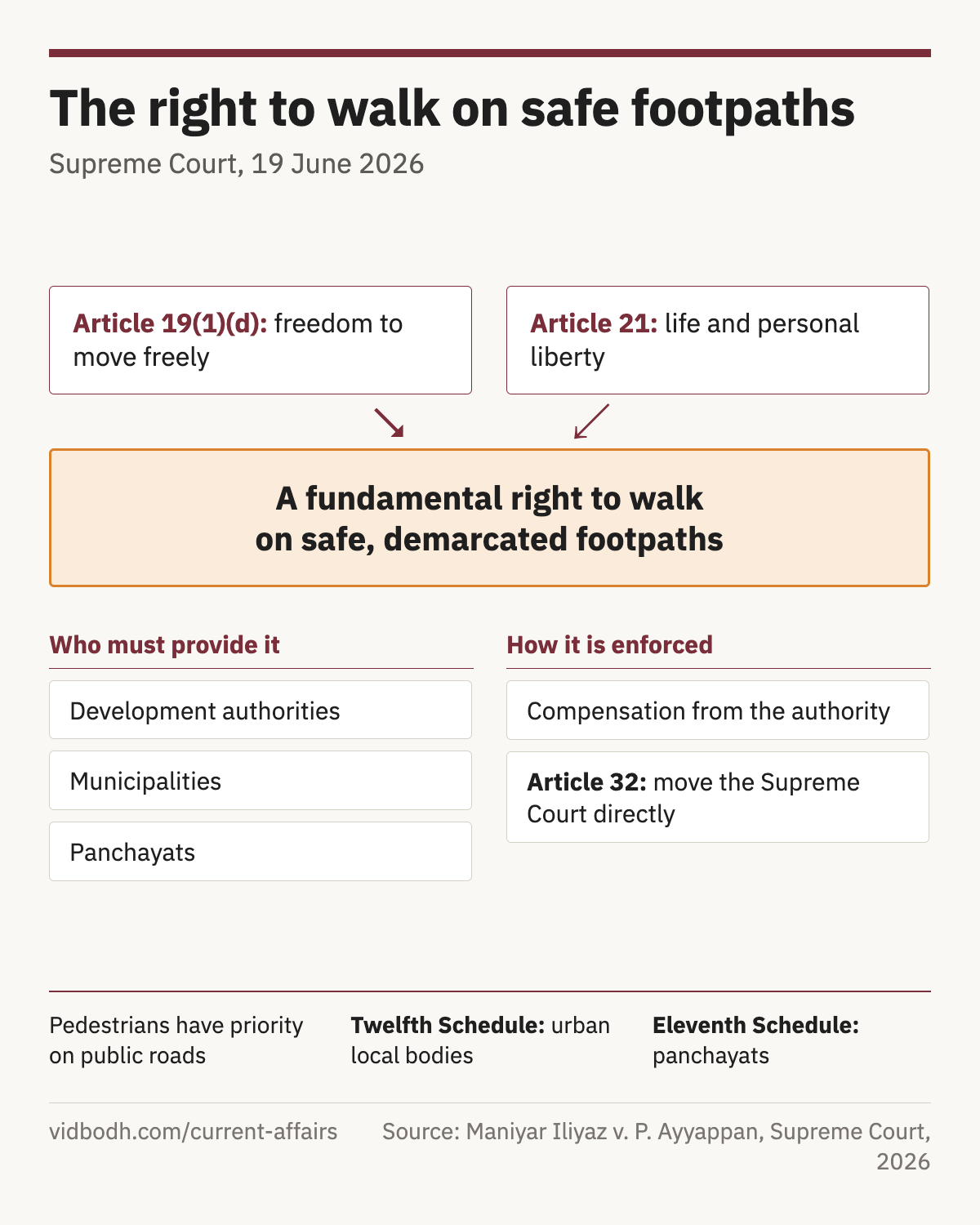
On 19 June 2026 the Supreme Court held that walking on safe, demarcated footpaths is a fundamental right under Articles 19(1)(d) and 21, and directed local bodies to build and protect them.
Background
- Article 21 protects life and personal liberty. Since 1978 the Court has read it to include what makes life worth living, and not mere survival.
- Article 19(1)(d) gives citizens the freedom to move freely throughout India.
- The case began as a claim for compensation after a road accident, and the Court used it to ask what the State owes pedestrians.
- Roads are a municipal function in the Twelfth Schedule and a panchayat function in the Eleventh Schedule.
What the Court held
- The freedom to move means little if a person cannot walk safely, so the right flows from both Articles together.
- Pedestrians have priority over motor vehicles on public roads.
- Development authorities, municipalities and panchayats must demarcate, build, maintain and protect footpaths.
- A citizen may claim compensation from the authority responsible, apart from any claim under the Motor Vehicles Act, 1988, and may approach the Court under Article 32.
- The judgment was sent to the Law Commission and three ministries, so that a law can be considered.
The growth of Article 21
- The Court has read into Article 21 the rights to livelihood, health, shelter, a clean environment, privacy and more.
- Each new right turns a matter of policy into an entitlement that a court will enforce.
The difficulty
- Money: the duty falls on local bodies, which are the weakest tier in finances.
- Separation of powers: designing road space and a regulator for it is the work of the executive and the legislature.
- Enforcement: a right declared without a budget or a law may stay on paper.
Cases to cite
- Maneka Gandhi v. Union of India (1978): the procedure that takes away liberty must be just, fair and reasonable.
- Olga Tellis v. Bombay Municipal Corporation (1985): the right to life includes the right to livelihood.
- Nilabati Behera v. State of Orissa (1993): the State must pay compensation for violating a fundamental right.
- Maniyar Iliyaz v. P. Ayyappan (2026): the right to walk on safe footpaths.
The way forward
- Write footpaths into municipal budgets and master plans, with minimum standards.
- Give local bodies the funds and powers the 74th Amendment promised.
- Remove encroachments with rehabilitation of vendors under the street vendors law.
- Legislate, so that the right rests on a statute and not on litigation alone.
Prelims facts
- The right rests on Articles 19(1)(d) and 21.
- The duty falls on development authorities, municipalities and panchayats.
- The Twelfth Schedule was added by the 74th Amendment; the Eleventh by the 73rd.
- Article 19 rights belong to citizens; Article 21 protects every person.
Sources: The Hindu, 19 Jun 2026: Supreme Court declares right to walk on footpath a fundamental right, wants law (opens in a new tab) · News On AIR, 19 Jun 2026: Supreme Court rules right to walk on demarcated footpath is a fundamental right (opens in a new tab) · Supreme Court Observer, 30 Jun 2026: Supreme Court monthly review: June 2026 (opens in a new tab)
Earlier coverage: The right to walk on safe footpaths · The monthly magazine, June 2026