The Supreme Court's strength raised by ordinance
LeadPrelims and MainsJune 2026
Why in news
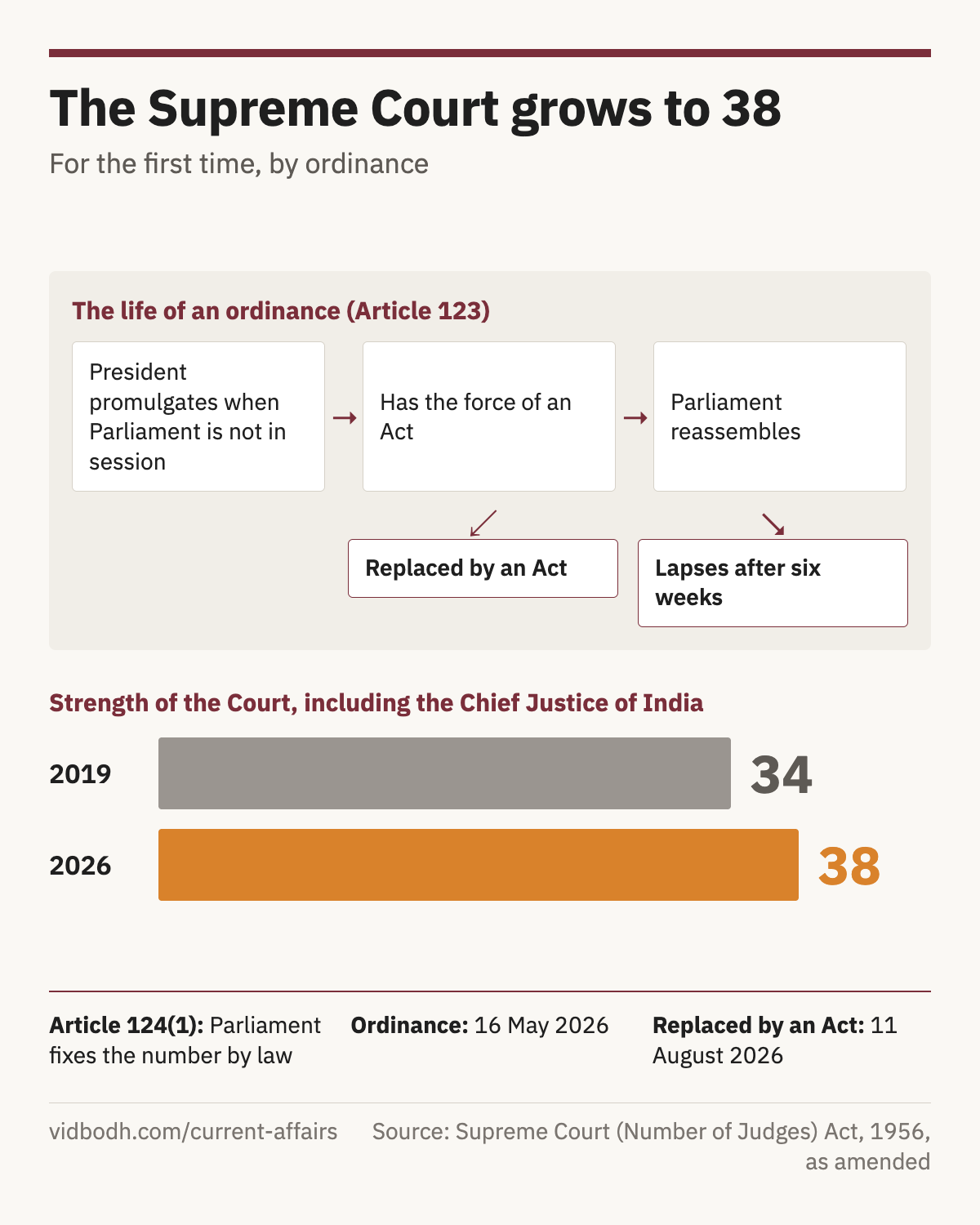
On 2 June 2026 five new judges took the oath, taking the Supreme Court to a working strength of 37. An ordinance of 16 May 2026 had raised the Court's sanctioned strength from 34 to 38, and three of the five sit in posts it created.
Background
- Article 124(1) lets Parliament fix by law the number of judges besides the Chief Justice of India.
- Parliament does this through the Supreme Court (Number of Judges) Act, 1956. The number was last raised in 2019, from 30 to 33 besides the Chief Justice.
- Every earlier increase came through an amending Act. This one came through an ordinance under Article 123.
- Judges are appointed by the President under Article 124(2), on the recommendation of the collegium.
The ordinance question
- An ordinance has the force of an Act, but it lapses six weeks after Parliament reassembles unless Parliament replaces it.
- So judges were sworn into seats that would vanish if the ordinance lapsed.
- The Cabinet had already approved a Bill, which raises the question of why an ordinance was needed.
- Critics see a risk to judicial independence: the Union is the largest litigant before the Court, and a judge's seat should not depend on the executive getting a law passed.
- Supporters answer that every appointment went through the collegium, and that Parliament was certain to approve.
Pendency as the reason
- More than 92,000 cases were pending in the Supreme Court when the ordinance was made.
- More judges allow more benches to sit at once, including Constitution Benches.
- But numbers alone do not address the Court's wide appellate docket or the way cases are listed.
Cases to cite
- D.C. Wadhwa v. State of Bihar (1987): repeated repromulgation of ordinances is a fraud on the Constitution.
- Krishna Kumar Singh v. State of Bihar (2017): ordinance making is subject to judicial review; laying before the legislature is mandatory.
- Supreme Court Advocates on Record Association v. Union of India (2015): struck down the National Judicial Appointments Commission to protect judicial primacy in appointments.
The way forward
- Fix the strength of the Court by Act and not ordinance, since no urgency prevents Parliament from legislating.
- Pair more judges with reform of the docket: fewer routine appeals, and regular Constitution Benches.
- Fill vacancies promptly, since sanctioned posts mean little when left empty.
Prelims facts
- Strength of the Supreme Court: 38, including the Chief Justice of India.
- It is fixed by Parliament by law under Article 124(1); no constitutional amendment is needed.
- An ordinance lapses six weeks after Parliament reassembles.
- The collegium system comes from the Second and Third Judges cases.
Sources: The Hindu, 2 Jun 2026: Five new judges join Supreme Court following increase in sanctioned strength (opens in a new tab) · SCC Online, 18 May 2026: Supreme Court judges increase: the Ordinance, 2026 explained (opens in a new tab) · Supreme Court Observer, 30 Jun 2026: 2026 summer session review (opens in a new tab) · News On AIR, 2 Jun 2026: Five newly appointed Supreme Court judges to take oath today (opens in a new tab)
Earlier coverage: Strength of the Supreme Court · The monthly magazine, June 2026