Clearance after the fact: the Supreme Court on ex post facto environmental clearance
LeadPrelims and MainsJuly 2026
Why in news
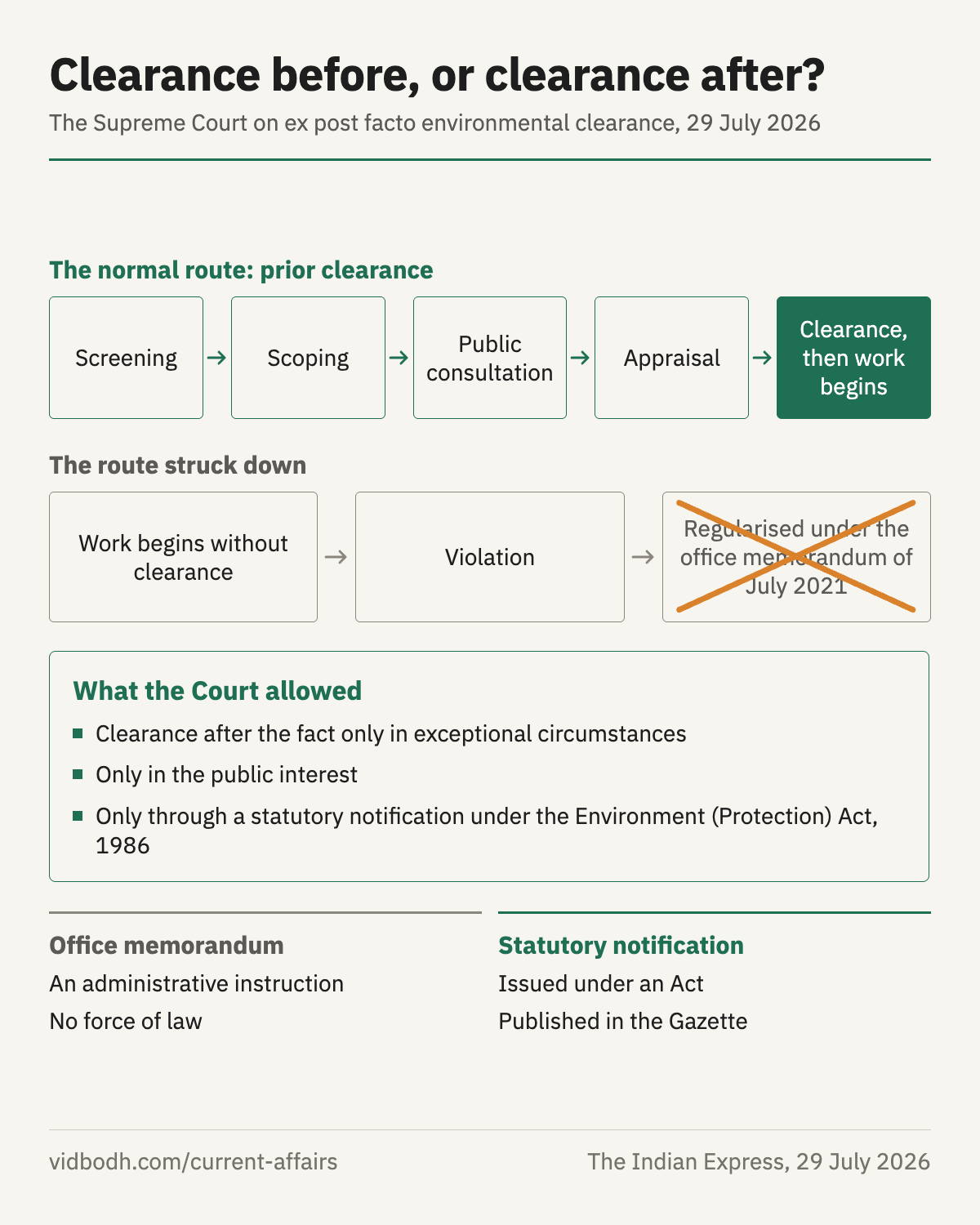
The Supreme Court on 29 July 2026 struck down the Environment Ministry's office memorandum of July 2021, which had set a standard procedure for clearing projects that began work without environmental clearance.
Background
- Environmental clearance is the approval that listed categories of projects must obtain before work begins, under the Environment Impact Assessment (EIA) Notification, 2006, issued under the Environment (Protection) Act, 1986.
- The process has four steps: screening, scoping, public consultation and appraisal.
- The whole design rests on prior approval: the impact is studied before the damage is done.
- An ex post facto clearance is permission granted after a project has been built or begun, which regularises a violation.
What the Court held
- An office memorandum is an administrative instruction with no force of law, so it cannot create a procedure of this kind.
- Clearance after the fact may still be allowed in exceptional circumstances and in the public interest.
- It can be done only through a statutory notification under the Environment (Protection) Act, 1986.
- So the Court closed the open ended route and left a narrow one.
Why the instrument matters
- A statutory notification is issued under a power given by an Act and is published in the Gazette.
- An office memorandum is issued within a ministry and is not published in the Gazette.
- Much of environmental regulation is changed through memoranda and circulars, which is why the ruling reaches beyond this one case.
The argument on both sides
- For allowing it: closing or demolishing a working plant costs jobs and investment, and may cause its own pollution.
- Against: if clearance can be bought later, prior appraisal means little and violation becomes a business decision.
- It also defeats the precautionary principle and replaces public consultation with a penalty.
The way forward
- Frame any future notification narrowly, with a public interest test stated in it.
- Make the penalty exceed the gain from starting without clearance.
- Strengthen monitoring after clearance, so that violations are caught early and not regularised late.
Prelims facts
- Environmental clearance comes under the EIA Notification, 2006, issued under the Environment (Protection) Act, 1986.
- The memorandum struck down was of July 2021.
- After the ruling, only a statutory notification can provide for clearance after the fact.