Citizenship and due process: the Foreigners Tribunals ruling
LeadMainsJuly 2026
Why in news
On 13 July 2026 the Supreme Court, in Sabitri Dey v. Union of India, allowed 27 appeals. It set aside High Court judgments that had upheld declarations made by Foreigners Tribunals in the persons' absence, and sent the cases back for a fresh hearing. It held that citizenship cannot be decided mechanically.
Background
- Foreigners Tribunals are quasi judicial bodies, mostly in Assam, that decide whether a person referred to them is a foreigner.
- They were set up under the Foreigners (Tribunals) Order, 1964.
- The law places the burden of proving citizenship on the person, not on the State.
- A declaration can lead to detention, deportation or statelessness.
- Articles 14 and 21 protect every person, citizen or not, against arbitrary action by the State.
What the Court held
- The burden of proof does not allow a declaration merely because a person is absent.
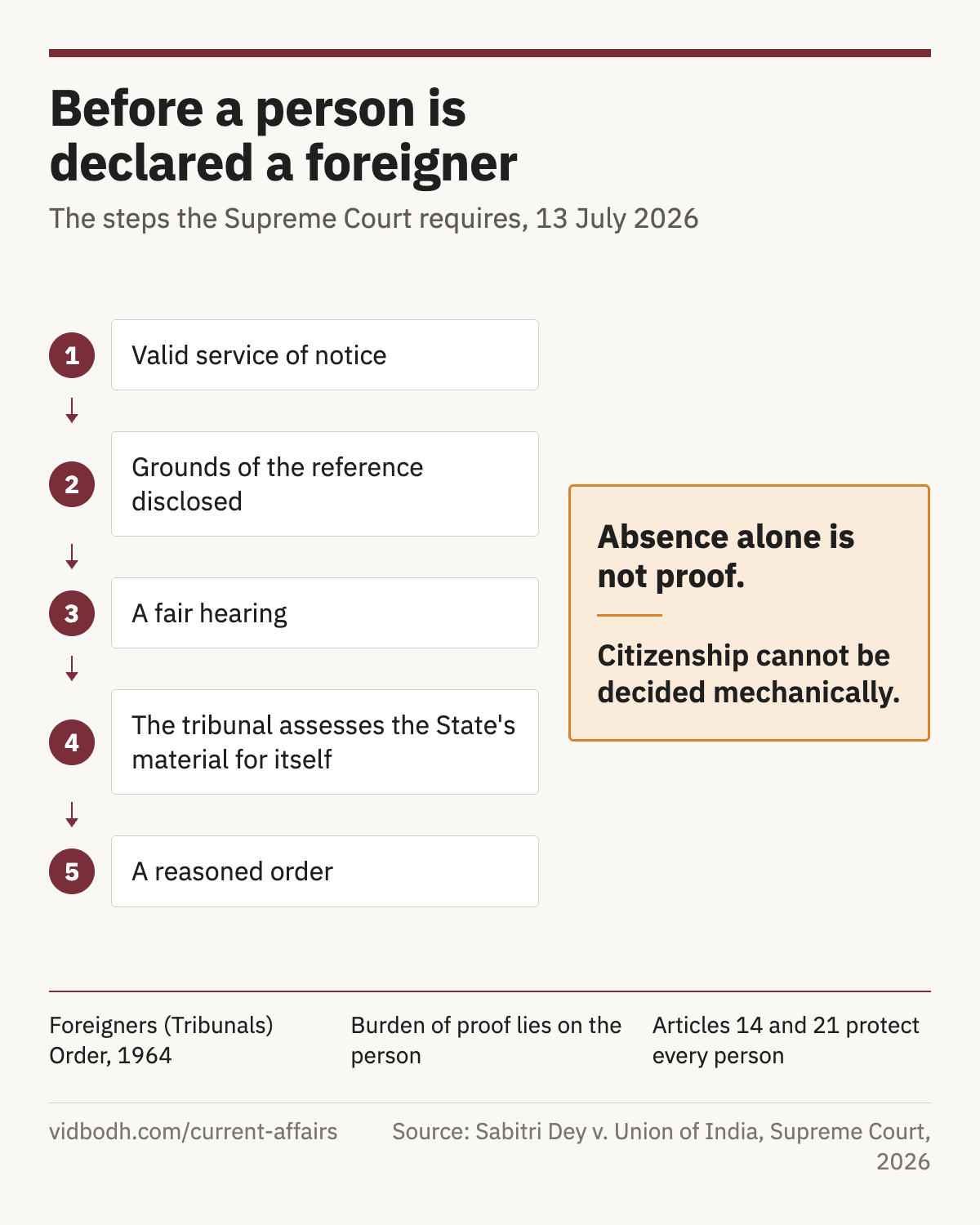
- A tribunal must ensure valid service of notice.
- It must disclose the grounds on which the person was referred.
- It must assess the State's material for itself, give a fair hearing and record reasons.
Why it matters
- The stakes: no order of a court takes more from a person than one that says he does not belong to the country.
- Ex parte orders: many declarations are made in the absence of the person, often a poor or unlettered one who never received the notice.
- A reverse burden needs stronger safeguards, not weaker ones.
- The larger setting: Assam's citizenship question rests on the Assam Accord and Section 6A of the Citizenship Act, which covers those who entered before 25 March 1971.
Cases to cite
- Sarbananda Sonowal v. Union of India (2005): struck down the Illegal Migrants (Determination by Tribunals) Act, 1983.
- In re Section 6A of the Citizenship Act (2024): upheld Section 6A by four to one.
- Sabitri Dey v. Union of India (2026): fair procedure in citizenship determination.
The way forward
- Appoint judicially trained members with secure tenure to the tribunals.
- Provide legal aid to every person referred.
- Review ex parte declarations already made.
- Keep detention as a last resort, with periodic review.
Prelims facts
- Foreigners Tribunals were created by an executive Order of 1964.
- The burden of proof lies on the person alleged to be a foreigner.
- Section 6A of the Citizenship Act applies to those who entered Assam before 25 March 1971.
- Articles 14 and 21 apply to all persons.
Sources: The Hindu, 14 Jul 2026: Fair, reasoned process must decide citizenship: Supreme Court (opens in a new tab) · LiveLaw, 13 Jul 2026: Sabitri Dey v. Union of India, 2026 LiveLaw (SC) 672: judgment (opens in a new tab)
Earlier coverage: Foreigners Tribunals and due process · The monthly magazine, July 2026