Why in news
The Central Drugs Standard Control Organisation granted marketing authorisation to Qdenga in July 2026, the first dengue vaccine approved in India, for people aged 4 to 60.
Background
- Dengue is a viral disease spread by the Aedes aegypti mosquito, which bites by day and breeds in clean standing water.
- The virus has four serotypes, DENV-1 to DENV-4. Infection with one gives lasting protection against that one, and only brief protection against the others.
- A second infection by a different serotype is often more severe than the first.
- India carries close to a third of the world's dengue burden.
Why dengue vaccines are hard to make
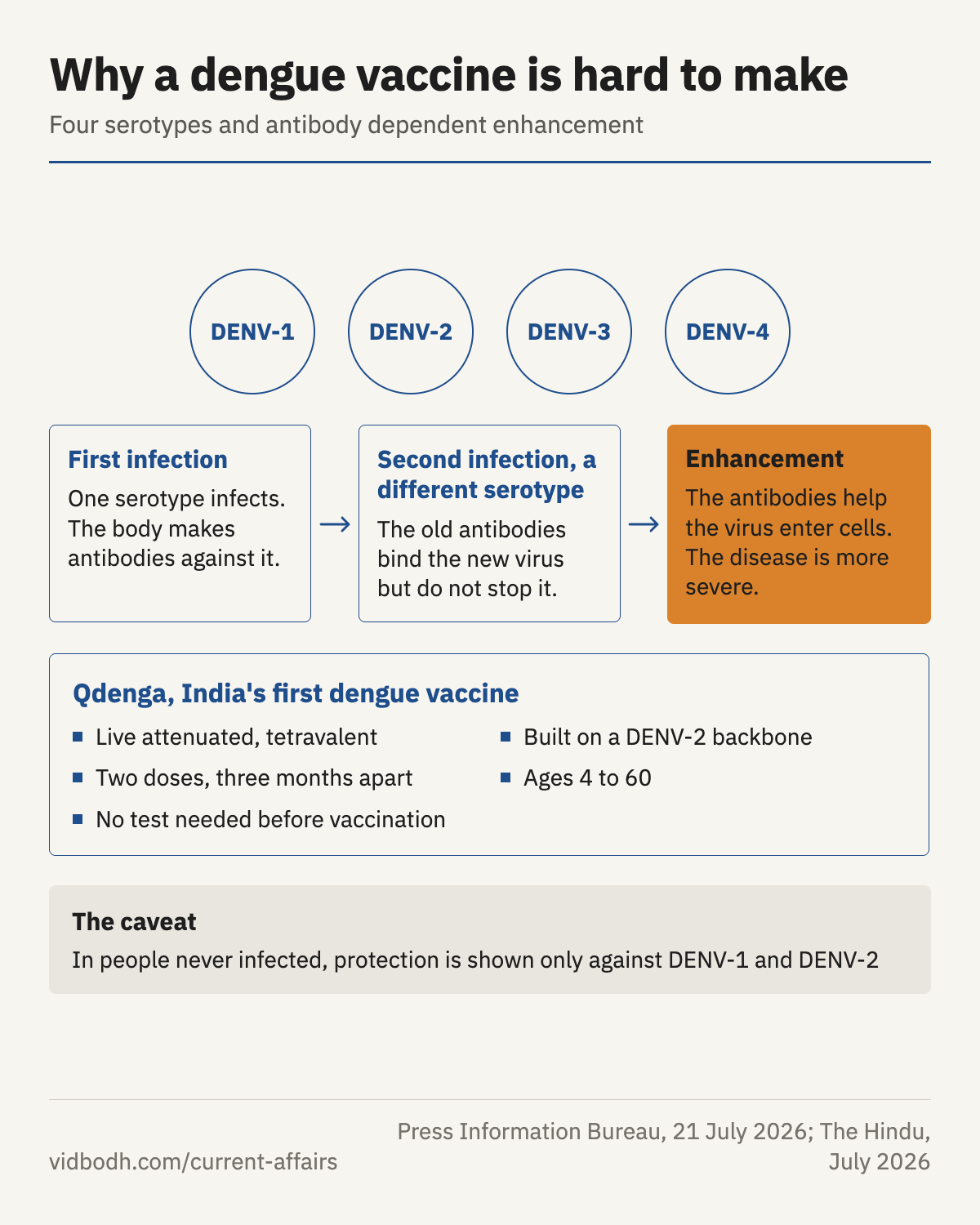
- Antibodies from a first infection can help a different serotype enter cells in a second infection. This is antibody dependent enhancement.
- So a vaccine must protect against all four serotypes equally. Partial protection can leave a person worse off than no vaccine.
- An earlier vaccine could be given safely only to people who had already had dengue, which meant testing before vaccination.
The vaccine
- Qdenga is a live attenuated tetravalent vaccine, built on a dengue type 2 backbone.
- It is given as two doses, three months apart, and needs no test for earlier infection.
- In trials it was about 80 per cent effective against confirmed dengue and about 90 per cent against hospitalisation.
- The caveat: in people who have never had dengue, protection is shown only against DENV-1 and DENV-2, which raises a concern about later disease from DENV-3.
- It is not part of the Universal Immunisation Programme.
All four serotypes, together
- A national study found all four serotypes circulating together in eight States and Union Territories, a state called hyperendemicity.
- DENV-2 was the most common.
- About 7 per cent of patients carried two or more serotypes at once, and were more likely to develop severe dengue.
- Which serotype circulates decides how well the vaccine works, so surveillance has to continue alongside it.
The way forward
- Keep serotype surveillance running, and watch vaccinated children for later severe disease.
- Decide on a public programme only with Indian data on safety in those never infected.
- Continue mosquito control, since no vaccine removes the need for it.
- Support the indigenous vaccine candidates now in trials.
Prelims facts
- Dengue has four serotypes; the vector is Aedes aegypti.
- Qdenga: live attenuated, tetravalent, two doses, ages 4 to 60, no test before vaccination.
- It is built on a DENV-2 backbone.
- Approval in India comes from the Central Drugs Standard Control Organisation.
See also: Dengue serotypes in India
Sources: PIB, 21 Jul 2026: Dengue Vaccine Approved in 42 Countries with WHO Prequalification and Strong Global Safety Record (opens in a new tab) · The Hindu, 21 Jul 2026: India's first dengue vaccine arrives with a crucial safety caveat (opens in a new tab) · The Indian Express, 20 Jul 2026: India approves its first dengue vaccine, Qdenga, for ages four to sixty (opens in a new tab) · The Hindu, 29 Jul 2026: Study finds multiple dengue virus strains circulating together in India (opens in a new tab)
Earlier coverage: Dengue vaccines: Qdenga, DengiAll and antibody dependent enhancement · The monthly magazine, July 2026