Urea: a new investment policy and an old subsidy problem
LeadPrelims and MainsJuly 2026
Why in news
On 15 July 2026 the Cabinet approved the National Investment Policy for Urea, 2026, to draw investment into new gas based urea plants. In June the fertiliser subsidy for the year had been projected at double the Budget's figure, as import prices rose.
Background
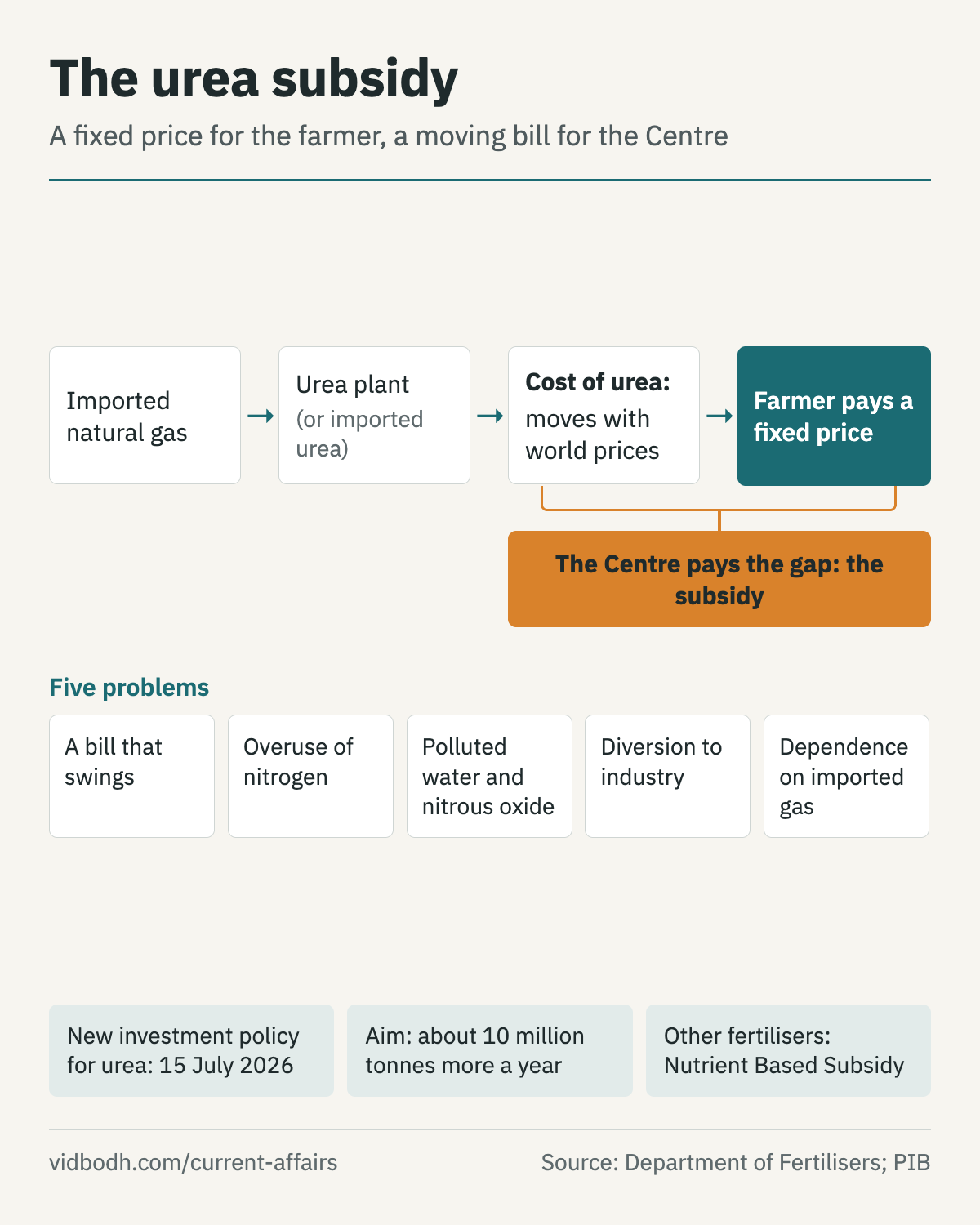
- Urea is sold to farmers at a price fixed by the government, far below its cost. The Centre pays the difference to the maker or importer.
- Other fertilisers, those with phosphorus and potash, come under the Nutrient Based Subsidy, where the subsidy is fixed and the price is free to move.
- India makes about three quarters of the urea it uses and imports the rest. Most plants run on natural gas, and much of that gas is imported too.
- So the price of gas and of urea abroad passes straight into the subsidy bill.
What the new policy does
- It assures investors a return on equity within a band.
- It aims at eight or nine new plants, adding about 10 million tonnes a year, enough to close the import gap.
- It follows the policy of 2012, which brought six new plants.
Why the subsidy is a problem
- Fiscal: the bill swings with world prices and is hard to budget.
- Soil: cheap urea is overused. Nitrogen, phosphorus and potash should be applied at about 4:2:1; in practice nitrogen far exceeds that.
- Environment: excess nitrogen pollutes groundwater and gives off nitrous oxide, a greenhouse gas.
- Leakage: subsidised urea is diverted to industry and across borders.
- Dependence: making urea at home still needs imported gas, so self reliance in urea is not self reliance in energy.
The way forward
- Bring urea under the Nutrient Based Subsidy, so that prices signal balanced use.
- Move in time to a direct transfer to the farmer, for each acre or each unit of nutrient.
- Promote nano urea, coated urea and organic sources.
- Use soil health cards to guide the dose.
Prelims facts
- Urea supplies nitrogen; it is 46 per cent nitrogen.
- Urea is under statutory price control; phosphatic and potassic fertilisers are under the Nutrient Based Subsidy, in force since 2010.
- All urea made or imported for farming is neem coated.
- India imports about a quarter of its urea.
- The Department of Fertilisers is under the Ministry of Chemicals and Fertilisers.
See also: Fertiliser registration and nutrient use efficiency
Sources: Press Information Bureau, 15 Jul 2026: Cabinet approves the National Investment Policy for Urea 2026 (opens in a new tab) · The Hindu, 15 Jul 2026: Cabinet approves ₹1.27 lakh crore for Semicon Mission 2.0, for mobile manufacturing, new highways (opens in a new tab) · The Indian Express, 10 Jun 2026
Earlier coverage: Urea policy and the fertiliser subsidy · The monthly magazine, July 2026