Why in news
Vikram-1, built by Skyroot Aerospace of Hyderabad, lifted off from Sriharikota on 18 July 2026 and placed its payloads in low Earth orbit. It is the first privately built Indian rocket to reach orbit.
Background
- Until 2020 only the Indian Space Research Organisation (ISRO) built and launched rockets in India.
- The space reforms of 2020 opened the sector to private firms and set up IN-SPACe to authorise and support them.
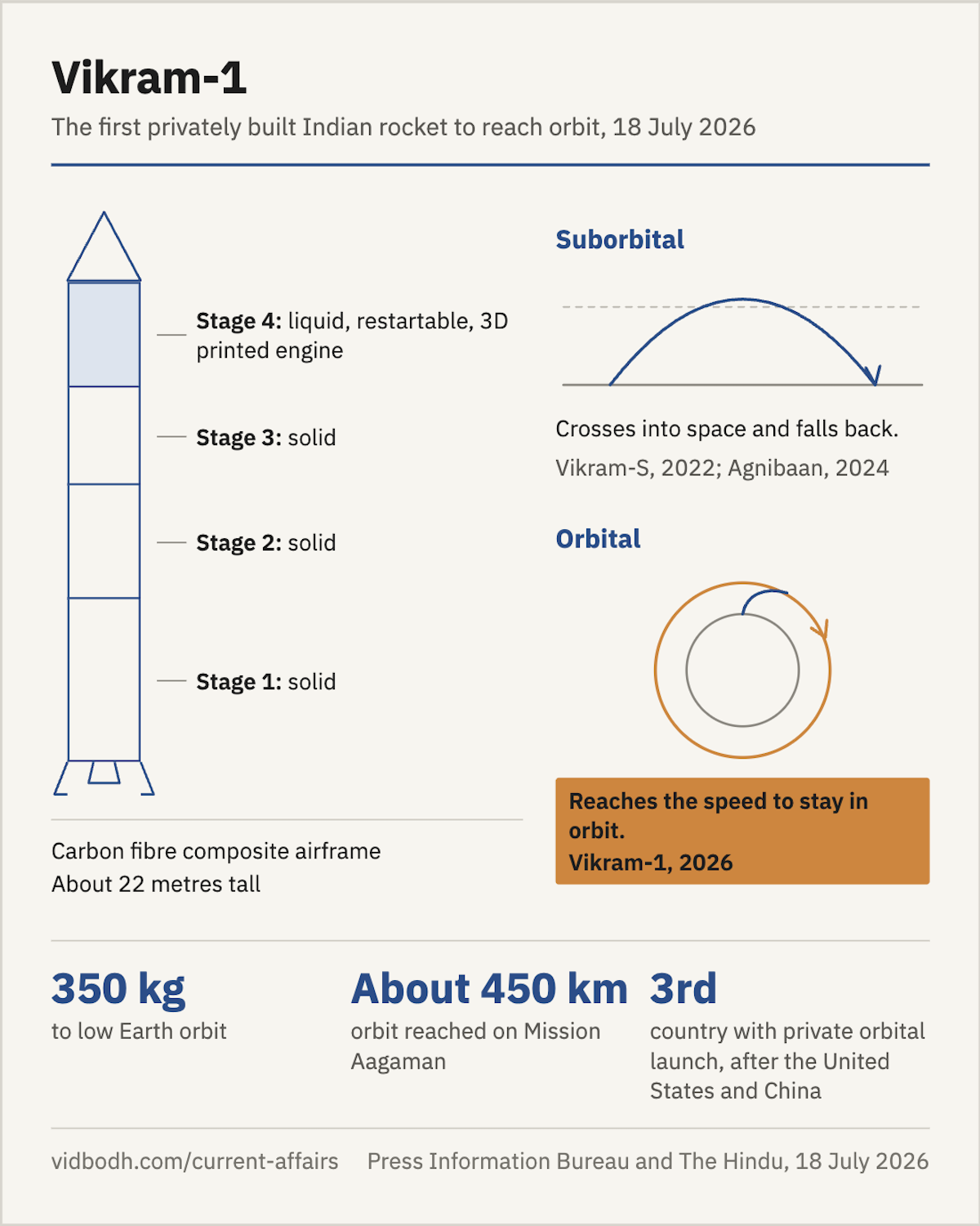
- A suborbital flight crosses into space and falls back. An orbital flight reaches the speed needed to stay in orbit, which is far harder.
- Earlier private flights, Skyroot's Vikram-S in 2022 and Agnikul's Agnibaan in 2024, were suborbital.
The rocket
- Vikram-1 is a four stage vehicle about 22 metres tall: three solid stages and a restartable liquid upper stage.
- It can place about 350 kg in low Earth orbit, which makes it a small satellite launch vehicle.
- Its airframe is carbon fibre composite, lighter than steel for the same strength.
- Its liquid engine is 3D printed as a single piece, which removes the joints and seals where engines leak.
The flight
- The mission, named Aagaman, placed six technology demonstration payloads in an orbit of about 450 km.
- India is the third country, after the United States and China, whose private industry has reached orbit.
- It was a developmental flight; two more are planned before commercial service.
Why it matters
- The reforms had so far produced private satellites and applications; this adds launch capability.
- Small satellites are the fastest growing part of the launch market, and a small rocket can launch them on demand.
- It widens India's launch capacity beyond ISRO's own vehicles, at a time when India flies few launches a year.
What remains
- A rocket becomes a business only with repeated, reliable flights.
- India has no space activities law yet, so liability for damage by a private launch rests on policy and not statute.
- Private firms still depend on ISRO's launch pads and test facilities.
The way forward
- Pass a space activities law that settles licensing, liability and insurance.
- Give private firms assured demand, through government launch contracts.
- Complete the handover of the Kulasekarapattinam small satellite launch complex to a private operator, and open test facilities on the same terms.
Prelims facts
- Vikram-1: Skyroot Aerospace, Hyderabad; four stages, three of them solid.
- Mission Aagaman; launched from the first launch pad at Sriharikota.
- Vikram-S (2022) and Agnibaan (2024) were suborbital.
- India is the third country with private orbital launch, after the United States and China.
See also: IN-SPACe · Indian Space Policy 2023
Sources: PIB, 18 Jul 2026: Vikram-1 Mission Strengthens India's Position in the Global Commercial Market: Dr. Jitendra Singh (opens in a new tab) · PIB, 23 Jul 2026: ISRO missions (opens in a new tab) · The Hindu, 18 Jul 2026: The materials and methods that made the Vikram-1 launch unique (opens in a new tab) · The Indian Express, 18 Jul 2026: Vikram-1 becomes India's first privately built rocket to reach orbit (opens in a new tab)
Earlier coverage: Vikram-1 · The monthly magazine, July 2026