Why in news
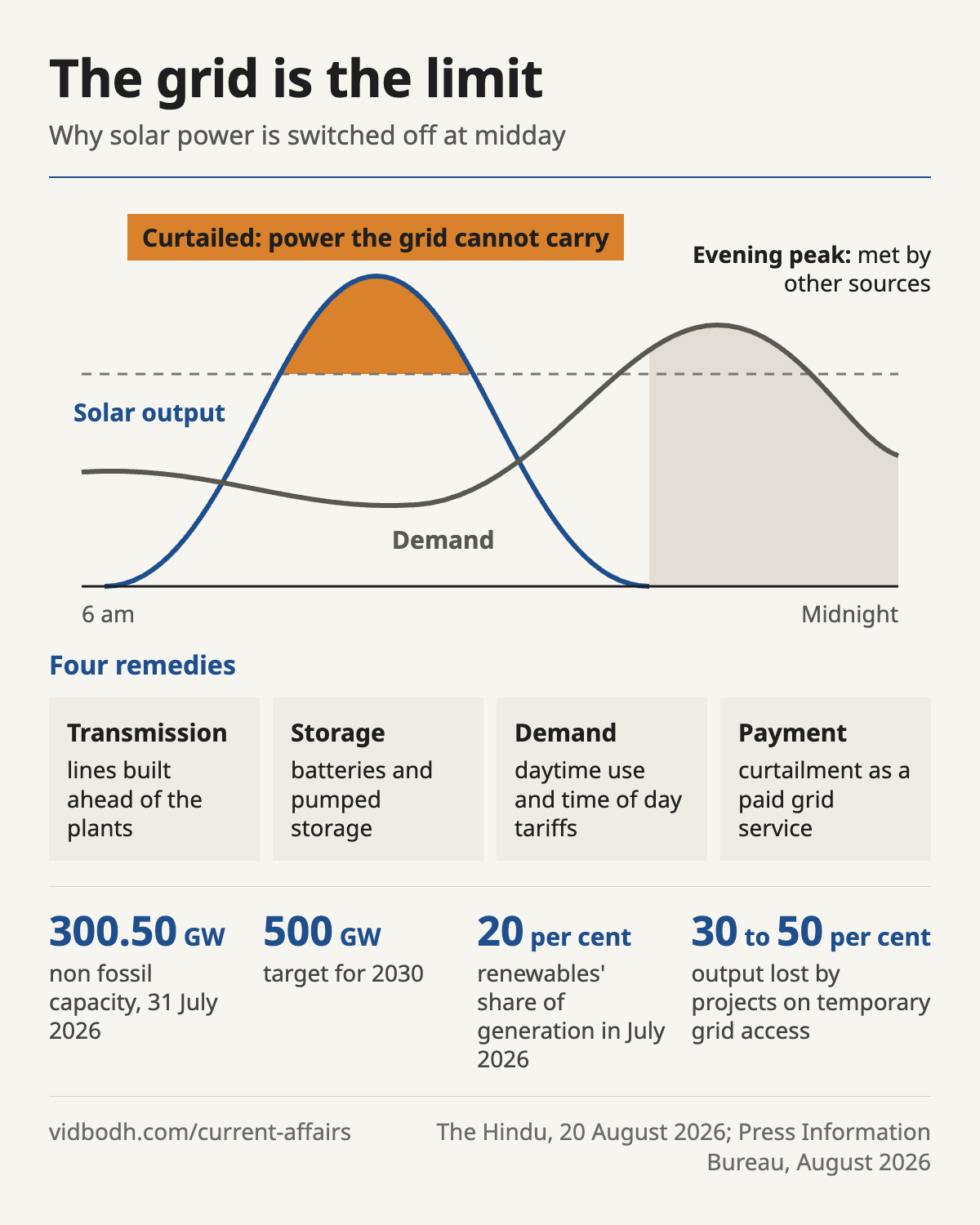
India's non fossil capacity crossed 300 GW on 31 July 2026, and renewables supplied a record 20 per cent of generation in July. In the same weeks solar plants were being told to switch off output, because the grid could not carry it.
- 300.50 GWnon fossil capacity, over 54 per cent of installed capacity
- 500 GWthe target for non fossil capacity by 2030
- 20 per centrenewables' share of generation in July 2026, a record
- 30 to 50 per centoutput lost by projects on temporary grid access
Background
- Installed capacity is what plants could produce at full output, measured in gigawatts; generation is the electricity they actually deliver.
- Solar and wind run only when the weather allows, so their share of generation is far below their share of capacity.
- Solar output peaks at midday, while Indian demand peaks after sunset.
- India reached 50 per cent non fossil capacity five years ahead of its 2030 target.
What curtailment is
- Curtailment is the deliberate cutting of a plant's output below what it could generate, because the grid cannot absorb or carry the power.
- The generator is usually not compensated for the power it was ready to supply.
- Projects connected on temporary network access lose the most, 30 to 50 per cent of their output.
- New auctions have slowed, and 40 to 45 GW of awarded capacity has no signed power purchase agreement.
Why a solar heavy grid is harder to run
- A coal or hydro turbine is a heavy spinning mass, and that inertia steadies the grid's frequency by itself.
- Solar and wind are inverter based resources: they reach the grid through power electronics and give no such inertia.
- The result is lower grid strength, with voltage and frequency less stable.
- The answers are grid forming inverters and synchronous condensers.
The remedies
- Transmission: lines built ahead of the plants, as under the Green Energy Corridor.
- Storage: batteries and pumped storage carry midday power into the evening.
- Demand: time of day tariffs, daytime charging of electric vehicles and industrial use moved into solar hours.
- Payment: treating curtailment as a grid service that is compensated.
The way forward
- Plan transmission and generation together, so that no plant is finished before its line.
- Require storage with new solar, as the floating solar scheme already does.
- Use the existing grid better, since new lines alone cannot keep pace with new capacity.
Prelims facts
- Non fossil capacity includes solar, wind, hydro, bio power and nuclear.
- India's target is 500 GW of non fossil capacity by 2030.
- Solar is the largest part of non fossil capacity.
- Inertia comes from rotating turbines, not from solar panels.
See also: India's renewable capacity · Inverter based resources · Green Energy Corridor · Pumped storage
Sources: The Hindu, 20 Aug 2026: Transmission bottlenecks force curtailment of renewable power (opens in a new tab) · PIB, 9 Aug 2026: Non-fossil capacity crosses 300 GW; floating solar scheme approved (opens in a new tab) · PIB, 13 Aug 2026: Non-fossil capacity crosses 300 GW; floating solar scheme approved (opens in a new tab) · The Indian Express, 25 Aug 2026: How to make a solar-heavy grid stable and affordable (opens in a new tab)
Earlier coverage: Curtailment · The monthly magazine, August 2026