Why in news
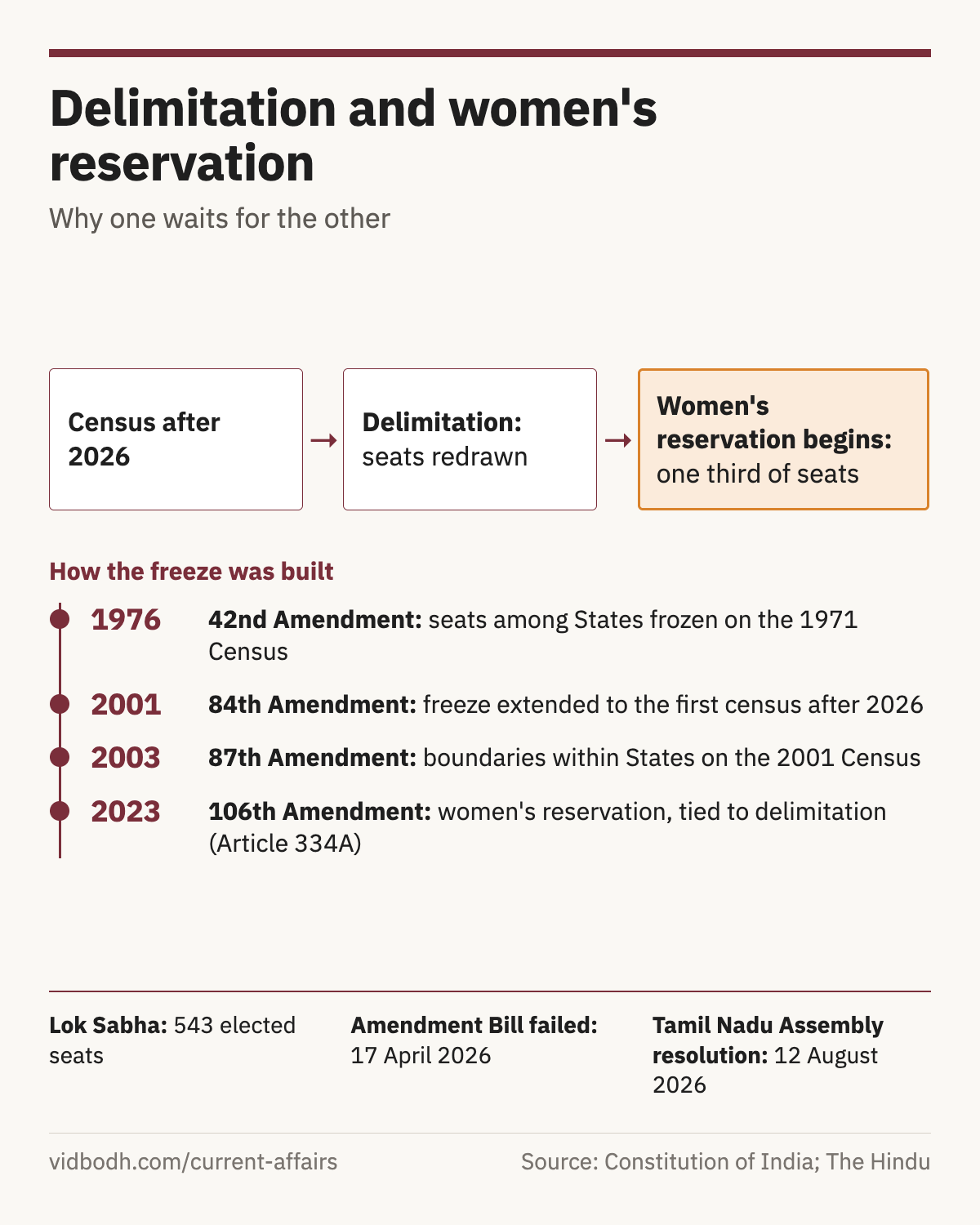
In August 2026 the Union government sought support to bring back a constitutional amendment on delimitation, which had failed in the Lok Sabha on 17 April 2026. On 12 August the Tamil Nadu Assembly resolved that the Lok Sabha should stay at 543 seats.
Background
- Delimitation is the drawing of constituency boundaries and the allotment of seats, so that each vote carries about the same weight.
- Article 82 requires a readjustment after every census. Article 81 asks that the ratio of seats to population be, as far as possible, the same for all States.
- To avoid punishing States that controlled their population, the 42nd Amendment (1976) froze the allocation of seats among States on the 1971 Census.
- The 84th Amendment (2001) extended the freeze until the first census taken after 2026.
- The 106th Amendment (2023) reserves one third of seats in the Lok Sabha and the Assemblies for women, but Article 334A starts it only after a delimitation based on the next census.
Why the two questions are tied
- Women's reservation cannot begin until seats are redrawn.
- Seats cannot be redrawn among States until a census after 2026 is published.
- So the date from which women get reserved seats depends on the census and on what Parliament decides about the freeze.
- The failed Bill would have used the 2011 Census to cut this wait.
The federal problem
- Seats by present population would shift representation to the northern States, where population grew faster.
- The southern States say they would lose voice for having met the national goal of population control.
- The other side: a vote in a large northern constituency already counts for far less than a vote in a small southern one, which strains the principle of one person, one vote, one value.
Proposals on the table
- Tamil Nadu's resolution: keep 543 seats, keep the present shares, and start women's reservation in 2029 on the existing seats.
- A larger House with protected shares: raise every State's seats by the same proportion, so that no State's share falls.
- A further freeze of 25 years on the 1971 basis.
- A State Assembly's resolution is a request; only Parliament can amend Articles 81 and 82, by special majority.
Cases to cite
- Meghraj Kothari v. Delimitation Commission (1967): orders of the Delimitation Commission, once published, cannot be questioned in court (Article 329(a)).
- Kishorchandra Chhanganlal Rathod v. Union of India (2024): a court may still examine a delimitation order that is manifestly arbitrary.
- R.C. Poudyal v. Union of India (1993): exact equality of population between constituencies is not required; reasonable departures are allowed.
The way forward
- Separate the two questions: start women's reservation on the existing seats, and settle seat allocation with time.
- If the House is enlarged, protect each State's present share.
- Give States a stronger voice in the Rajya Sabha and in fiscal bodies, to balance a population based Lok Sabha.
- Build agreement through an all party process, since the amendment needs two thirds in each House.
Prelims facts
- Seats among States are frozen on the 1971 Census; boundaries within States were redrawn on the 2001 Census (87th Amendment).
- Delimitation Commissions have been set up four times: 1952, 1963, 1973 and 2002.
- Articles 330A and 332A: women's reservation in the Lok Sabha and the Assemblies. Article 334A: when it begins.
- Women's reservation lasts 15 years from its start, and Parliament may extend it.
- The Lok Sabha has 543 elected seats.
See also: Census 2027
Sources: The Hindu, 6 Aug 2026: DMK lays down conditions to support delimitation Bill (opens in a new tab) · The Hindu, 12 Aug 2026: Tamil Nadu Assembly adopts resolution to freeze Lok Sabha seats at 543 (opens in a new tab) · The Indian Express, 7 Aug 2026
Earlier coverage: Delimitation and women's reservation · The monthly magazine, August 2026