The elephant in India: numbers, corridors and conflict
LeadPrelims and MainsAugust 2026
Why in news
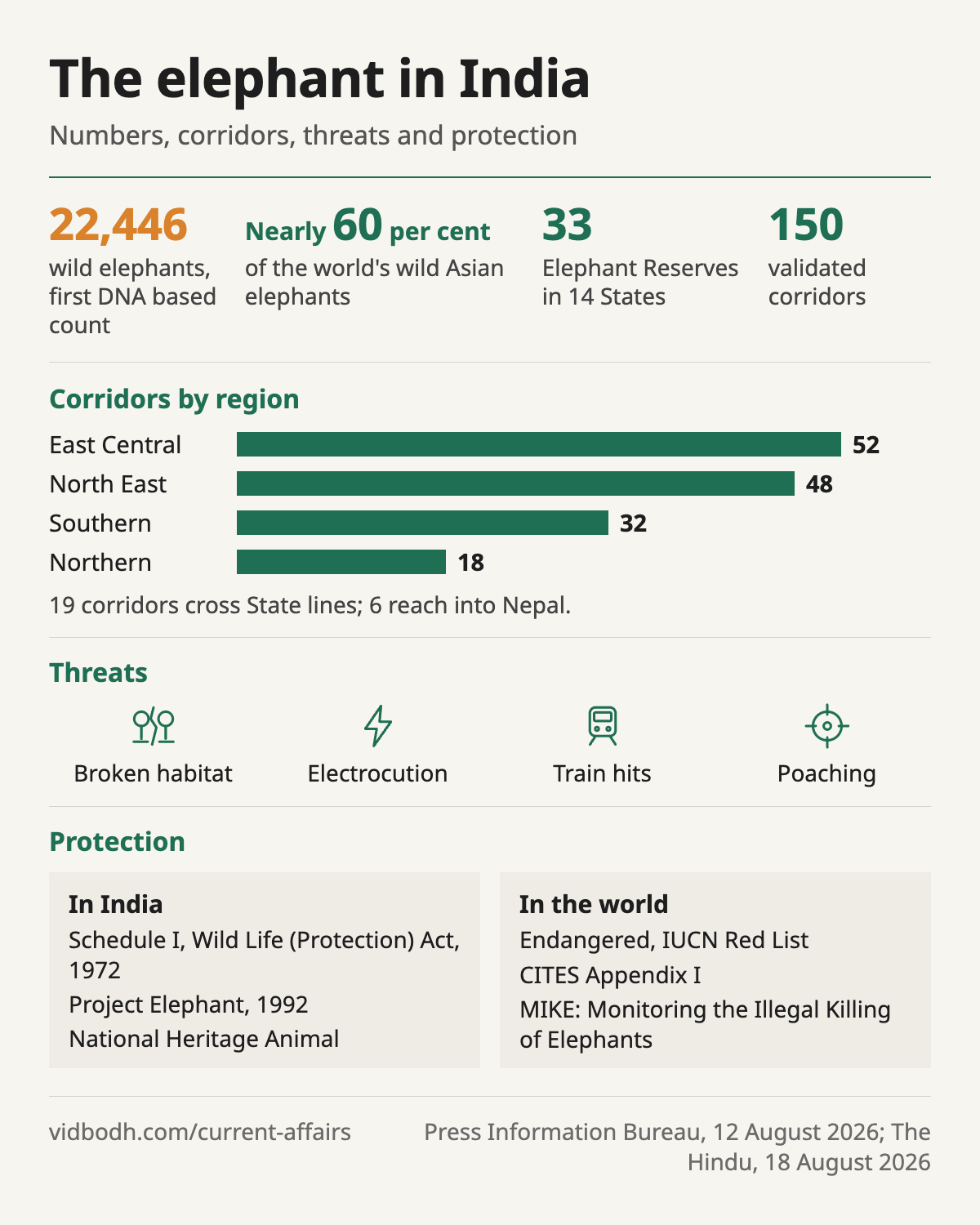
The Supreme Court on 17 August 2026 ordered a fresh national survey of elephant corridors and held that no State may block a traditional elephant route. Five days earlier, on World Elephant Day, the government set out the result of India's first DNA based count: 22,446 wild elephants.
- 22,446wild elephants in India, by the first DNA based count
- nearly 60 per centof the world's wild Asian elephants that live in India
- 33Elephant Reserves, in 14 States
- 150validated elephant corridors
Background
- The Asian elephant (Elephas maximus) is Endangered on the IUCN Red List, in Schedule I of the Wild Life (Protection) Act, 1972 and in Appendix I of CITES.
- It is India's National Heritage Animal, declared in 2010.
- Elephants live in herds led by the oldest female, the matriarch, and move over large ranges through the year in search of food and water.
- The elephant is a keystone species: it disperses seeds and opens paths and clearings that other animals use.
- Africa has two species, the savanna elephant and the forest elephant, both more threatened than they were a decade ago.
How India counts and protects elephants
- Project Elephant, launched in 1992, is the centrally sponsored programme for elephants, their habitat and corridors, conflict and captive elephants.
- Since 2023 it has been run together with Project Tiger by a single Project Tiger and Elephant Division of the Environment Ministry.
- An Elephant Reserve is an administrative unit under Project Elephant and is not a category under the Wild Life (Protection) Act, so it carries no legal protection of its own.
- The new count, the Synchronous All India Population Estimation of Elephants, identified individual elephants from the DNA in dung samples, replacing counts by sighting.
Corridors
- An elephant corridor is a strip of habitat that connects two larger elephant habitats.
- The 2023 assessment validated 150 corridors, most of them in the East Central region, and West Bengal has the largest number among States.
- Nineteen cross State lines and six reach into Nepal, so one State cannot settle a route alone.
- Corridors too have no protection in law unless they fall inside a protected area, which is why they are lost to roads, railways, canals and farms.
What the Supreme Court ordered
- The Centre must resurvey the national map of corridors and report in eight weeks on removing obstructions.
- No State may block a traditional route to deal with crop damage, since elephants move across States.
- The Centre must check reports that fireballs, torches and spikes are still used to drive elephants away, which the Court banned in 2018.
Human elephant conflict
- Conflict rises where habitat is broken up and herds are pushed into farms, and it kills both people and elephants.
- Elephants die mainly from electrocution, train hits, poisoning and poaching.
- On World Elephant Day the government released a Regional Action Plan on conflict for the southern States and 30 Giant Steps for elephant conservation.
- Invasive plants such as Lantana camara crowd out fodder inside forests, which is one reason herds leave them; a project in Assam is clearing them and turning the biomass into biochar.
The international side
- CITES Appendix I bars international commercial trade in the Asian elephant and its ivory.
- MIKE, Monitoring the Illegal Killing of Elephants, is the CITES programme that tracks elephant deaths at chosen sites in Africa and Asia.
- World Elephant Day is observed on 12 August.
The way forward
- Give corridors legal protection, by notifying them under the Wild Life (Protection) Act or as ecologically sensitive areas.
- Build crossings on roads, railways and canals that cut through corridors, and plan new lines around them.
- Settle conflict across States, through joint plans for shared herds, since an elephant driven out of one State enters the next.
- Pay compensation quickly for crops and lives, so that farmers do not turn to electric fences and poison.
Prelims facts
- Asian elephant: Endangered, Schedule I, CITES Appendix I, National Heritage Animal.
- Project Elephant began in 1992; there are 33 Elephant Reserves in 14 States.
- The East Central region has the most corridors; West Bengal has the most among States.
- The count of 22,446 is the first made from DNA in dung samples.
- An Elephant Reserve has no legal status under the Wild Life (Protection) Act.
See also: Project Elephant
Sources: The Hindu, 18 Aug 2026: Supreme Court: no State can block elephant corridors (opens in a new tab) · PIB, 13 Aug 2026: World Elephant Day: first DNA-based count puts wild elephants at 22,446 (opens in a new tab) · PIB, 12 Aug 2026: World Elephant Day: first DNA-based count puts wild elephants at 22,446 (opens in a new tab) · PIB, 12 Aug 2026: World Elephant Day: first DNA-based count puts wild elephants at 22,446 (opens in a new tab) · PIB, 3 Aug 2026: Updated counts: forest cover, protected areas, tiger and elephant reserves (opens in a new tab) · The Hindu, 23 Aug 2026: Clearing invasive weeds to restore Assam's elephant habitat (opens in a new tab)
Earlier coverage: Elephant corridors · The monthly magazine, August 2026