VidBodh · Current affairs
The monthly magazine, August 2026 · Global Affairs and International Relations › Pakistan
Printed on · vidbodh.com/current-affairs
The Indus Waters Treaty in abeyance: the Court of Arbitration's award and India's reply
LeadPrelims and MainsAugust 2026
Why in news
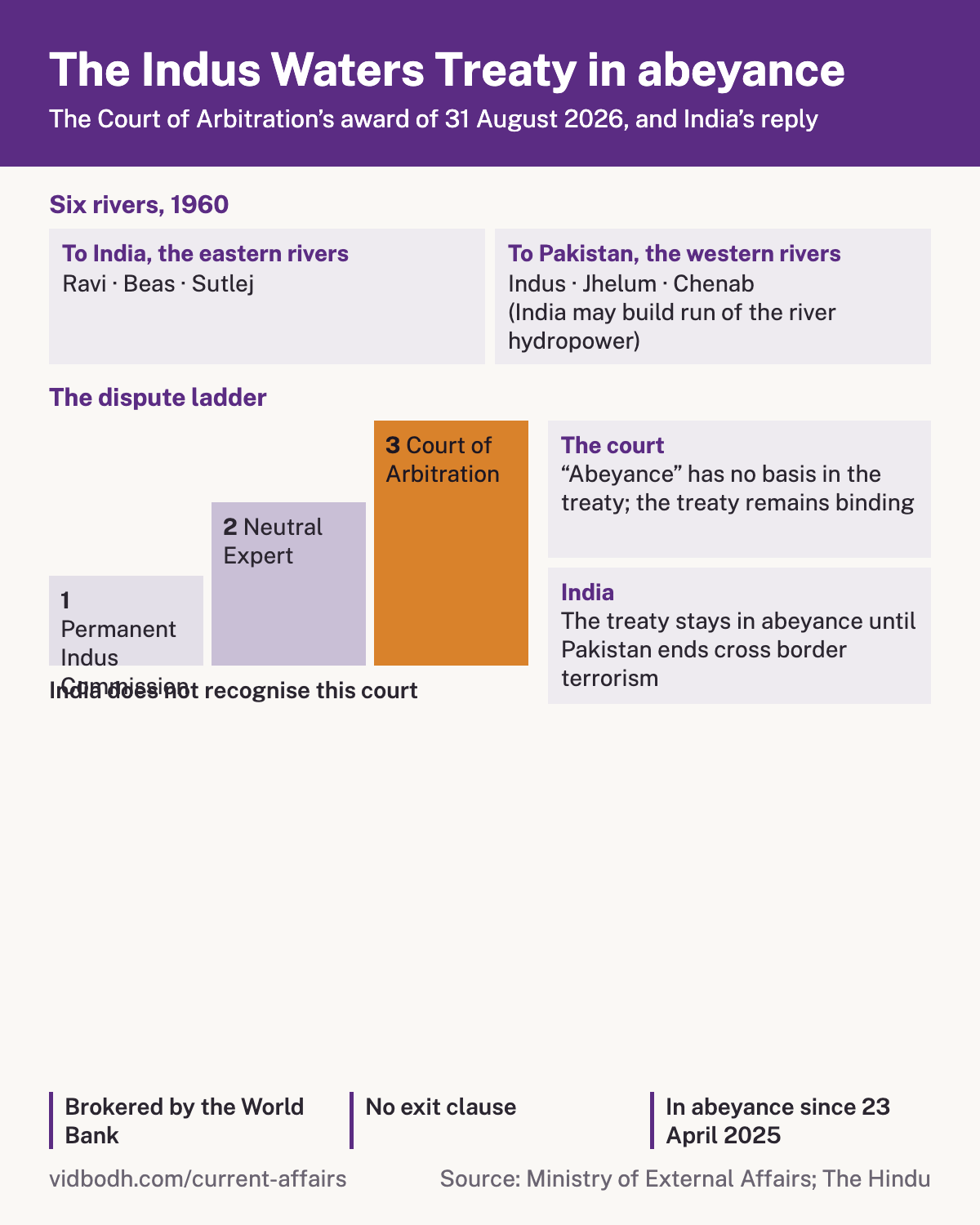
On 31 August 2026 the Court of Arbitration constituted at Pakistan's request held that India's placing of the Indus Waters Treaty "in abeyance" has no basis in the treaty or in international law, and that the treaty remains binding on India. India rejected the award within hours, saying it has never recognised the court.
Background
- The treaty of 1960, brokered by the World Bank, gives India the three eastern rivers (Ravi, Beas, Sutlej) and Pakistan the three western rivers (Indus, Jhelum, Chenab), on which India may build run of the river hydropower within design limits.
- Disputes rise in steps: the Permanent Indus Commission, then a Neutral Expert, then a Court of Arbitration. The treaty has no exit clause.
- After the Pahalgam attack of 22 April 2025, India placed the treaty in abeyance until Pakistan gives up support for cross border terrorism.
- India disputes the court itself: it says the questions on the Kishenganga and Ratle projects belong to the Neutral Expert, and that the World Bank acted in breach of the treaty in appointing a court as well.
What the court held
- "Abeyance" is unknown to the treaty and to international law; a treaty cannot be suspended by one party in this way.
- The treaty is fully in force: pacta sunt servanda, agreements must be kept.
- As an interim measure, India may not concrete the Ratle dam wall and power intake above set levels until 90 days after the Neutral Expert decides, which is expected in July 2027.
- In May the same court had ruled on maximum pondage at Kishenganga and Ratle; India called that award null and void too.
India's position
- India has not withdrawn from the treaty. Abeyance means it has stopped the meetings, data sharing and visits the treaty provides, while keeping its rights.
- It says the treaty is outdated: signed for a different era, with no provision for climate change, population or terrorism.
- It says the court is illegally constituted and will not take part in its proceedings.
- It has still shared flood warnings with Pakistan on humanitarian grounds through diplomatic channels, as in the Chenab floods of July.
The legal and political question
- The treaty has no exit clause. The rules of the Vienna Convention on the Law of Treaties on material breach and fundamental change of circumstances are treated as customary law, though neither country is a party to it and it does not apply directly to a 1960 treaty. India has not formally invoked either ground.
- Pakistan reads the award as a win; there is no machinery to enforce an award against a party that does not recognise the court.
- The real pressure is on water: the eastern rivers are already India's; what India can do on the western rivers is limited by geography and by the dams it has built.
- Any move to divert western waters would take years of construction.
The way forward
- Use abeyance to modernise the treaty: climate data, sediment, groundwater and a faster dispute ladder.
- Build the run of the river projects the treaty already allows, which is where India's leverage lies.
- Keep humanitarian flood data flowing, which costs nothing and preserves India's standing.
- Decide whether to invoke the Vienna Convention formally, so that India's position has a stated legal basis.
Prelims facts
- Treaty signed in 1960, brokered by the World Bank.
- Eastern rivers (Ravi, Beas, Sutlej) to India; western rivers (Indus, Jhelum, Chenab) to Pakistan.
- The Permanent Indus Commission has one commissioner from each side and is required to meet at least once a year; it last met in May 2022.
- Kishenganga is on a tributary of the Jhelum; Ratle is on the Chenab.
- India placed the treaty in abeyance on 23 April 2025.
Sources: The Hindu, 31 Aug 2026: Citing lack of jurisdiction, India rejects Hague court's Indus Waters Treaty ruling (opens in a new tab) · LiveLaw, 31 Aug 2026: India must continue to honour Indus Waters Treaty with Pakistan, cannot keep it in abeyance: Permanent Court of Arbitration (opens in a new tab) · ThePrint, 31 Aug 2026: Indus Waters Treaty Hague ruling: the tussle over India's abeyance decision, explained (opens in a new tab) · DD India, 4 Aug 2026: MEA calls Pakistan occupied Kashmir elections a farce (opens in a new tab) · DD India, 5 Aug 2026: India rejects Pakistan's Youm-e-Istehsal observance (opens in a new tab) · DD India, 11 Aug 2026: India urges global accountability for Pakistan over PoJK rights violations (opens in a new tab) · The Hindu, 19 Jun 2026: India calls Pakistan a 'Frankenstein state' at U.N. (opens in a new tab) · The Hindu, 17 May 2026: Morning Digest: India rejects award on Indus Waters Treaty (opens in a new tab) · News On AIR, 1 Jul 2026: India condemns demolition of historic 125 year old gurdwara in Pakistan (opens in a new tab) · News On AIR, 25 Jul 2026: UN human rights agency voices concern over unrest in PoJK (opens in a new tab) · News On AIR, 25 Jul 2026: India expresses disappointment over UN's silence on repression in PoJK (opens in a new tab) · News On AIR, 25 Jul 2026: MEA reiterates J&K, Ladakh including PoK are integral parts of India (opens in a new tab) · News On AIR, 25 Jul 2026: Indus Waters Treaty remains in abeyance until Islamabad abjures support for cross border terrorism (opens in a new tab)
Earlier coverage: The Indus Waters Treaty in abeyance · The monthly magazine, August 2026