Small enterprises and late payments: the MSME Amendment Act, 2026
LeadPrelims and MainsAugust 2026
Why in news
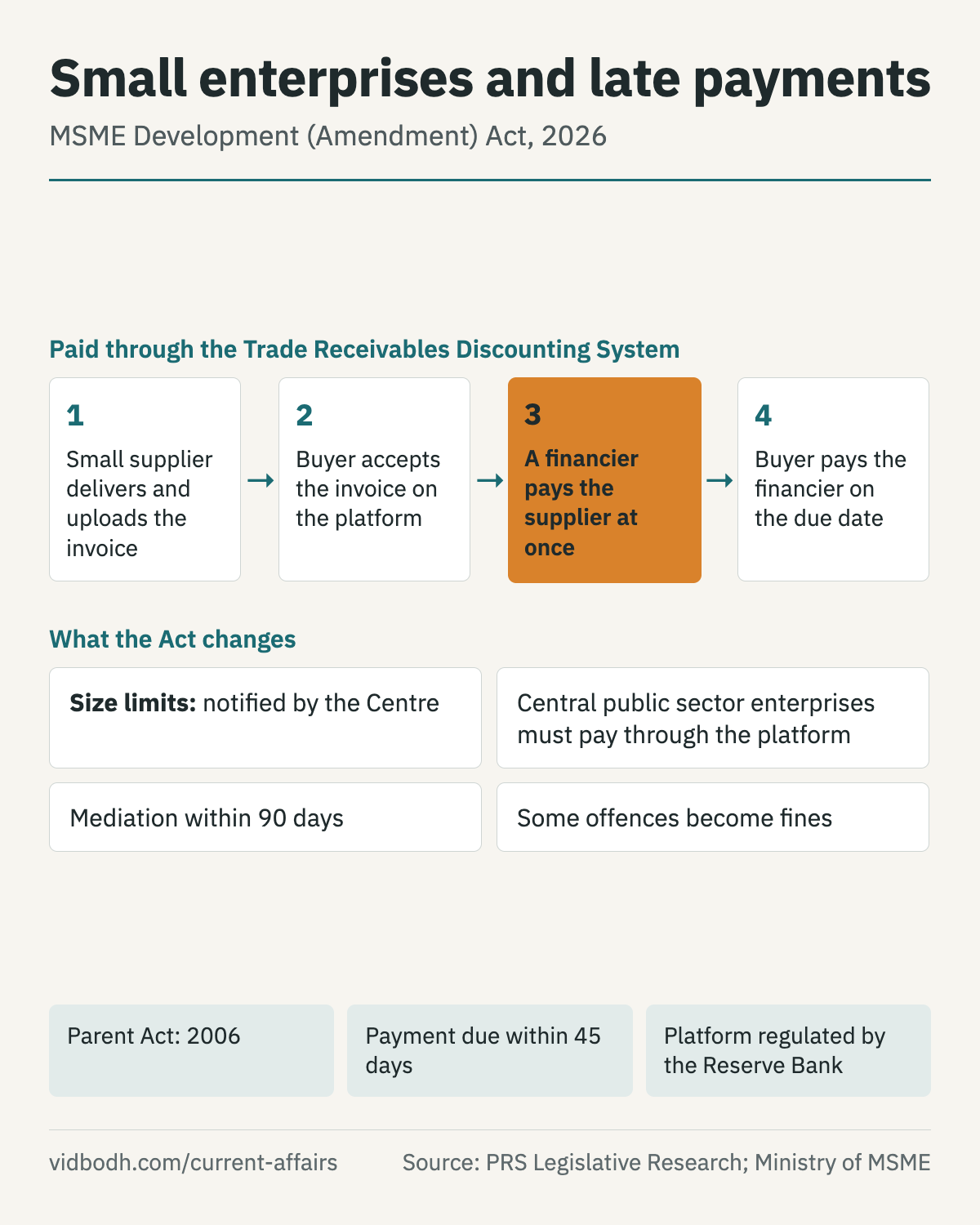
The Micro, Small and Medium Enterprises Development (Amendment) Act, 2026 received assent on 13 August 2026. It lets the Centre set the size limits by notification, makes central public sector enterprises pay small suppliers through an invoice discounting platform, and sets time limits for payment disputes.
Background
- The 2006 Act defines micro, small and medium enterprises (MSME) and gives them certain protections.
- Since 2020 the size of an enterprise is judged by a composite test: investment in plant and machinery, and turnover.
- A buyer must pay a micro or small supplier within 45 days at most. An unpaid supplier may go to a Facilitation Council.
- Delayed payment remains the sector's chief complaint: a small firm that waits months for its money must borrow to keep running.
What the Act changes
- Definition: the limits leave the Act; the Centre will notify them, so they can be revised without a new law.
- Payment: central public sector enterprises must settle the invoices of these suppliers through the Trade Receivables Discounting System.
- Disputes: mediation to end within 90 days, and an arbitration award within 90 days of the pleadings.
- Compliance: filing a memorandum becomes voluntary, and some offences become graded fines.
Why late payment is hard to cure
- The supplier depends on the buyer and fears losing the order if the supplier complains.
- Large buyers, the government among them, use small suppliers as a source of free credit.
- Councils are slow, and awards are challenged in court.
- A platform helps only if the buyer accepts the invoice on it; the Act now compels central enterprises to do so.
The larger picture
- These enterprises account for about three tenths of GDP and a large share of exports and jobs.
- Most are micro units, outside formal credit.
- Higher limits let a firm grow without losing benefits, but they also let larger firms share benefits meant for the smallest.
The way forward
- Extend the platform rule to State enterprises and large private buyers.
- Publish each large buyer's record of payment.
- Staff the Facilitation Councils and move them online.
- Tie credit to cash flow, using tax and invoice data, in place of collateral.
Prelims facts
- The parent Act is of 2006.
- Classification uses investment and turnover together.
- Payment to a micro or small supplier is due within 45 days.
- The Trade Receivables Discounting System is regulated by the Reserve Bank of India.
- Under the 2026 Act the Centre notifies the size limits.
Sources: PRS Legislative Research, 13 Aug 2026: Bill track: the Micro, Small and Medium Enterprises Development (Amendment) Bill, 2026 (opens in a new tab) · The Hindu, 7 Aug 2026: Lok Sabha passes MSME Development Amendment Bill without debate (opens in a new tab) · LiveLaw, 13 Aug 2026: Monsoon Session of Parliament 2026: 12 Bills passed (opens in a new tab)
Earlier coverage: MSME Development (Amendment) Act, 2026 · The monthly magazine, August 2026