Nuclear power: the liability cap before the Supreme Court
LeadPrelims and MainsAugust 2026
Why in news
The Supreme Court on 17 August 2026 issued notice on a challenge to the liability caps in the SHANTI Act, 2025. It asked whether a cap written into a statute can stop a constitutional court from awarding fair compensation to the victims of a nuclear accident.
Background
- Nuclear liability is the question of who pays the victims after an accident, and how much.
- Until 2025 the Civil Liability for Nuclear Damage Act, 2010 governed it. It let an operator recover money from an equipment supplier, which kept foreign reactor vendors away.
- Nuclear power was a government monopoly under the Atomic Energy Act, 1962.
- India's programme has three stages: heavy water reactors on natural uranium, fast breeder reactors on plutonium, and finally reactors on thorium, of which India has large reserves.
What the SHANTI Act changed
- The Sustainable Harnessing and Advancement of Nuclear Energy for Transforming India Act, 2025 replaced both earlier Acts.
- Private companies may own and run nuclear plants under licence.
- The Atomic Energy Regulatory Board became a statutory body.
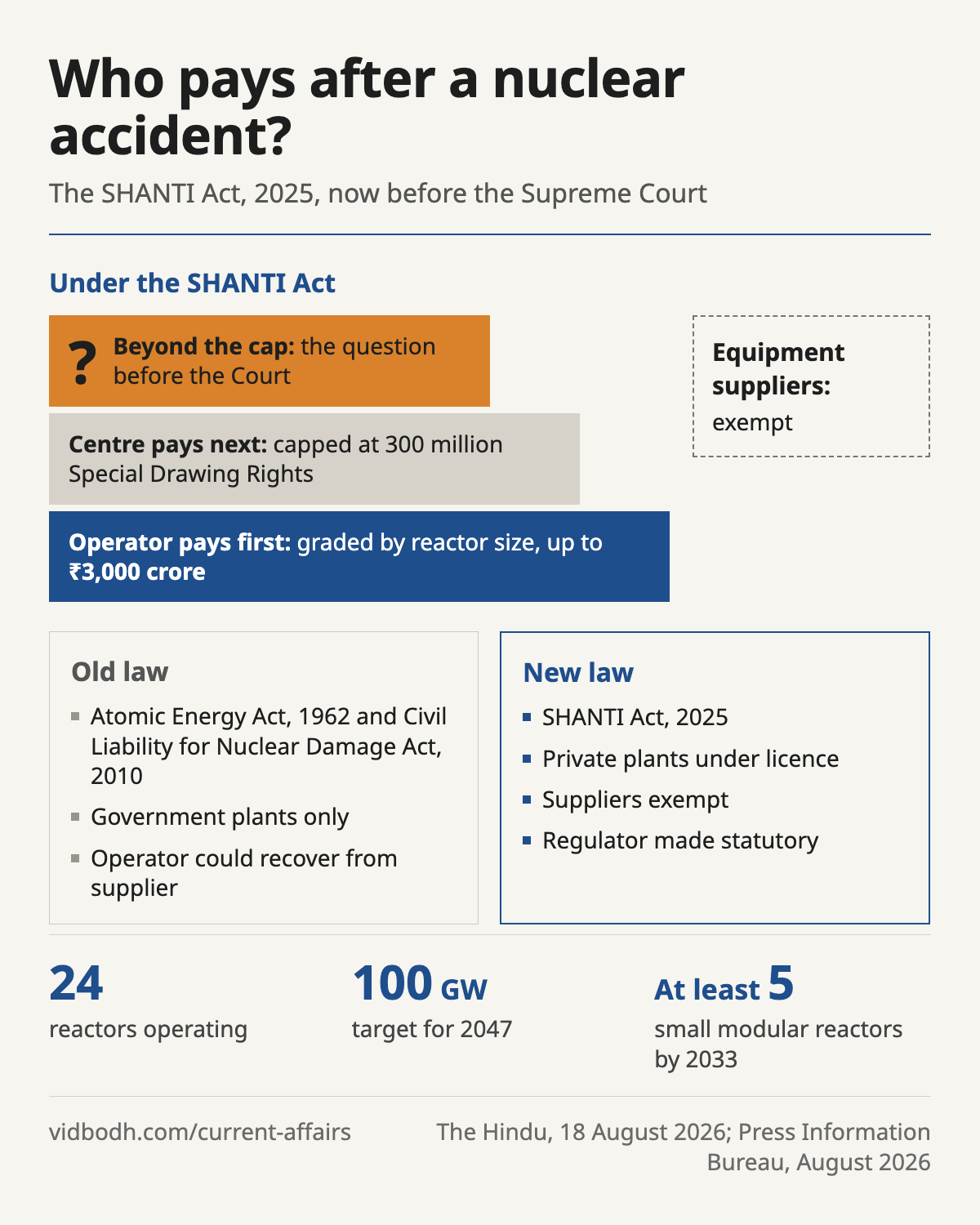
- An operator's liability is graded by reactor size up to ₹3,000 crore; the Centre's liability beyond that is capped at 300 million Special Drawing Rights; suppliers are exempt.
The case
- The petitioners set the caps against the estimated costs of Chernobyl and Fukushima, which ran far higher.
- The argument for a cap is that it makes the risk insurable, and no private operator or supplier would come without it.
- The argument against is that victims bear whatever lies above the cap, which touches the right to life under Article 21.
Where the programme stands
- India has 24 reactors with about 8.8 GW, and the target is 100 GW by 2047.
- Ten indigenous 700 MW pressurised heavy water reactors are being built together, to take capacity to about 22.5 GW by 2031 to 2032.
- The Prototype Fast Breeder Reactor at Kalpakkam reached first criticality in April 2026, which opened the second stage.
- At least five indigenous small modular reactors are to run by 2033; India is designing three kinds, among them the 220 MWe Bharat Small Modular Reactor.
The way forward
- Settle the liability question early, since investors and suppliers will wait for the Court.
- Frame the rules under the Act, which are still being drafted.
- Keep the regulator independent of the operators it licenses, private or public.
- Plan for spent fuel and waste as private plants come in.
Prelims facts
- The SHANTI Act replaced the Atomic Energy Act, 1962 and the Civil Liability for Nuclear Damage Act, 2010.
- Under it suppliers are exempt from liability.
- A pressurised heavy water reactor uses natural uranium and needs no enrichment.
- The fast breeder reactor uses liquid sodium as coolant and belongs to the second stage.
- A small modular reactor is of up to about 300 MWe.
See also: Pressurised heavy water reactors · Small modular reactors · The Prototype Fast Breeder Reactor
Sources: The Hindu, 18 Aug 2026: Supreme Court questions nuclear liability caps in the SHANTI Act (opens in a new tab) · PIB, 12 Aug 2026: Small Modular Reactors, the SHANTI Act and the 100 GW goal (opens in a new tab) · PIB, 5 Aug 2026: Small Modular Reactors, the SHANTI Act and the 100 GW goal (opens in a new tab) · PIB, 5 Aug 2026: Small Modular Reactors, the SHANTI Act and the 100 GW goal (opens in a new tab) · PIB, 5 Aug 2026: PFBR criticality and status of India's reactor fleet (opens in a new tab) · PIB, 13 Aug 2026: PFBR criticality and status of India's reactor fleet (opens in a new tab)
Earlier coverage: The SHANTI Act · The monthly magazine, August 2026