The Tribunals Reforms Act, 2026 and the National Tribunals Commission
LeadPrelims and MainsAugust 2026
Why in news
Parliament passed the Tribunals Reforms Act, 2026, and the President gave assent on 13 August 2026. It creates a National Tribunals Commission to select the members of 16 tribunals, review their work and inquire into complaints against them. It came into force on 25 August.
Background
- A tribunal is a body set up by law to decide disputes in a special field, such as service matters, tax, company law or the environment. It is meant to be quicker and more expert than a court.
- The 42nd Amendment (1976) added Article 323A (administrative tribunals) and Article 323B (tribunals for other matters).
- For a decade Parliament and the Supreme Court have gone back and forth. Parliament fixed short tenures and gave the executive a large say in selection; the Court struck the provisions down; Parliament passed them again.
- On 19 November 2025 the Court held that the Tribunals Reforms Act, 2021 had re enacted what it had already struck down. The 2026 Act is Parliament's answer.
What the Act creates
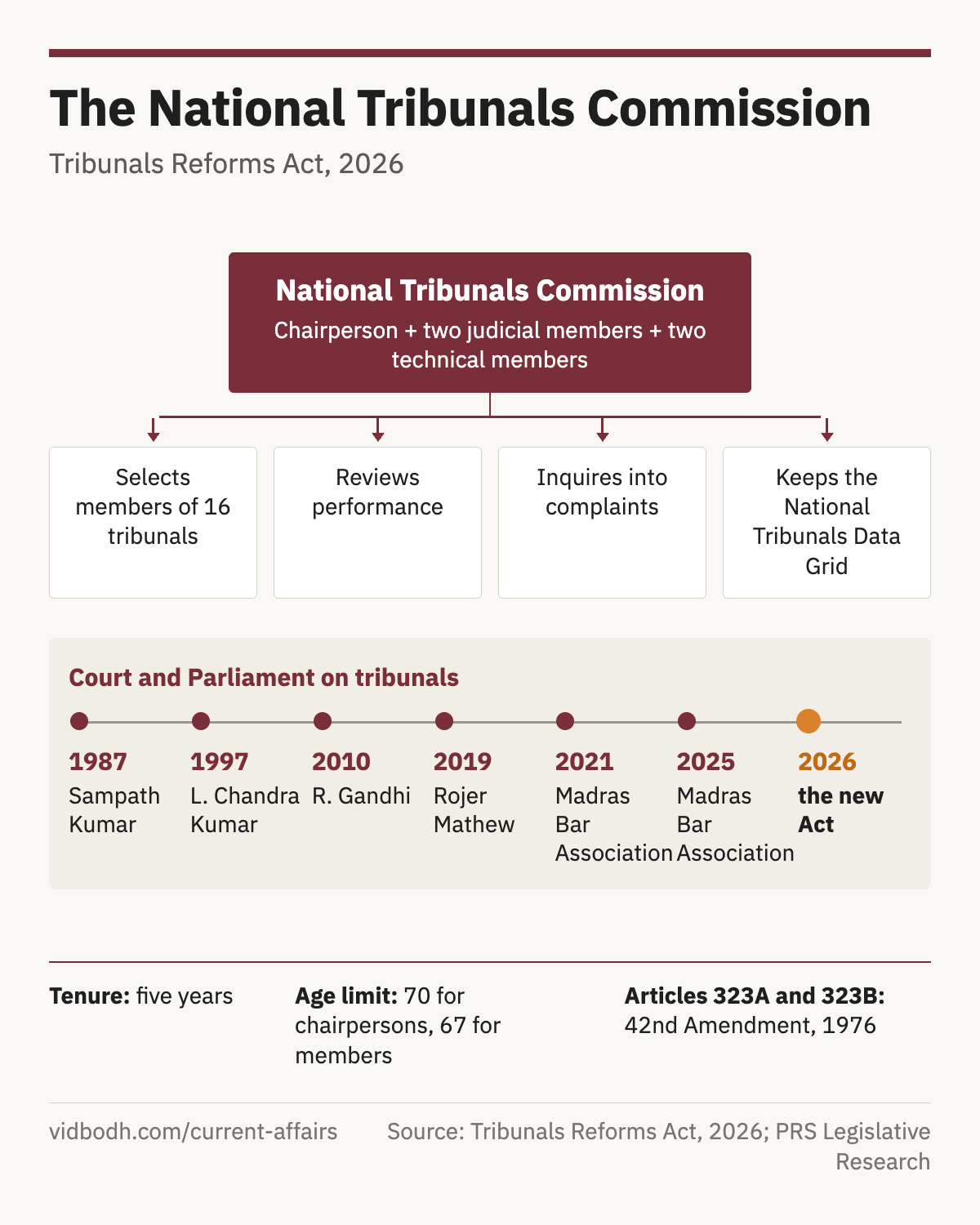
- The Commission: a Chairperson who is a former Supreme Court judge or former Chief Justice of a High Court, appointed after consulting the Chief Justice of India; two judicial and two technical members.
- Its work: run selections, review the performance of tribunals, inquire into complaints, and keep a National Tribunals Data Grid.
- Tenure: five years, up to the age of 70 for chairpersons and 67 for members, with reappointment allowed.
- The Centre must appoint within three months of a recommendation.
- The Act repeals the 2021 Act and saves appointments already made.
Does it meet the Court's test?
- The Court has asked for three things: judges in the majority in selection, security of tenure, and freedom from the parent ministry.
- For it: a single commission headed by a judge is what the Court itself suggested, and the tenure is now five years, not four.
- Against it: a Union Secretary sits on each selection committee and the Centre makes the final appointment, while the Union is the largest litigant before these tribunals.
- A performance review can become a lever over members if its data stays with the executive.
How it was passed
- The Lok Sabha introduced and passed the Bill on the same day, without debate.
- This matters because the earlier laws fell partly for want of engagement with the Court's directions.
- A Standing Committee had reported days earlier on vacancies, notably in the Income Tax Appellate Tribunal and the National Green Tribunal.
Cases to cite
- S.P. Sampath Kumar v. Union of India (1987): a tribunal can replace a High Court only if it is an equally effective alternative.
- L. Chandra Kumar v. Union of India (1997): judicial review by the High Courts and the Supreme Court is part of the basic structure; tribunal decisions go to a Division Bench of the High Court.
- Union of India v. R. Gandhi (2010): tribunals must have the independence of the courts they replace.
- Rojer Mathew v. South Indian Bank (2019): struck down the tribunal rules made under the Finance Act, 2017.
- Madras Bar Association v. Union of India (2021 and 2025): struck down the four year tenure and the minimum age of 50; the 2025 ruling held that Parliament cannot re-enact a provision without curing the defect.
The way forward
- Give the Commission its own budget and secretariat, outside the ministries whose orders the tribunals review.
- Place the Data Grid in the public domain.
- Fill vacancies before they arise, by starting selection six months ahead.
- Review whether every tribunal is needed; where a High Court bench would serve, merge or wind up.
Prelims facts
- Articles 323A and 323B were inserted by the 42nd Amendment, 1976.
- Article 323A tribunals can be set up only by Parliament; Article 323B tribunals by Parliament or a State legislature.
- National Tribunals Commission: Chairperson, two judicial and two technical members.
- Tenure under the 2026 Act: five years; age limit 70 (chairperson) and 67 (member).
- The Central Administrative Tribunal was set up in 1985.
Sources: The Hindu, 11 Aug 2026: Parliament Monsoon Session Day 17 updates (opens in a new tab) · PRS Legislative Research, 31 Aug 2026: Monthly Policy Review, August 2026 (opens in a new tab) · SCC Online, 11 Aug 2026: Tribunals Reforms Bill, 2026: the provisions (opens in a new tab) · SCC Online, 27 Aug 2026: Tribunals Reforms Act, 2026 comes into force (opens in a new tab) · LiveLaw, 10 Aug 2026: Lok Sabha passes Tribunals Reforms Bill, 2026 without debate (opens in a new tab) · Bar and Bench, 13 Aug 2026: Tribunals Reforms Act, 2026 gets President's assent (opens in a new tab) · Supreme Court Observer, 31 Aug 2026: Legislating India's tribunals: a timeline (opens in a new tab)
Earlier coverage: Tribunals and the National Tribunals Commission · The monthly magazine, August 2026