Western Ghats: the seventh draft and the question of the line
LeadPrelims and MainsAugust 2026
Why in news
The Centre issued a seventh draft notification on the Western Ghats Ecologically Sensitive Area on 27 July 2026, after the sixth lapsed. It proposes 56,825.7 sq km across six States, and the States still do not agree on where the line should fall.
Background
- The Western Ghats run through six States: Gujarat, Maharashtra, Goa, Karnataka, Kerala and Tamil Nadu.
- They are a World Heritage Site and one of the world's biodiversity hotspots, and the source of the peninsula's major rivers.
- An Ecologically Sensitive Area (ESA) is notified under the Environment (Protection) Act, 1986, and damaging activities are restricted inside it.
- A draft notification lapses if it is not made final in time, which is why the same proposal has been issued again and again since 2014.
Two panels, two answers
- The Gadgil panel, the Western Ghats Ecology Expert Panel, reported in 2011 and recommended 142 talukas as ecologically sensitive, with graded regulation built upward from the gram sabha.
- The Kasturirangan group followed and cut the area to about 37 per cent of the Ghats, separating natural landscape from cultural landscape where people live and farm.
- The draft notifications follow the Kasturirangan approach, and the Gadgil report remains the reference point for those who want wider protection.
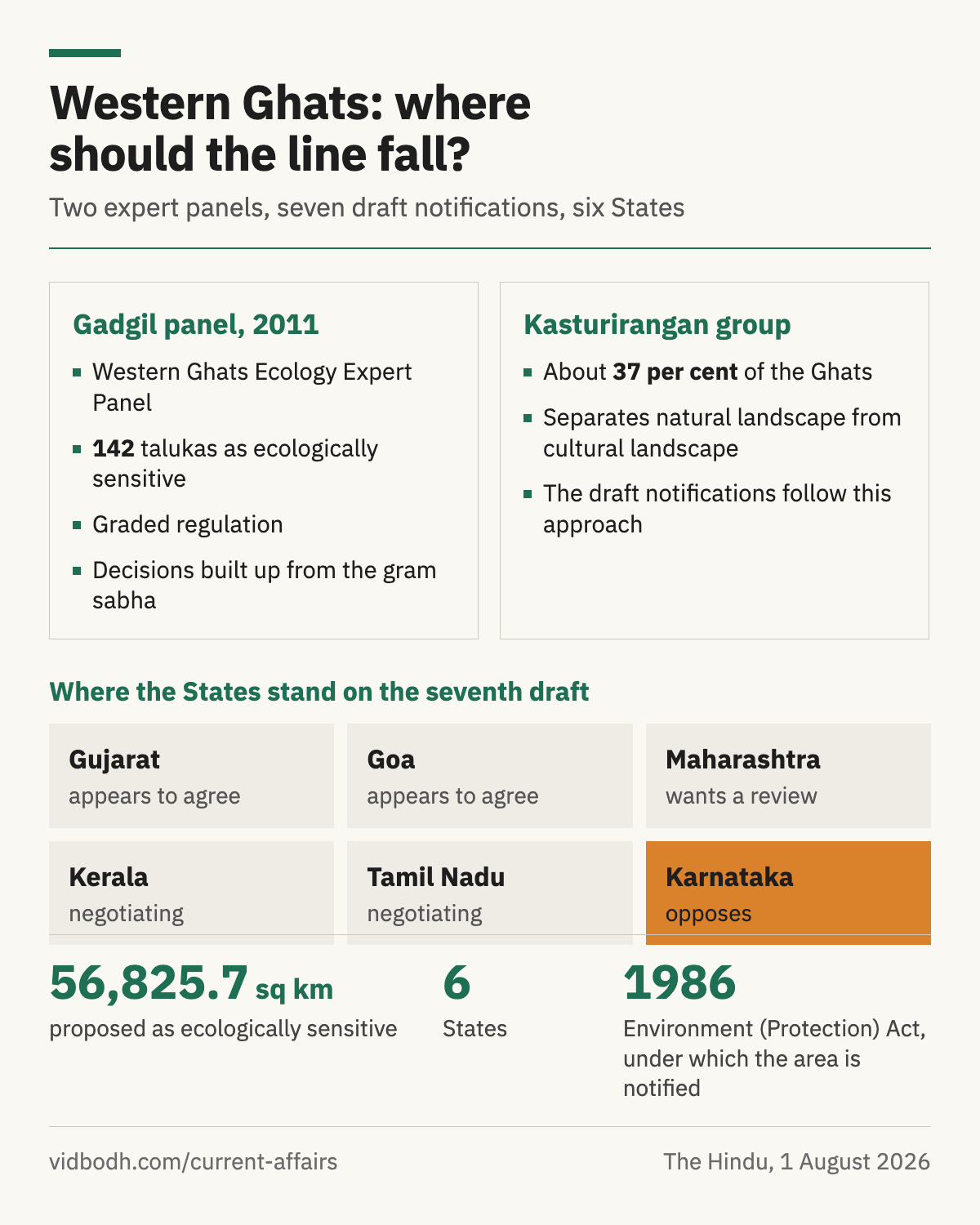
Where the States stand
- Gujarat and Goa appear to agree with the draft.
- Maharashtra wants a review, and Kerala and Tamil Nadu are still negotiating.
- Karnataka, which carries the largest share of the proposed area, opposes it outright and cites livelihoods.
- The expert panel has until July 2027, so a phased rollout, State by State, is possible.
Why agreement is hard
- The area is drawn by the Centre, but land is a State subject, and the restrictions fall on villages, farms and plantations.
- People living in the Ghats fear that a listing will stop roads, houses and farm work, though the curbs are aimed at mining, quarrying, thermal power and polluting industry.
- Each landslide and flood in the Ghats, such as Wayanad in 2024, renews the case for a final notification.
The way forward
- Notify the area State by State where agreement exists, instead of waiting for all six.
- Fix boundaries by ground survey with the villages, so that farms and settlements are not caught by a line drawn from satellite images.
- Pair restrictions with support for livelihoods that suit the landscape, so that conservation is not seen as a cost borne only by local people.
Prelims facts
- The ESA is notified under the Environment (Protection) Act, 1986, not the Wild Life (Protection) Act.
- The Gadgil panel is the Western Ghats Ecology Expert Panel; it recommended 142 talukas.
- The Western Ghats pass through six States; the proposed area is largest in Karnataka, then Maharashtra.
Sources: The Hindu, 1 Aug 2026: Western Ghats eco-sensitive area remains unresolved (opens in a new tab) · The Indian Express, 27 Jul 2026: Centre issues a seventh draft notification declaring 56,825.7 sq km of the Western Ghats as an ecologically sensitive area (opens in a new tab) · The Hindu, 27 Sep 2026: What is Karnataka’s objection to the ESA? | Explained (opens in a new tab)
Earlier coverage: The Western Ghats Ecologically Sensitive Area · The monthly magazine, August 2026