Why in news
On 25 September 2026 the Supreme Court closed Punjab's petition over two Bills of 2023 that the Governor had reserved for the President: the President refused assent to one and sent queries on the other. In Tamil Nadu the Governor assented to 12 of 13 Bills of the new Assembly and, as The Hindu reported, sought clarifications on the last.
Background
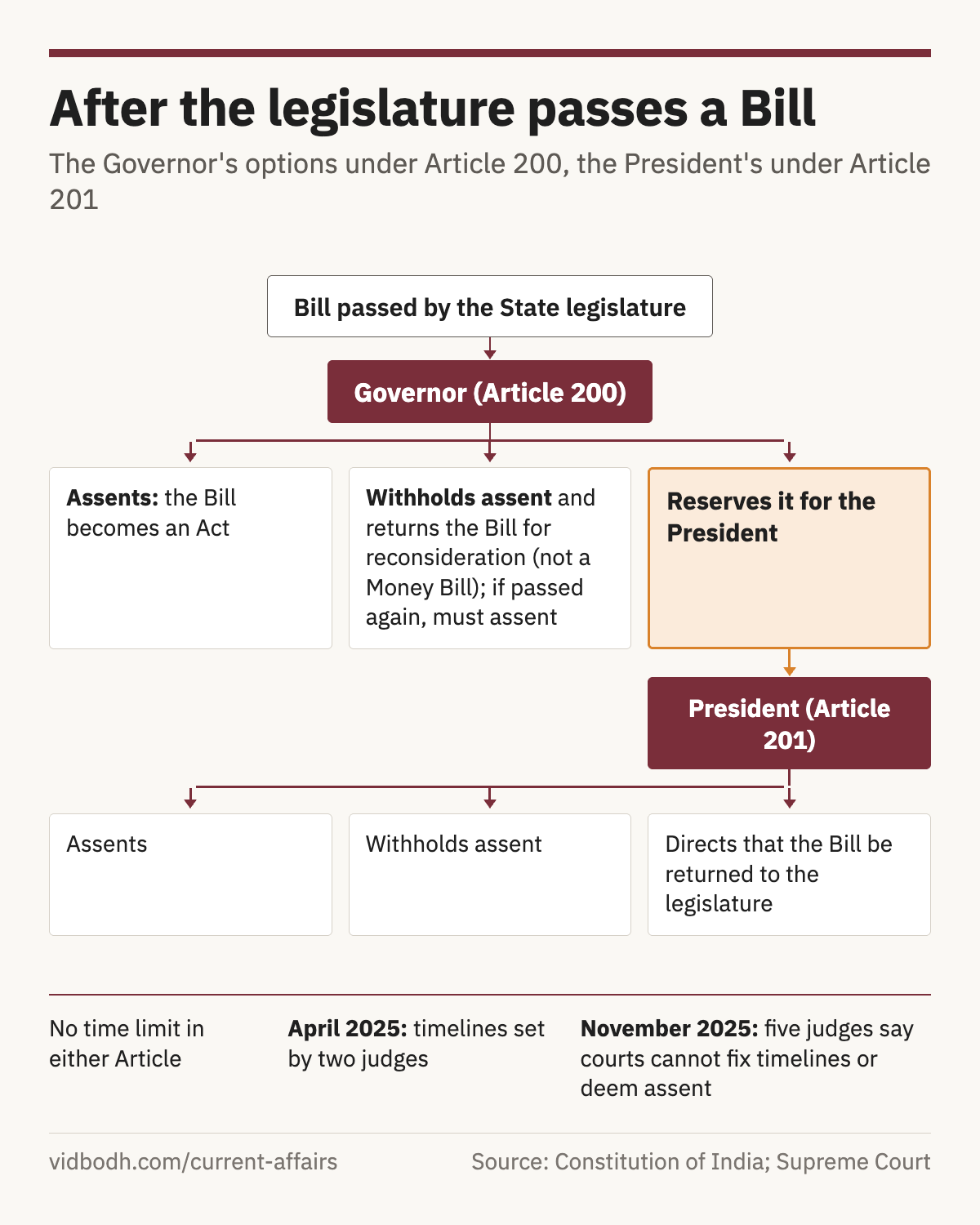
- Article 200: when a Bill passed by the State legislature reaches the Governor, he may assent, withhold assent, return it for reconsideration (if it is not a Money Bill), or reserve it for the President.
- If the legislature passes a returned Bill again, the Governor shall not withhold assent.
- The Supreme Court reads these as three options, since a Governor who withholds assent must return the Bill to the legislature.
- Article 201: the President may assent to a reserved Bill, withhold assent, or direct that it be returned. There is no time limit.
- Neither Article says how long the Governor may take. "As soon as possible" appears only for returning a Bill.
Two rulings in one year
- April 2025, two judges, the Tamil Nadu case: indefinite delay is unlawful. The Court set time limits and used Article 142 to treat ten Bills as assented to.
- November 2025, five judges, on a reference by the President under Article 143: courts cannot fix timelines and cannot declare deemed assent. But long and unexplained inaction is open to limited judicial review: a court may direct the Governor to decide, not what to decide.
What September showed
- With no deadline, reservation for the President has become the route by which a State Bill can be held: the clock under Article 201 has no limit.
- In the Punjab case a judge noted that the time starts afresh each time queries are sent to the State.
- A Governor asking for "clarifications" is a step the Constitution does not list.
The federal question
- The Governor is appointed by the President and holds office during his pleasure, but is the constitutional head of the State.
- He acts on the advice of the State's Council of Ministers, except where the Constitution gives discretion.
- Holding back a Bill passed by an elected legislature sets an appointed office against an elected one.
- The other view: the Governor is a check where a State law may clash with a central law or the Constitution, which is the purpose of reservation.
Cases to cite
- Shamsher Singh v. State of Punjab (1974): the Governor acts on the aid and advice of the Council of Ministers.
- Nabam Rebia v. Deputy Speaker (2016): the Governor's discretion is limited to what the Constitution expressly gives.
- State of Punjab v. Principal Secretary to the Governor (2023): a Governor cannot sit on a Bill; withholding assent means returning it to the legislature.
- State of Tamil Nadu v. Governor of Tamil Nadu (2025): time limits and deemed assent.
- In re Assent, Withholding or Reservation of Bills (2025): the Presidential reference; no judicial timelines, limited review of inaction.
The way forward
- Write a time limit into Articles 200 and 201; the Sarkaria Commission suggested norms and the Punchhi Commission proposed six months.
- Limit reservation to Bills that clash with a central law or endanger the High Court's position.
- Require reasons in writing when assent is withheld or a Bill is reserved.
- Appoint Governors after consulting the Chief Minister, as both Commissions advised.
Prelims facts
- Article 200: the Governor's options. Article 201: Bills reserved for the President.
- A Money Bill cannot be returned for reconsideration.
- A Bill that would endanger the position of the High Court must be reserved.
- An opinion under Article 143 is advisory.
- The President is not bound to assent even if the State legislature passes a reserved Bill again.
Sources: The Hindu, 21 Sep 2026: Why has the Tamil Nadu Private Universities (Amendment) Bill, 2026, triggered a controversy? | Explained (opens in a new tab) · The Hindu, 20 Nov 2025: Judiciary cannot tie President, Governor to timelines, says Supreme Court (opens in a new tab) · LiveLaw, 25 Sep 2026: Supreme Court closes Punjab's plea against Governor reserving two Bills for President's assent (opens in a new tab) · ThePrint, 18 Sep 2026: TN Guv gives assent to 12 Bills (opens in a new tab)
Earlier coverage: The Governor and assent to State Bills · The monthly magazine, September 2026