A fee returns to UPI: the merchant discount rate
LeadPrelims and MainsSeptember 2026
Why in news
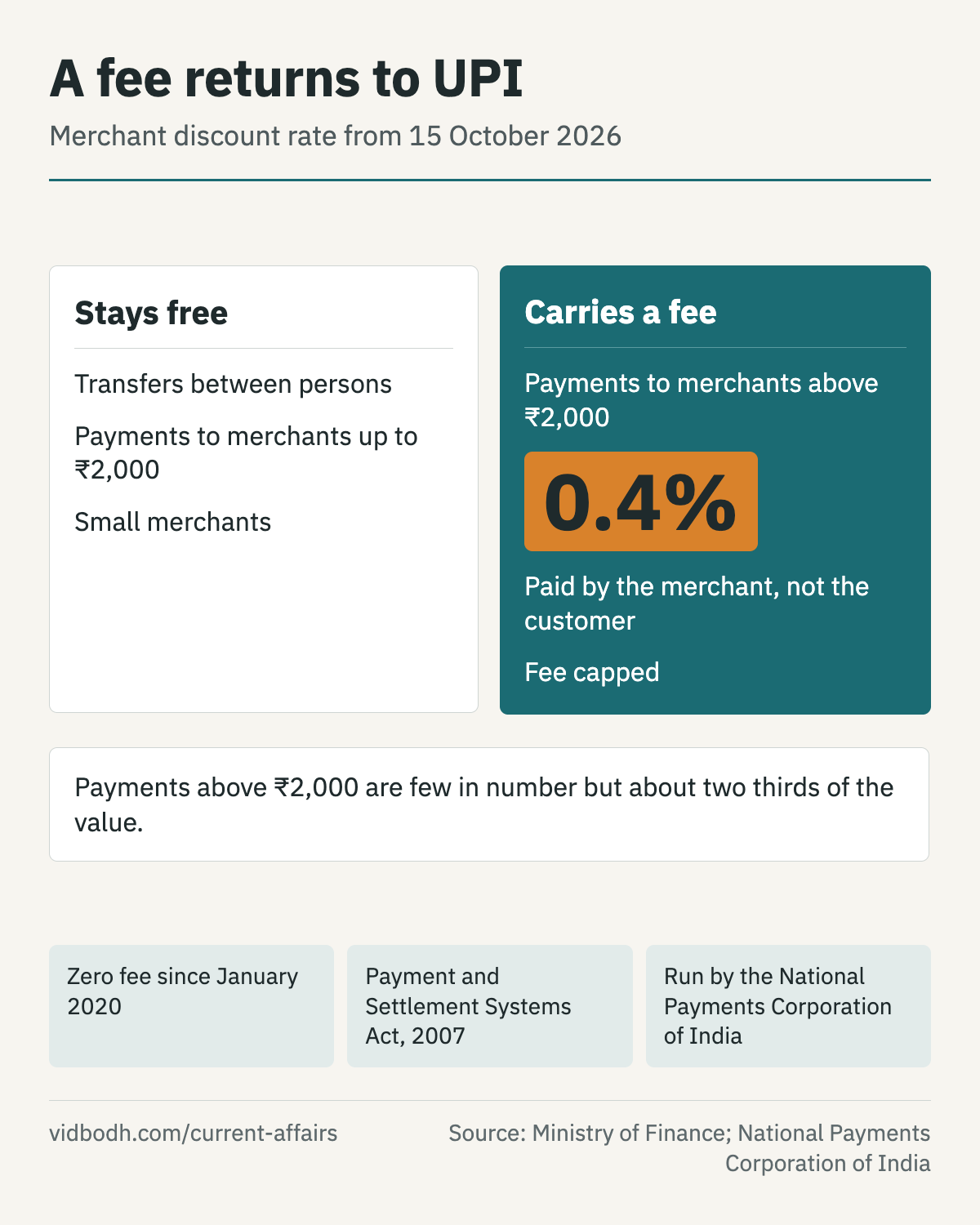
From 15 October 2026 merchants will pay a fee of 0.4 per cent on payments above ₹2,000 received through the Unified Payments Interface (UPI). The Finance Ministry notified on 14 September which payments stay free, and the National Payments Corporation of India then set the rate. Payments between persons, and small payments to merchants, stay free.
Background
- The merchant discount rate is the fee a merchant pays the banks and payment firms that process a digital payment.
- Since January 2020 the law has barred this fee on UPI and RuPay debit cards. In its place the Centre paid banks an incentive from the Budget.
- UPI grew to over two thousand crore transactions a month. But someone must pay for servers, security and the settling of disputes.
What is charged, and what is not
- Charged: payments to a merchant above ₹2,000, at 0.4 per cent, with a cap on the fee.
- Free: transfers between persons; payments up to ₹2,000; small merchants.
- The fee is borne by the merchant, not the customer.
- Large payments are few in number but about two thirds of the value, so a narrow fee raises real money.
The case for a fee
- A free service paid for by the Budget depends on the Budget, and the incentive was small beside the cost of running the system.
- Banks and payment firms had little reason to invest in a product that earned nothing.
- Revenue can pay for security against fraud.
The worries
- Merchants may pass the fee on, or steer customers back to cash.
- UPI is public infrastructure; a fee may slow its spread among small traders.
- A petition before the Supreme Court says the amended law gives the executive unguided power; the Court refused a stay but asked whether the charge is a tax or a fee.
The way forward
- Enforce the rule that the merchant pays.
- Review the rate at fixed intervals, in the open.
- Keep small payments free, since that is where inclusion lies.
- Spend the revenue on security and reach.
Prelims facts
- UPI and RuPay are run by the National Payments Corporation of India, set up by the Reserve Bank and the Indian Banks' Association.
- The law is the Payment and Settlement Systems Act, 2007.
- Zero fee on UPI and RuPay debit cards applied from January 2020.
- New fee: 0.4 per cent on payments to merchants above ₹2,000, from 15 October 2026.
- UPI was launched in 2016.
Sources: The Indian Express, 15 Sep 2026 · The Indian Express, 17 Sep 2026 · The Indian Express, 18 Sep 2026 · The Hindu, 26 Sep 2026 · The Hindu, 28 Sep 2026: If neither a tax nor fee, what is this expropriation, SC asks govt. on UPI merchant discount rate (opens in a new tab) · The Hindu, 6 Aug 2026: Lok Sabha passes Bill to authorise Govt. to permit banks to levy charges on UPI transactions (opens in a new tab) · The Hindu, 18 Aug 2026: Amendment to Taxation Act, Payment and Settlement Systems Act get President's assent (opens in a new tab) · PRS Legislative Research, 18 Aug 2026: Bill track: the Taxation and Other Laws (Amendment) Bill, 2026 (opens in a new tab) · PRS Legislative Research, 13 Aug 2026: Vital stats: Monsoon Session 2026 (opens in a new tab) · StudyCafe, 17 Aug 2026: Centre notifies Taxation and Other Laws (Amendment) Act, 2026 (opens in a new tab)
Earlier coverage: Merchant discount rate on UPI · The monthly magazine, September 2026