Himalayan hazards: lake outbursts and avalanche cascades
LeadPrelims and MainsSeptember 2026
Why in news
Uttarakhand began installing its first glacial lake early warning system at Vasundhara Tal in Chamoli on 29 September 2026. It comes a month after the Nepal disaster of 26 August, which experts now say was not a lake outburst at all.
- 195high risk glacial lakes on the national list
- 30 of 100marks the risk index gives to downstream vulnerability
- about 73 per centof mapped Himalayan glacial lakes that lie outside India
Background
- A glacial lake forms where a retreating glacier leaves a hollow that fills with meltwater, held back by bedrock or by moraine, the loose rock and sediment the glacier leaves behind.
- A moraine dam can fail by slow erosion, by the melting of ice buried inside it, or when an avalanche or landslide falls into the lake and sends a wave over it.
- In Nepal on 26 August 2026, ice and rock broke away on Langtang Lirung and ran down the valley as a debris flow, leaving 1,410 dead and over 6,000 missing.
Two hazards, not one
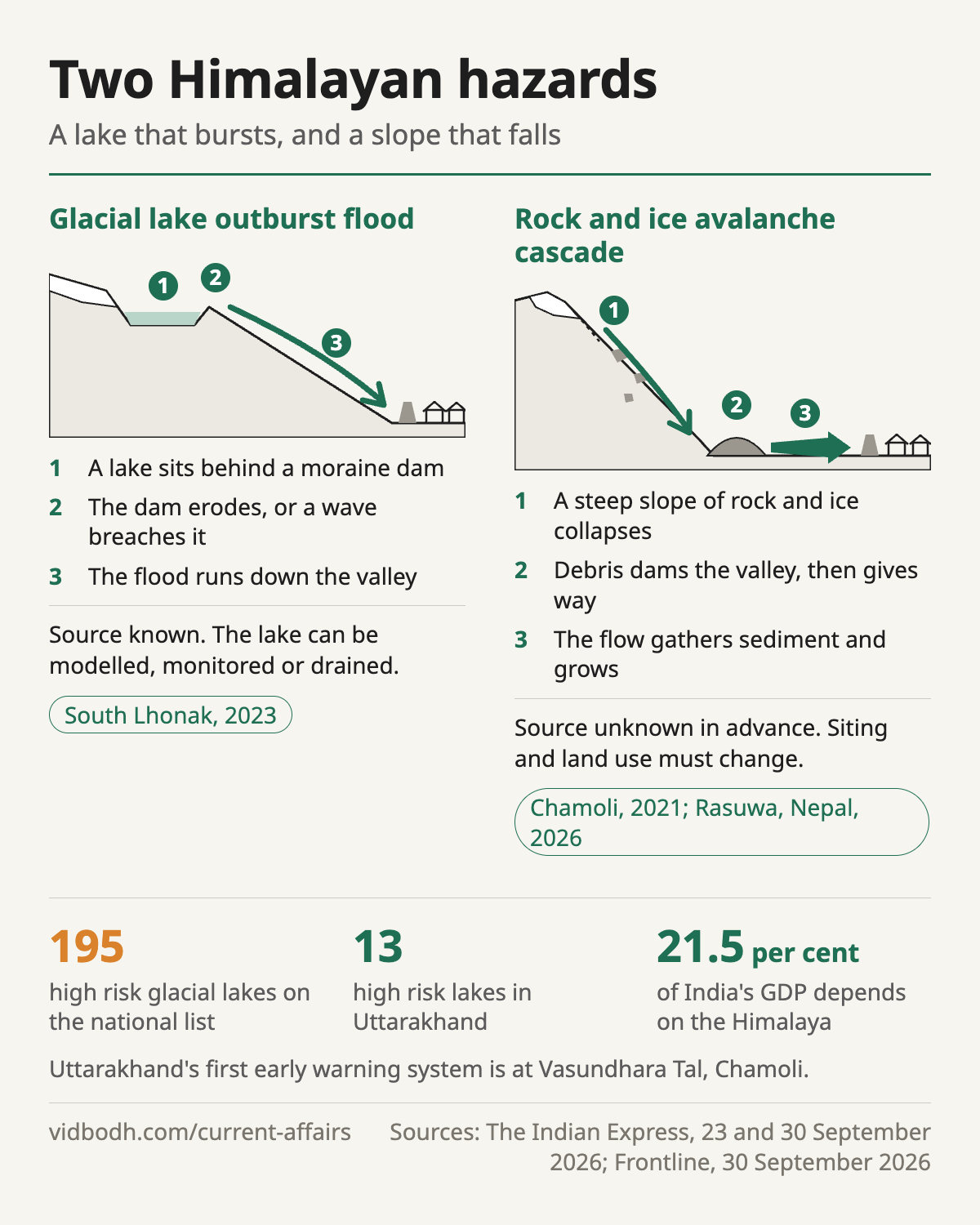
- A glacial lake outburst flood (GLOF) has a known source, the lake, which can be modelled, monitored or drained.
- A rock and ice avalanche cascade can begin on any of hundreds of thousands of steep slopes where permafrost is thawing, so it is far harder to plan for.
- Chamoli in 2021 and Rasuwa in Nepal in 2026 were both cascades, and in both many of the dead and missing were hydropower workers in the path of the flow.
What India has built
- The National Disaster Management Authority keeps a list of 195 high risk lakes, and a National GLOF Risk Mitigation Programme covers Arunachal Pradesh, Himachal Pradesh, Sikkim and Uttarakhand.
- The Central Water Commission scores lakes on twelve criteria, giving 30 of 100 marks to downstream vulnerability, because risk is hazard meeting exposure.
- The Vasundhara Tal system tracks water level, weather, ground movement and discharge, and sends data by satellite to a dashboard that raises an alert at set thresholds.
The gaps
- Detection is not warning: the alert has to reach districts, project operators and villages in time, and people act on it only if they trust it.
- The Nepal flow crossed the border with Tibet, and there is no shared data feed across it, so a warning system that stops at the border misses half the hazard.
- Black carbon from brick kilns, cookstoves and crop burning darkens snow and speeds melting, and accounts for about a third of Himalayan glacier mass loss.
A lake outburst and an avalanche cascade
| Glacial lake outburst flood | Rock and ice avalanche cascade | |
|---|---|---|
| Source | one known lake | any steep, deglaciating slope |
| Trigger | the moraine dam erodes, or a wave from a falling mass breaches it | a slope of rock and ice collapses |
| What can be done | the lake can be modelled, monitored or drained | hard to plan for; siting and land use must change |
| Cases | South Lhonak, 2023 | Chamoli, 2021; Rasuwa, 2026 |
The way forward
- Site hydropower and settlements with the cascade hazard in mind, since many Himalayan dams were planned decades ago without knowledge of climate change.
- Share warning data across borders, which India can lead with early warning data from ISRO and a regional risk and insurance facility.
- Cut black carbon at the scale of the airshed, taking kilns, cookstoves, transport and crop residue burning together.
Prelims facts
- Permafrost is ground that stays frozen for at least two consecutive years.
- Peak water is the point at which glacier meltwater reaches its maximum, after which river flow declines.
- Vasundhara Tal is in Chamoli, Uttarakhand; Ladakh has the most glacial lakes of any State or Union Territory.
- The Hindu Kush Himalaya could lose up to 80 per cent of its present glacier volume by 2100.
See also: The Nepal flood of August 2026
Sources: The Indian Express, 30 Sep 2026: Uttarakhand's first glacial lake early-warning system: What it will monitor, why it matters (opens in a new tab) · Frontline, 30 Sep 2026: India can see the danger in the Himalaya. Can it manage the risk? (opens in a new tab) · The Indian Express, 23 Sep 2026: Building trust is key in warnings on melting glaciers (opens in a new tab) · The Indian Express, 19 Sep 2026: AI can be used to map hazards during disasters like Nepal floods: Kamal Bawa, Founder, ATREE (opens in a new tab) · The Indian Express, 17 Sep 2026: Why melting glaciers could 'put 20% of India's GDP at risk', and one change that can help (opens in a new tab) · The Hindu, 18 Sep 2026: Why WFP has called Nepal flood relief one of its toughest missions | Explained (opens in a new tab) · The Indian Express, 21 Sep 2026: Nepal's climate call is a test for India (opens in a new tab)
Earlier coverage: Glacial lake risk in India · The monthly magazine, September 2026