Reserves bought, not earned: the swap window and the liquidity glut
LeadPrelims and MainsSeptember 2026
Why in news
India's foreign exchange reserves rose by a record amount in the first week of September 2026 to about 786 billion dollars, the fourth largest in the world. Most of the rise came from deposits raised under the Reserve Bank's swap window, which closed for deposits on 31 August.
Background
- In June the Reserve Bank opened a window under which banks could swap dollars raised from non residents for rupees, at a subsidised cost (see the June lead).
- By 31 August about 136 billion dollars had come in, almost all of it as Foreign Currency Non Resident (FCNR) deposits with banks, known as FCNR(B) deposits. In 2013 a similar window brought 34 billion.
- The rupee steadied, and reserves reached a record.
Why these reserves are borrowed
- Reserves built from a surplus on the current account are earned. Direct investment brings no fixed date of repayment.
- Reserves that come through a swap carry a promise: the Reserve Bank must return the dollars when the swap matures.
- So the headline figure rises, and the Reserve Bank's forward liabilities rise with it.
- The swap covers the principal only. Banks must find dollars for the interest, and many have not hedged that.
The rupee side: too much money
- For every dollar it takes in, the Reserve Bank releases rupees.
- The surplus in the banking system reached about ₹10 lakh crore, the highest in four years.
- These deposits are exempt from the cash reserve ratio, which adds to the effect.
- Surplus money pushes short term rates below the repo rate, at a time when inflation is above 4 per cent. Policy says one thing and the market another.
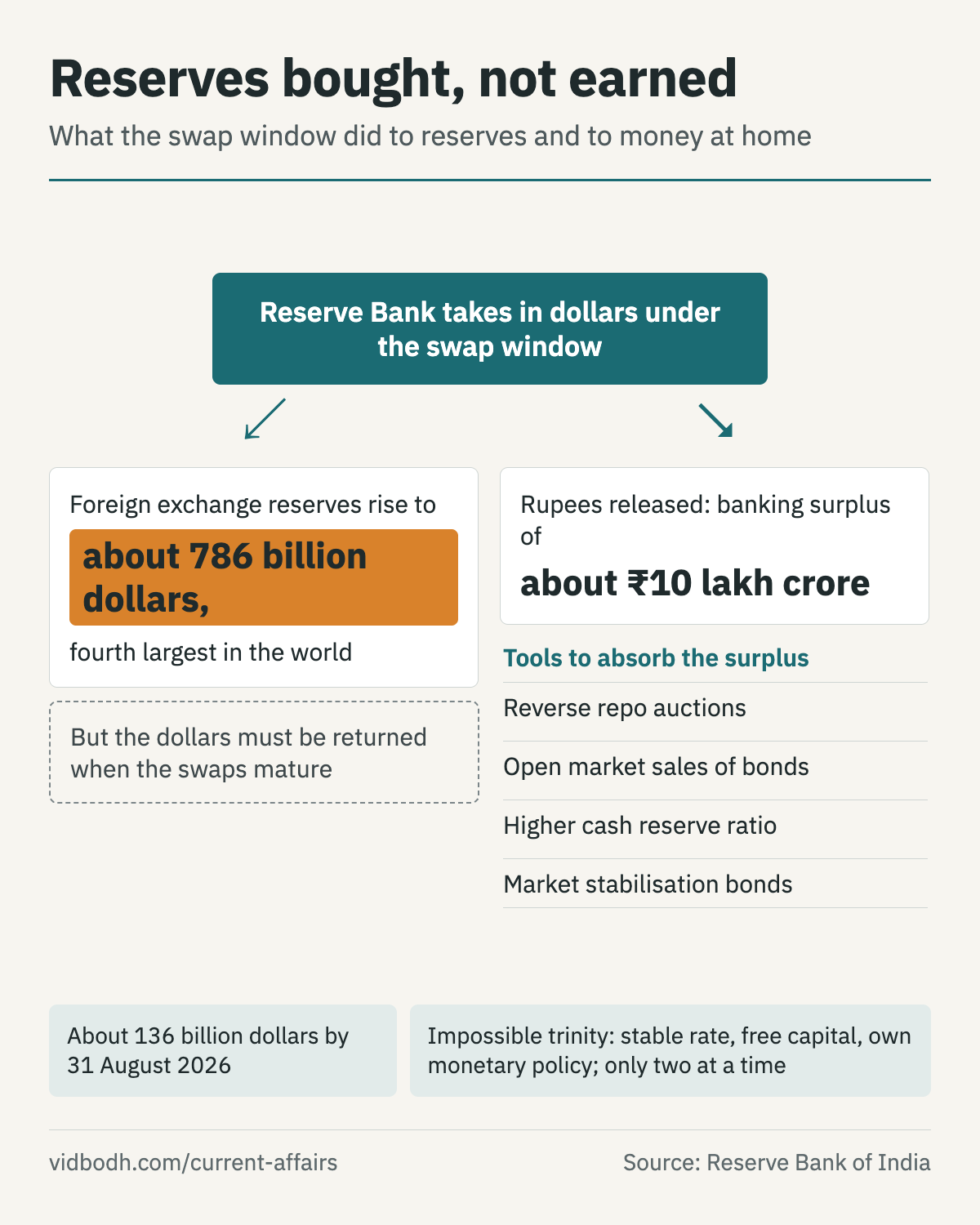
How a central bank mops up money
- Reverse repo auctions: taking money from banks for a short period. The Reserve Bank has been doing this.
- Open market sales of government bonds.
- A higher cash reserve ratio.
- Market stabilisation bonds, issued by the government only to absorb money.
- Each has a cost: interest paid to banks, or a higher cost of credit.
The impossible trinity
- A country cannot have all three: a stable exchange rate, free movement of capital and an independent monetary policy.
- India chose in 2026 to steady the rupee and welcome capital. The price is paid in control over money at home.
The way forward
- Sterilise the surplus step by step, without choking credit.
- Replace swap dollars with lasting inflows before the deposits mature in three to five years.
- Make banks hedge their interest exposure.
- Stagger the maturities, so that repayments do not bunch.
Prelims facts
- Reserves have four parts: foreign currency assets, gold, Special Drawing Rights and the reserve tranche position.
- India's reserves rank fourth, after China, Japan and Switzerland.
- A reverse repo absorbs money; a repo injects it.
- FCNR(B) deposits are exempt from the cash reserve ratio and the statutory liquidity ratio under this window.
- The Market Stabilisation Scheme dates from 2004.
See also: Defending the rupee
Sources: The Hindu, 11 Sep 2026: India's forex reserves jump by a record $44.903 billion (opens in a new tab) · The Hindu, 9 Sep 2026: FCNR(B) deposits: Who bears the currency risk? Explained (opens in a new tab) · Reserve Bank of India, 2 Sep 2026: Forex inflows under the swap facility (opens in a new tab) · The Hindu, 2 Sep 2026: RBI's forex swap facility draws over $136 billion (opens in a new tab) · The Hindu, 21 Sep 2026: FCNR(B) $133bn windfall: banks gain funding boost, face future refinancing test (opens in a new tab) · News On AIR, 22 Sep 2026: RBI receives over $143.5 billion through special forex swap facility (opens in a new tab) · The Hindu, 14 Sep 2026: Retail inflation rises to 4.82% in August (opens in a new tab) · The Hindu, 15 Sep 2026: August retail inflation raises chances of RBI rate hike in October, say economists (opens in a new tab) · The Hindu, 5 Aug 2026: Sensex gains as RBI keeps policy rates unchanged (opens in a new tab) · Ministry of Statistics and Programme Implementation, 14 Sep 2026: Consumer Price Index, August 2026 (opens in a new tab) · GoldenPi, 5 Aug 2026: RBI MPC August 2026 meeting highlights: repo rate held, forecasts revised (opens in a new tab)
Earlier coverage: The swap window, reserves and liquidity · The monthly magazine, September 2026