History atlas · Theme 11
Contemporary powers: Vakatakas, Kadambas, Western Gangas, early Pallavas
250 to 600 CE; the Western Gangas run on to 1000
The Guptas governed the Ganga basin directly and the rest of India through relationships: alliance with the Vakatakas, conquest of the Western Satraps, nominal submission from the far south. Meanwhile the Deccan and the south were developing independently, as the Vakatakas, Kadambas, Western Gangas and Pallavas built the institutions, temple architecture and regional identities that dominated after the Guptas fell. Gupta power in the peninsula worked through marriage, tribute and prestige, which is why it dissolved so completely, and the Chalukyas and Pallavas of the seventh century emerge from this world.
- Kingdom around its capital, borders not fixed
- Capital
- Cave inscription
- Site
- Sacred site
- Port
- UNESCO World Heritage Site
- The Talagunda pillar inscription, of Kakusthavarman's reign, tells the Kadamba founding story of Mayurasharman.
- The Hirahadagalli and Mayidavolu copper plates, issued in Prakrit, make Sivaskandavarman the first clearly historical Pallava.
- An Ajanta inscription calls the founder Vindhyashakti a dvija, and the Cave 16 inscription names Harishena's minister Varahadeva.
- The Prayaga Prashasti lists Vishnugopa of Kanchi among the kings of Dakshinapatha whom Samudragupta captured and released.
- Prabhavatigupta's copper plates, in her own name and with the Gupta formula, document her regency.
- About a dozen copper plate grants from Vidarbha belong to Pravarasena II, the largest number of any Vakataka.
- The poet Dandin, in the sixth century, describes Harishena as powerful, truthful and bountiful.
- The Puranas call the Vakatakas Vindhyakas, and the Halmidi inscription of about 450 CE is the oldest in Kannada.
- Vindhyashakti founded the Vakataka line, and Pravarasena I, alone among Vakataka rulers, took the title Samrat.
- Rudrasena II married Prabhavatigupta, who then ruled as regent, and Pravarasena II wrote the Setubandha.
- Sarvasena founded the Vatsagulma branch and wrote the Harivijaya, and Harishena united the two branches.
- Mayurasharman, later Mayuravarman, founded the Kadambas, and Kakusthavarman was their greatest king.
- Konganivarman Madhava founded the Western Gangas, Durvinita was a scholar king, and Chamundaraya served Rachamalla.
- Sivaskandavarman is the first clearly historical Pallava, Vishnugopa met Samudragupta, and Simhavishnu defeated the Kalabhras.
- Dignaga, founder of Buddhist logic, studied at Kanchipuram, and the poet Dandin praised Harishena.
Vindhyashakti
king
Founder of the Vakataka line, about 250 to 270 CE; described as a dvija in an Ajanta inscription.
Pravarasena I
king
About 270 to 330 CE; the real builder of Vakataka power; performed the ashvamedha and vajapeya; alone took the title Samrat.
Rudrasena I
king
Grandson of Pravarasena I; founder of the Nandivardhana branch.
Sarvasena
king
About 330 to 355 CE; son of Pravarasena I, founder of the Vatsagulma branch; wrote the Harivijaya, some verses of which entered the Gathasaptashati.
Prithvishena I
king
About 365 to 390 CE; likened to Yudhishthira; allied with Chandragupta II against the Shaka Satraps.
Rudrasena II
king
About 390 to 395 CE; married Prabhavatigupta and died after five years.
Pravarasena II
king
About 400 to 440 CE; originally Damodarasena; founded Pravarapura; wrote the Setubandha; a Shaiva.
Narendrasena
king
Held the Nandivardhana line under pressure from the Nalas and the southern branch.
Prithvishena II
king
Claimed twice to have rescued the sunken fortunes of the family.
Harishena
king
About 475 to 500 CE; the last great Vakataka; united the branches; Ajanta's second phase under his patronage.
Varahadeva
official
Harishena's minister, named in the Ajanta Cave 16 inscription.
Dandin
poet
Sixth century poet who describes Harishena as powerful, truthful and bountiful.
Mayurasharman
king; also Mayuravarman
Founder of the Kadambas; a Brahmin who took the name Mayuravarman.
Kakusthavarman
king
The greatest Kadamba; married his daughters into the Guptas and Vakatakas; the Talagunda pillar is of his reign.
Konganivarman Madhava
king
Founder of the Western Gangas, traditionally about 350 CE.
Durvinita
king
Sixth century Western Ganga scholar king, credited with a commentary on the Kiratarjuniya.
Rachamalla
king
The Western Ganga king whose minister commissioned the Gommateshvara.
Chamundaraya
official
Minister and general of Rachamalla; commissioned the Gommateshvara about 981 CE.
Sivaskandavarman
king
About the fourth century; the first clearly historical Pallava; Prakrit plates; the ashvamedha; Dharmamaharaja.
Vishnugopa
king
Of Kanchi; among the kings of Dakshinapatha captured and released by Samudragupta.
Simhavarman
king
Pallava; his charters mark the shift from Prakrit to Sanskrit.
Simhavishnu
king
About 575 to 600 CE; defeated the Kalabhras and took the title Avanisimha, opening the imperial Pallava phase.
- The Guptas governed the Ganga basin directly, but their power in the peninsula was indirect, through marriage, tribute and prestige.
- The Deccan and the south were developing independently, and the Chalukyas and Pallavas of the seventh century emerge from this world.
The Vakatakas
about 250 to 500 CE
- The Vakatakas succeeded the Satavahanas in the Deccan and were the exact contemporaries of the Guptas.
- They were Brahmins, called Vindhyakas by the Puranas, yet the greatest Buddhist art of the period was made under them.
- Their inscriptions resemble the Pallavas', and no record has been found north of the Narmada, which argues for a southern origin.
- They ruled from southern Malwa and Gujarat to the Tungabhadra, and from the Arabian Sea to the borders of Chhattisgarh.
- They married into the Guptas, the Nagas of Padmavati, the Kadambas and the Vishnukundins.
- Pravarasena I performed the ashvamedha and the vajapeya, and after him the house split into two branches.
- Prithvishena I allied with Chandragupta II, and together they broke the Shaka Satraps of Malwa and Kathiawar.
- Prabhavatigupta's plates, in her own name and using the Gupta formula, mark a period of Gupta influence over the Deccan.
- Pravarasena II, originally Damodarasena, founded Pravarapura and issued about a dozen copper plate grants from Vidarbha.
- Narendrasena and Prithvishena II held the Nandivardhana line under pressure from the Nalas and the southern branch.
- Harishena, about 475 to 500 CE, united the branches and conquered Kuntala, Avanti, Kosala, Kalinga, Konkan and Andhra.
- After Harishena the dynasty collapsed quickly, its lands taken by the Nalas, Kadambas, Kalachuris and Yashodharman.
The Kadambas of Banavasi
about 345 to 525 CE
- Mayurasharman, a Brahmin insulted at Kanchipuram, abandoned his sacrificial grass for the sword and carved out a kingdom.
- The story comes from the Talagunda inscription, one of the clearest instances of a Brahmin founding a royal line.
- Recognised by the Pallavas, he took the name Mayuravarman, with a Kshatriya style ending, and ruled from Banavasi.
- The Kadambas were the first kingdom to use Kannada in administration alongside Sanskrit.
- Kakusthavarman married his daughters into the Guptas, the Vakatakas and other houses.
- Primarily Shaiva but tolerant, they also patronised Jainism, and were absorbed by the Chalukyas of Badami in the sixth century.
The Western Gangas of Talakad
about 350 to 1000 CE
- They ruled Gangavadi, southern Karnataka, from Kolar and then Talakad on the Kaveri.
- Founded by Konganivarman Madhava about 350 CE, they lasted about six and a half centuries, usually as subordinates.
- They were the most important patrons of Jainism in the Deccan.
- The Gommateshvara at Shravanabelagola was commissioned about 981 CE by Chamundaraya, minister of the Ganga king Rachamalla.
- Durvinita, in the sixth century, was a scholar king credited with a commentary on the Kiratarjuniya.
The early Pallavas
third to sixth century
- They ruled Tondaimandalam, northern Tamil Nadu and southern Andhra, from Kanchipuram, with the port at Mamallapuram.
- The early Pallavas issued charters first in Prakrit and then in Sanskrit, a regional power among several.
- Sivaskandavarman, known from the Hirahadagalli and Mayidavolu plates, performed the ashvamedha and was titled Dharmamaharaja.
- Vishnugopa of Kanchi was among the kings of Dakshinapatha whom Samudragupta captured and released, the one direct Gupta and Pallava meeting.
- Simhavarman and the later charters mark the shift from Prakrit to Sanskrit in Pallava administration.
- Simhavishnu, about 575 to 600 CE, defeated the Kalabhras, took the title Avanisimha and began the imperial phase.
Other powers
- The Vishnukundins of the Krishna and Godavari deltas are the bridge between the Ikshvakus and the Eastern Chalukyas.
- The Nalas of Bastar and Koraput fought the Vakatakas repeatedly in the fifth century.
- The Ikshvakus of the lower Krishna valley built Nagarjunakonda, where their queens were Buddhist donors though the kings performed Vedic sacrifices.
- The Maitrakas of Valabhi, from about 475 CE, were Gupta governors who became independent, and Valabhi became a centre of Buddhist learning.
- The Maukharis of Kannauj and the Pushyabhutis of Thanesar emerged in the sixth century from the wreckage of Gupta authority.
The two Vakataka branches
Pravarapura and Nandivardhana
- Capital at Nandivardhana near Nagpur, later Pravarapura at Paunar
- Founded by Rudrasena I, grandson of Pravarasena I
- Vidarbha and the northern Deccan
- The Gupta marriage alliance runs through this branch
- Greatest ruler: Pravarasena II
Vatsagulma
- Capital at Vatsagulma, modern Washim
- Founded by Sarvasena, son of Pravarasena I
- Between the Sahyadri range and the Godavari
- The Ajanta patronage runs through this branch
- Greatest ruler: Harishena
The four houses beside the Guptas
About 250 to 270 CE
Vindhyashakti founds the Vakataka line
About 319 to 335 CE
Chandragupta I founds Gupta imperial power
About 335 to 375 CE
Samudragupta captures and releases Vishnugopa of Kanchi
About 345 CE
Mayurasharman founds the Kadambas at Banavasi
About 350 CE
Konganivarman Madhava founds the Western Gangas
About 365 to 390 CE
Prithvishena I allies with Chandragupta II against the Shaka Satraps
About 390 to 395 CE
Rudrasena II marries Prabhavatigupta; her regency follows
About 400 to 440 CE
Pravarasena II founds Pravarapura
About 455 to 467 CE
Skandagupta, the last effective Gupta
About 475 to 500 CE
Harishena unites the Vakatakas; Ajanta's second phase
About 525 CE
The Kadambas end, absorbed by the Chalukyas of Badami in the sixth century
About 575 to 600 CE
Simhavishnu defeats the Kalabhras; the imperial Pallavas begin
About 981 CE
Chamundaraya commissions the Gommateshvara under the Western Gangas
- The Vakatakas were a Brahmin dynasty, yet Ajanta's second phase, the finest ancient Indian painting, is Vakataka work.
- Cave 16 carries an inscription of Harishena's minister Varahadeva.
- Pravarasena II's Setubandha, on Rama's bridge to Lanka, and Sarvasena's Harivijaya are major Prakrit kavyas.
- The Vaidarbhi riti, the Vidarbha style of Sanskrit marked by clarity, sweetness and restraint, was praised by Kalidasa, Dandin and Banabhatta.
- The Vakatakas were the Deccan bridge between north and south, and their Gupta alliance made the conquest of the Western Satraps possible.
- Marriage was an instrument of power: the Vakatakas and the Kadamba Kakusthavarman married into the leading houses.
- The Kadambas and the Gangas shaped early Kannada literature and the Jain character of medieval Karnataka.
- The Halmidi inscription of about 450 CE is the oldest Kannada inscription.
- Kanchipuram, later counted among the seven sacred cities, was a major Sanskrit and Tamil literary centre.
- Its standing explains why the Kadamba story begins with a Brahmin going to Kanchi to study, and why Samudragupta's claim over Vishnugopa mattered.
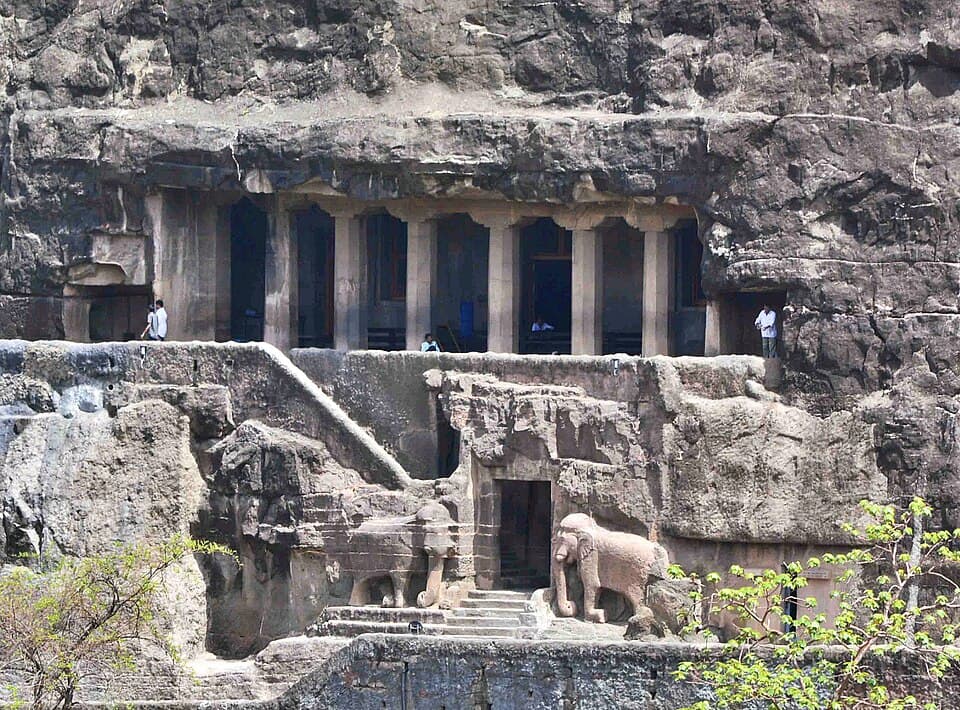
Ajanta Cave 16
Cave 16 carries an inscription of Harishena's minister Varahadeva, from Ajanta's second phase under Vakataka patronage.
Anupamg, CC BY-SA 4.0, via Wikimedia Commons
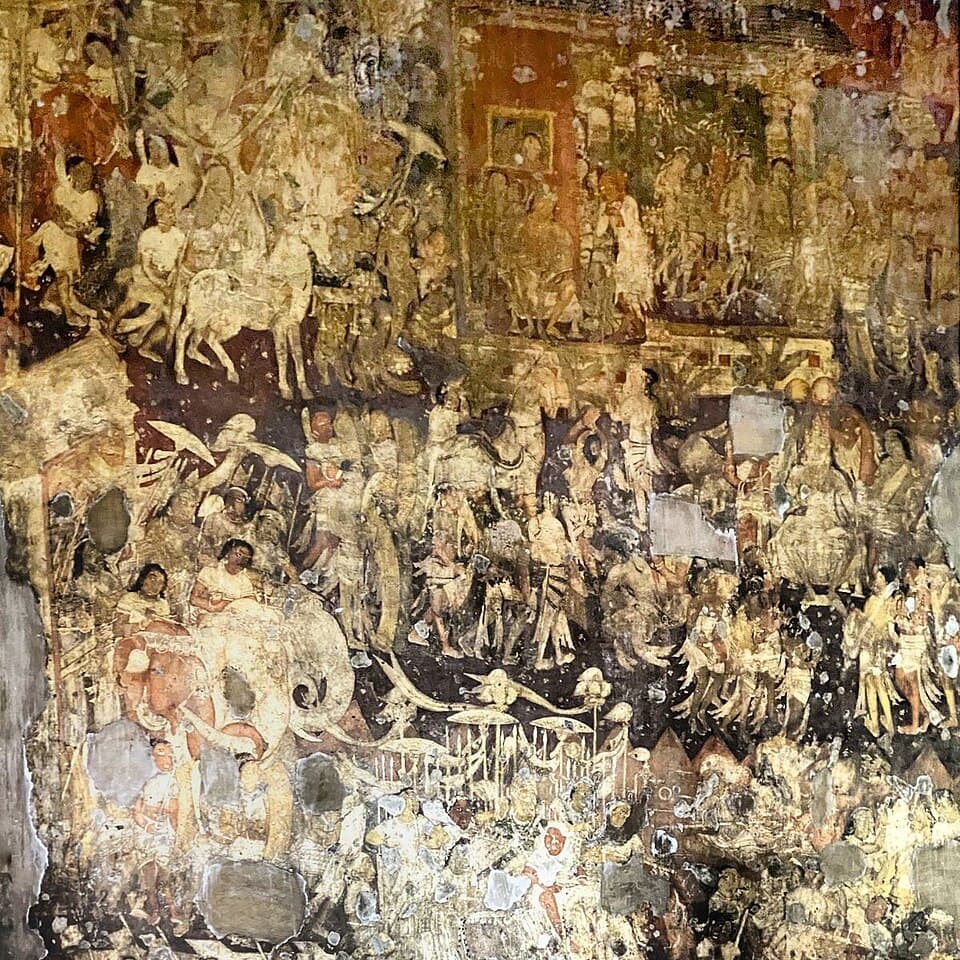
A painting in Ajanta Cave 17
Cave 17 holds the largest number of surviving paintings; the finest ancient Indian painting is Vakataka work.
SpeakingArch, CC BY-SA 4.0, via Wikimedia Commons
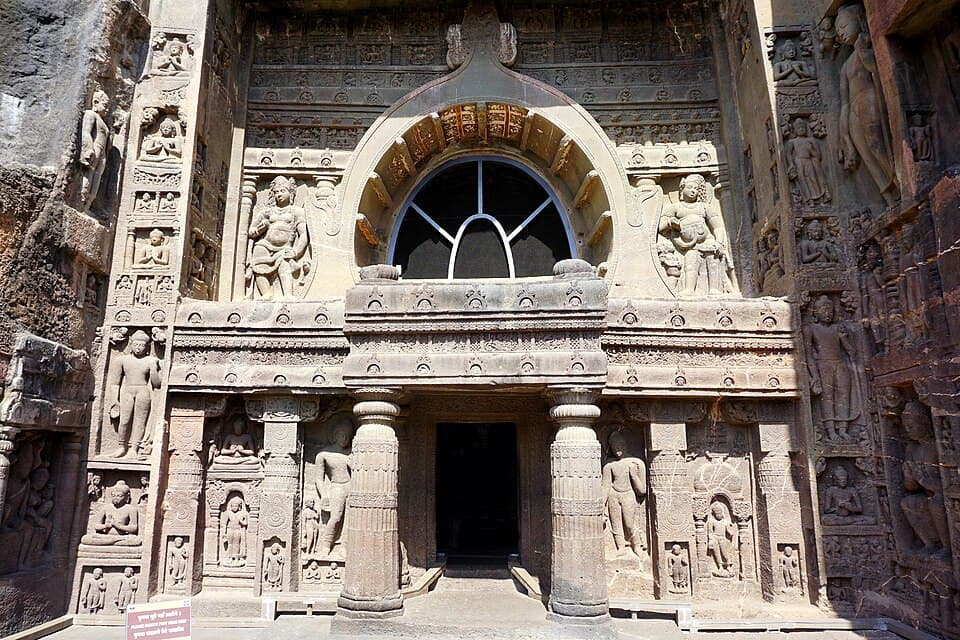
The facade of Ajanta Cave 19
Caves 19 and 26 are the finest chaitya halls of the second phase.
Photo Dharma from Sadao, Thailand, CC BY 2.0, via Wikimedia Commons
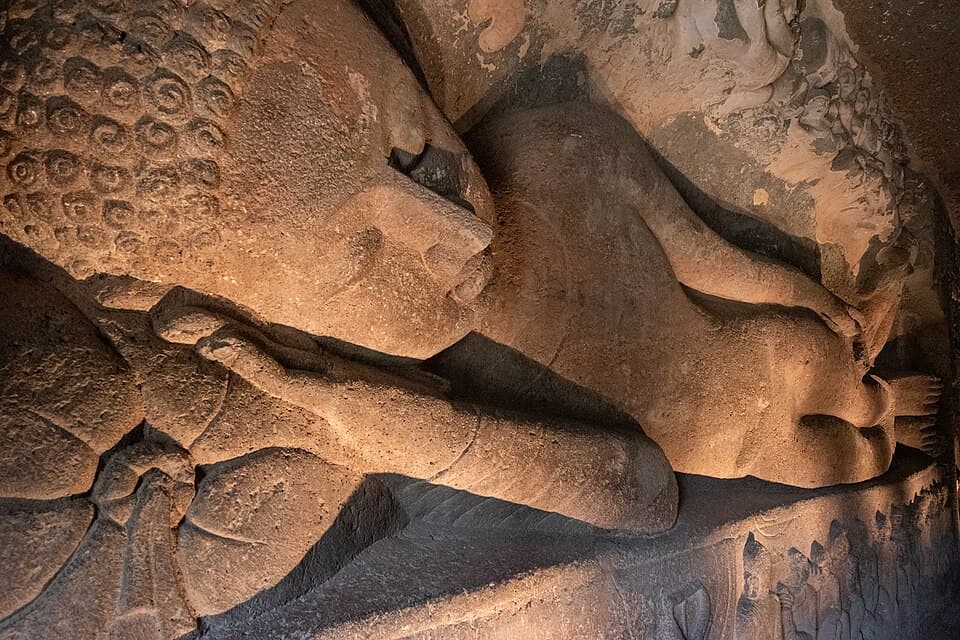
The Mahaparinirvana, Ajanta Cave 26
The great second phase of Ajanta, including cave 26, was executed under Vakataka patronage, above all under Harishena.
Rohit Sharma, CC BY-SA 4.0, via Wikimedia Commons

The Talagunda pillar inscription
It tells the Kadamba founding story of Mayurasharman, and belongs to Kakusthavarman's reign.
Dineshkannambadi, CC BY-SA 3.0, via Wikimedia Commons

The Halmidi inscription
The oldest Kannada inscription, of about 450 CE; the Kadambas were the first to use Kannada in administration.
Dineshkannambadi, CC BY-SA 3.0, via Wikimedia Commons
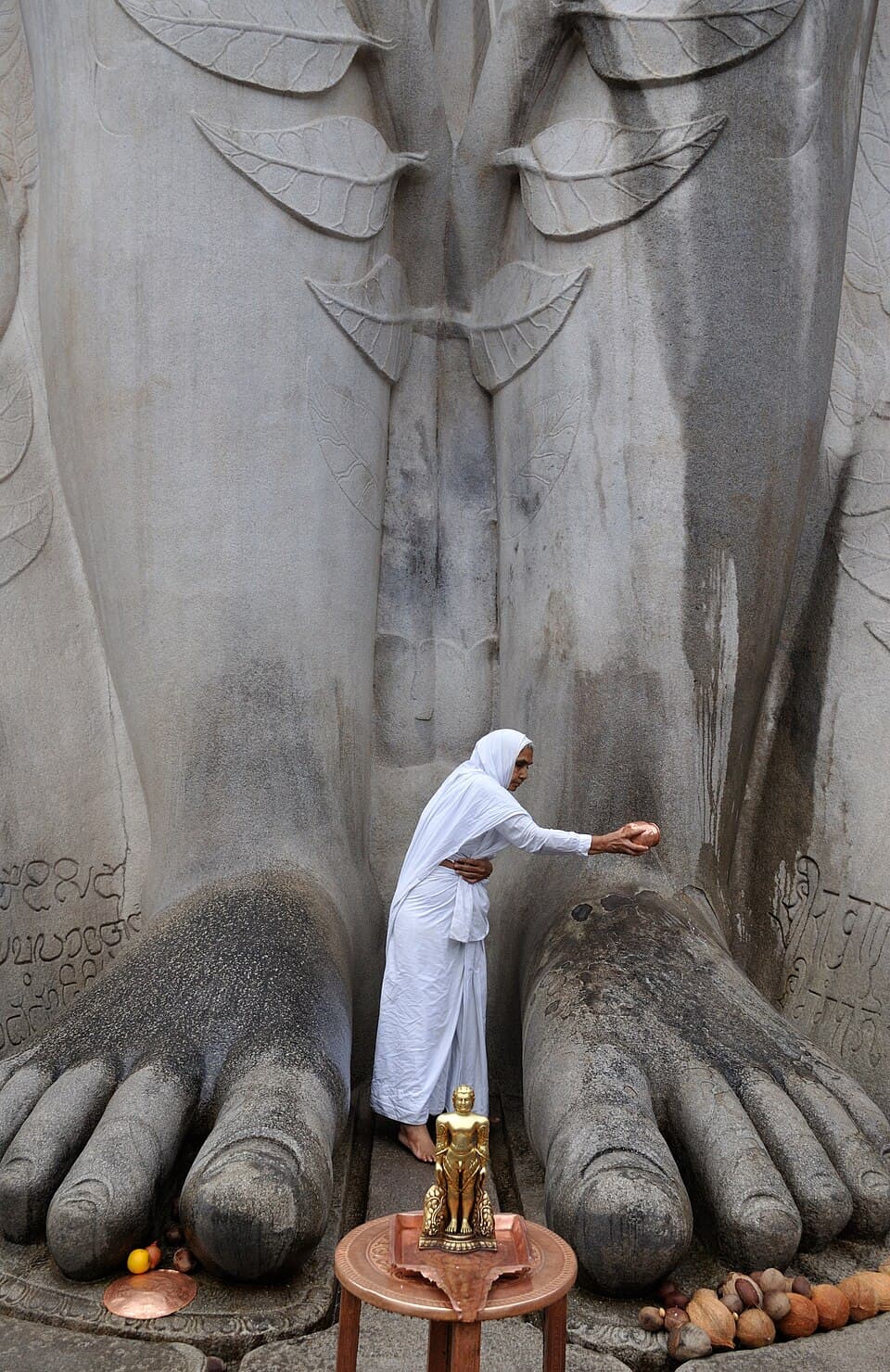
The Gommateshvara, Shravanabelagola
About 17 metres high, commissioned about 981 CE by Chamundaraya, minister of the Ganga king Rachamalla: Ganga patronage, not Chalukya or Hoysala.
Dey.sandip, CC BY-SA 4.0, via Wikimedia Commons


- Samrat
- Emperor; taken by Pravarasena I alone among the Vakatakas, the others using Maharaja.
- Vaidarbhi riti
- The Vidarbha style of Sanskrit composition, marked by clarity, sweetness and restraint.
- Dvija
- Twice born; Vindhyashakti is so described in an Ajanta inscription.
- Vindhyakas
- The Puranas' name for the Vakatakas.
- Gangavadi
- The land of the Western Gangas, southern Karnataka.
- Tondaimandalam
- The Pallava land of northern Tamil Nadu and southern Andhra.
- Dharmamaharaja
- The title of the early Pallava Sivaskandavarman.
- Avanisimha
- Lion of the earth; the title Simhavishnu took after defeating the Kalabhras.
- Kalabhra
- The power in the south whom Simhavishnu defeated, opening the imperial Pallava phase.
- Gommateshvara
- The Jain monolith at Shravanabelagola, about 17 metres high, of about 981 CE.
- Setubandha
- Pravarasena II's Maharashtri Prakrit kavya on Rama's bridge to Lanka, also called Ravanavaha.
- Harivijaya
- Sarvasena's Prakrit kavya.
Where did the Vakatakas come from?
The south
- Their inscriptions resemble the Pallavas', and no Vakataka record has been found north of the Narmada.
Open
- Their origins are debated, and the southern case rests on the absence of northern records.
The evidence argues for a southern origin, without settling it.
Where did the Pallavas come from?
Parthians or a local lineage
- One theory makes them Pahlavas from the name; another a local Tamil or Telugu lineage, perhaps linked to the Kurumbas.
Northern migrants or Satavahana feudatories
- Others see a northern family that migrated south, or Satavahana feudatories who rose after that empire fell.
The last two theories carry most weight today.
Whose monuments are Ajanta's paintings and the Gommateshvara?
The common attribution
- Ajanta's paintings are often called Gupta, and the Gommateshvara is often given to the Chalukyas or Hoysalas.
The patrons
- Ajanta's second phase was made under Vakataka patronage, and the Gommateshvara by Chamundaraya under the Gangas.
Both are frequently confused: Ajanta is Vakataka work, the Gommateshvara Ganga.