Ecology & Environment
Threatened Species of India
Critically Endangered, Endangered and Vulnerable species.
IUCN statuses change, so keep them updated from current affairs.
Three categories mean threatened: Critically Endangered, Endangered and Vulnerable. What each of them means, and the categories either side of them, is set out below the list.
Critically Endangered
2 speciesAnamalai Flying FrogRhacophorus pseudomalabaricus
AmphibianEndemic · Anamalai Hills, Western Ghats
Canopy of evergreen forest in the Anamalai and Cardamom hills, 1,000 to 1,400 m.
Glides between trees using extensive webbing between the toes. Breeds in tree holes and foam nests over water.
Kerala · Tamil Nadu
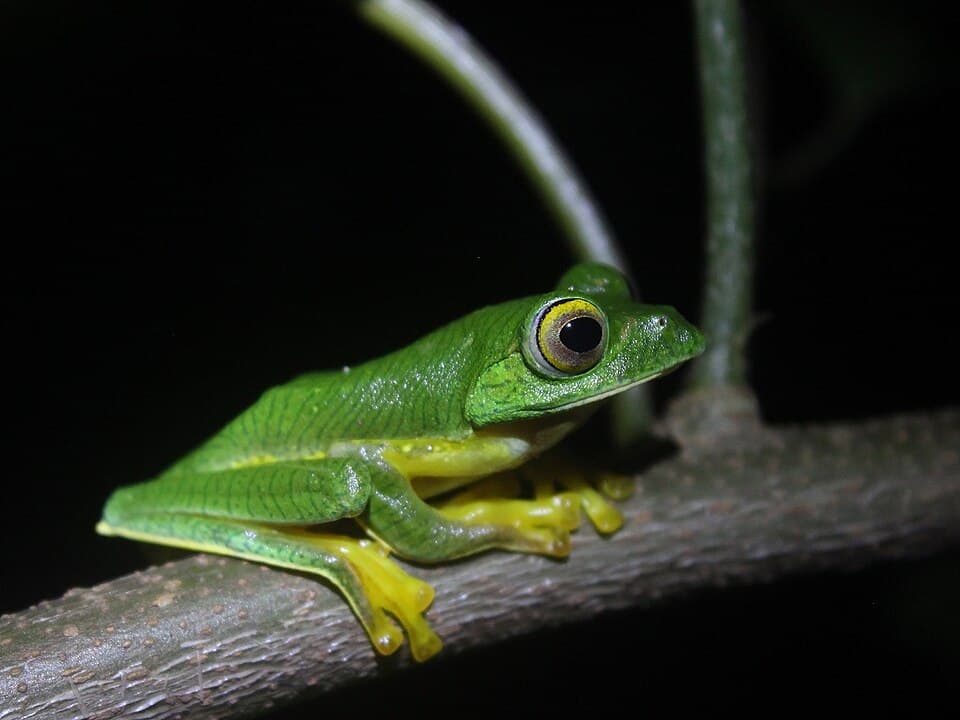
Photo: Vijay Karthick · CC BY-SA 4.0 · Wikimedia Commons Resplendent Shrub FrogRaorchestes resplendens
AmphibianEndemic · Anamudi summit
Restricted to about three square kilometres of grassland on the summit of Anamudi in Eravikulam National Park.
A stout orange-red frog with one of the smallest ranges of any vertebrate. Develops directly from egg to froglet with no tadpole stage.
Kerala
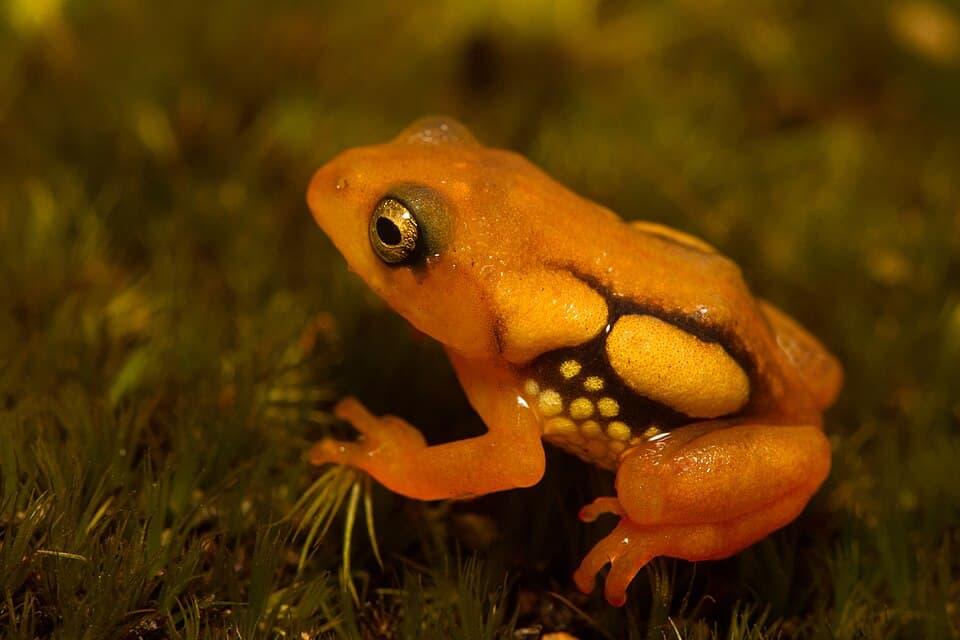
Photo: David V. Raju · CC BY-SA 4.0 · Wikimedia Commons


Endangered
1 speciesPurple Frog or Pig-nosed FrogNasikabatrachus sahyadrensis
AmphibianEndemic · Western Ghats
Spends almost its entire life underground in moist soil of the southern Western Ghats, surfacing for only a few days a year.
Described in 2003 and placed in its own family, with its closest relatives in the Seychelles. It is a living record of the break-up of Gondwana, having diverged over 100 million years ago. Feeds on termites through a fluted tongue pushed into their tunnels. State amphibian of Kerala.
Kerala · Tamil Nadu
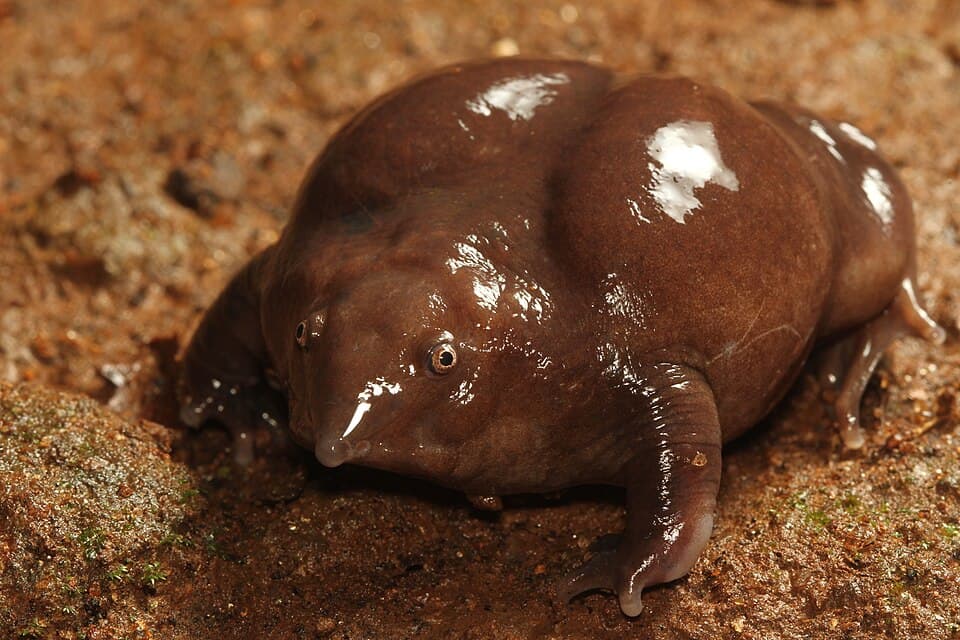
Photo: David V. Raju · CC BY-SA 4.0 · Wikimedia Commons

What the categories mean
IUCN Red List- EXExtinctNo reasonable doubt the last individual has died.
- EWExtinct in the WildSurvives only in cultivation, captivity or as a naturalised population outside its range.
- CRCritically EndangeredFacing an extremely high risk of extinction in the wild.
- ENEndangeredFacing a very high risk of extinction in the wild.
- VUVulnerableFacing a high risk of extinction in the wild.
- NTNear ThreatenedClose to qualifying as threatened, or likely to qualify soon. Not itself a threatened category.
- LCLeast ConcernAssessed, and does not qualify for any category above. Widespread and abundant species sit here.
The three that mean threatened. This page lists those and nothing else.
Outside the scale
- DDData DeficientNot enough information to assess the risk. It is a statement about the evidence, not about the species.
- NENot EvaluatedHas not yet been assessed against the criteria.
Recent status changes
12 to knowAssessments that have moved. Some of these species are no longer threatened and so are not in the list above.
Greater Adjutant
Downlisted from Endangered to Near Threatened in the 2023 Red List update, after the Hargila Army community programme in Assam raised nests in Kamrup from 28 in 2010 to more than 250. It should no longer be taught as Endangered.
Lesser Adjutant
Downlisted from Vulnerable to Near Threatened in 2023.
Painted Stork
Downlisted from Near Threatened to Least Concern in 2023.
Snow Leopard
Downlisted from Endangered to Vulnerable in 2017. Many Indian study materials still say Endangered.
Fishing Cat
Downlisted from Endangered to Vulnerable in 2016.
Asiatic Lion
The subspecies Panthera leo persica is assessed Endangered; the species Panthera leo is assessed Vulnerable. Both statements appear in print, so specify which you mean.
Himalayan Brown Bear
Often listed as Endangered or Critically Endangered in Indian material. The IUCN assesses the species Ursus arctos as Least Concern and has not assessed the Himalayan subspecies separately. It is Schedule I under the Wild Life (Protection) Act, which is a different thing from an IUCN category.
Red Sanders
Uplisted from Near Threatened to Endangered; older materials, including the handout, still say Near Threatened.
Indian Wild Ass
The species Equus hemionus is Near Threatened, not Endangered. The khur population in the Rann of Kachchh has grown steadily.
Blackbuck
Least Concern since 2017, not Near Threatened. It remains Schedule I in India.
Black-necked Crane
Downlisted from Vulnerable to Near Threatened in 2020.
Indian Leopard
Often taught as Near Threatened from older lists; the species has been Vulnerable since 2016.
What is being done
Species Recovery ProgrammeThe Government of India runs targeted recovery programmes for 22 entries covering 32 species, under the Integrated Development of Wildlife Habitats scheme. Three of them are Least Concern on the Red List and are on the national list all the same, because a programme answers to what has happened in India rather than to the species everywhere.
The Species Recovery Programme →Related current affairs
The topics that keep up with the news on this.