Ecology & Environment
Threatened Species of India
Critically Endangered, Endangered and Vulnerable species.
IUCN statuses change, so keep them updated from current affairs.
Three categories mean threatened: Critically Endangered, Endangered and Vulnerable. What each of them means, and the categories either side of them, is set out below the list.
Critically Endangered
50 speciesAndaman White-toothed ShrewCrocidura andamanensis
MammalEndemic · Andaman Islands
Leaf litter of tropical evergreen forest on South Andaman Island.
A nocturnal insectivore known from a handful of specimens. One of three shrews endemic to the islands, all Critically Endangered.
Andaman & Nicobar Islands
Jenkins's Andaman Spiny ShrewCrocidura jenkinsi
MammalEndemic · Andaman Islands
Forest floor of Mount Harriet, now Mount Manipur, on South Andaman.
Known only from the type locality. Distinguished by stiff, spiny guard hairs.
Andaman & Nicobar Islands
Nicobar White-tailed ShrewCrocidura nicobarica
MammalEndemic · Great Nicobar
Coastal forest of Great Nicobar around Campbell Bay.
Restricted to a very small area now overlapped by the Great Nicobar development project.
Andaman & Nicobar Islands
Kashmir Stag or HangulCervus hanglu hanglu
MammalEndemic · Kashmir Himalaya
Temperate riverine and coniferous forest, 1,700 to 4,000 m, almost entirely inside Dachigam National Park.
The only surviving red deer of the Indian subcontinent and the state animal of Jammu and Kashmir. Population about 300. Project Hangul and a second home at Tral Wildlife Sanctuary are the main interventions.
Jammu & Kashmir
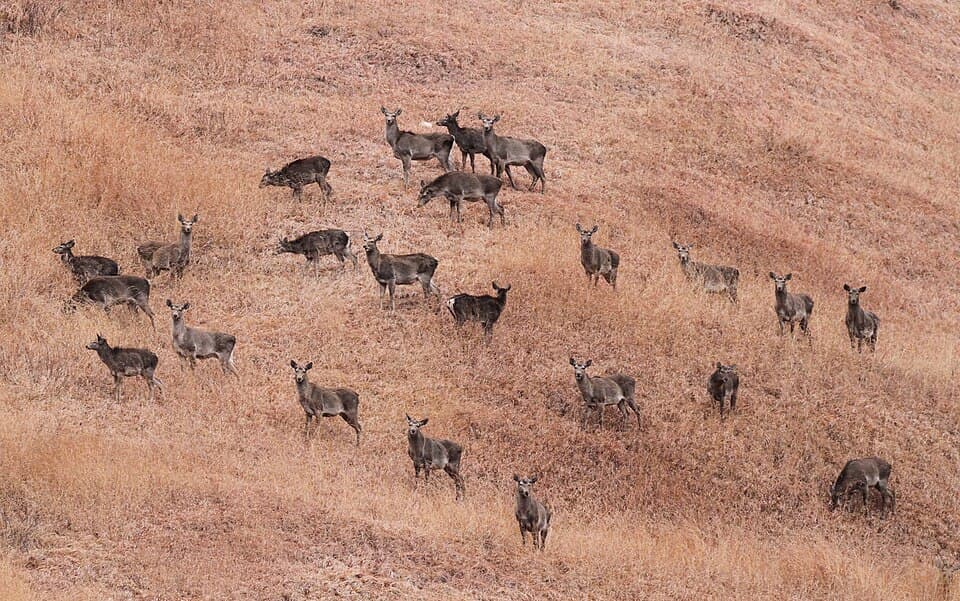
Photo: Tahirshawl · CC BY-SA 4.0 · Wikimedia Commons Elvira Rat or Large Rock RatCremnomys elvira
MammalEndemic · Eastern Ghats
Rocky slopes with dry deciduous and scrub forest in the Eastern Ghats around Salem.
A nocturnal, seed-eating rodent known from very few localities.
Tamil Nadu
Malabar CivetViverra civettina
MammalEndemic · Western Ghats
Lowland forest, cashew plantations and degraded coastal thickets of the Malabar coast.
Possibly already extinct. There has been no confirmed record for decades. Historically hunted for civetone, used in perfumery.
Kerala · Karnataka
Namdapha Flying SquirrelBiswamoyopterus biswasi
MammalEndemic · Namdapha
Tropical evergreen forest in the Noa-Dihing valley, Namdapha National Park.
Known from a single specimen collected in 1981. Among the rarest mammals in the world.
Arunachal Pradesh
Kondana Soft-furred RatMillardia kondana
MammalEndemic · Sinhagad plateau
Grass and scrub on the Sinhagad plateau near Pune, above 900 m.
Confined to an area of a few square kilometres under heavy tourism pressure.
Maharashtra
Chinese PangolinManis pentadactyla
Mammal
Subtropical and tropical forest, grassland and plantations of the north east and eastern Himalaya.
The world's most trafficked mammal group. Scales are smuggled for traditional medicine. Note that India has two pangolins: this one is Critically Endangered, the Indian pangolin is Endangered.
Assam · Arunachal Pradesh · Meghalaya · Nagaland · Manipur · Mizoram · Tripura · Sikkim · West Bengal
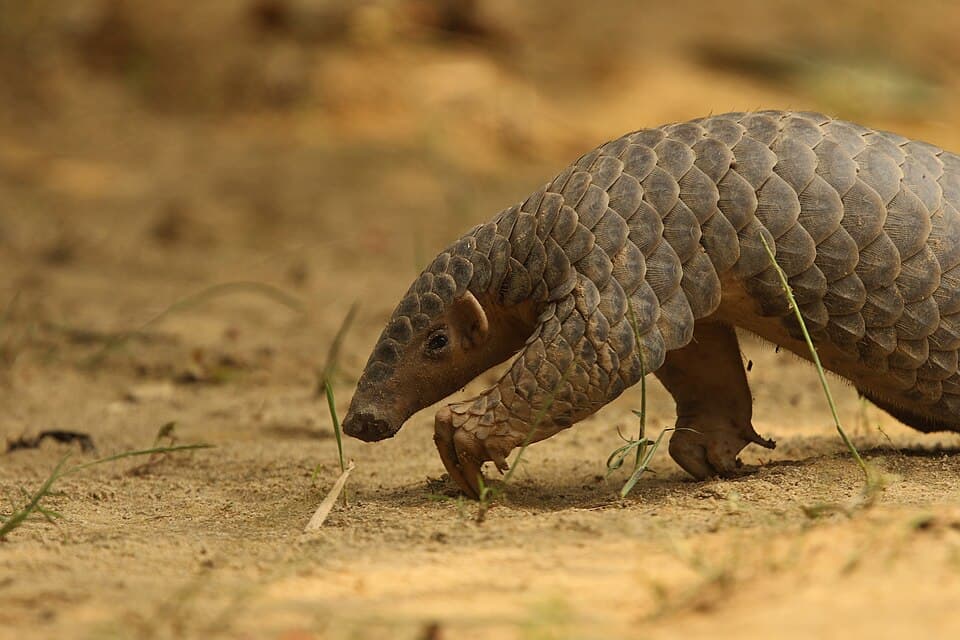
Photo: Adnan azad asif · CC BY-SA 4.0 · Wikimedia Commons Great Indian BustardArdeotis nigriceps
BirdEndemic · Indian subcontinent
Arid and semi-arid grassland, scrub and cropland. Core population in and around Desert National Park, Jaisalmer.
State bird of Rajasthan and among the heaviest flying birds. Fewer than 150 birds survive. Collision with overhead power lines is the single largest cause of adult mortality; the Supreme Court ordered undergrounding in 2021 and modified that order in March 2024. Conservation breeding centres at Sam and Ramdevra.
Rajasthan · Gujarat · Maharashtra · Karnataka · Andhra Pradesh
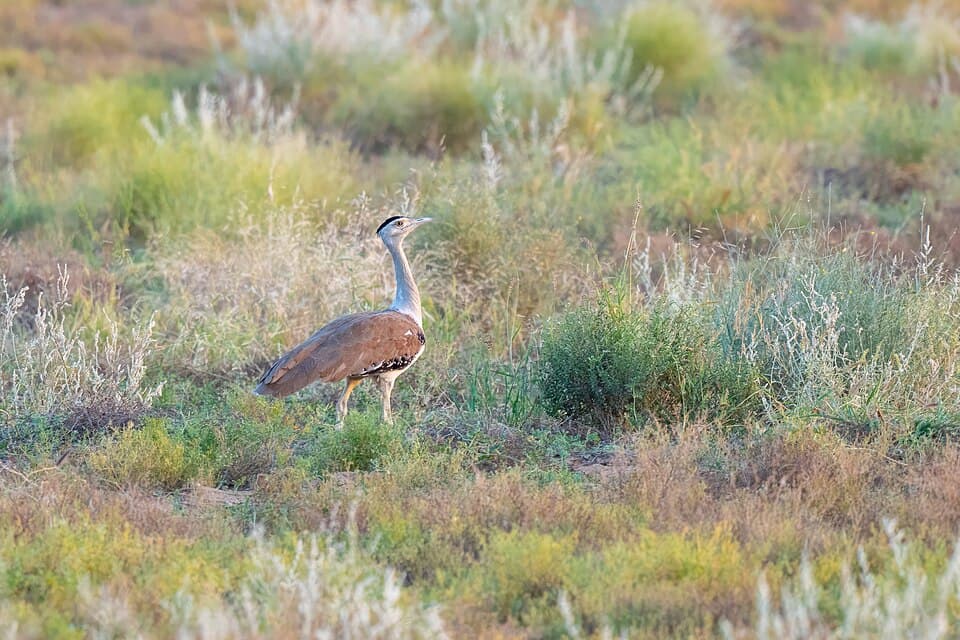
Photo: Saurabh Sawant · CC BY 4.0 · Wikimedia Commons Lesser FloricanSypheotides indicus
BirdEndemic · Indian subcontinent
Tall monsoon grassland and cropland; breeds during the south west monsoon.
The smallest bustard in the world. The male leaps repeatedly above the grass in a display flight. Uplisted to Critically Endangered in 2020 after a very steep decline.
Rajasthan · Gujarat · Madhya Pradesh · Maharashtra · Andhra Pradesh
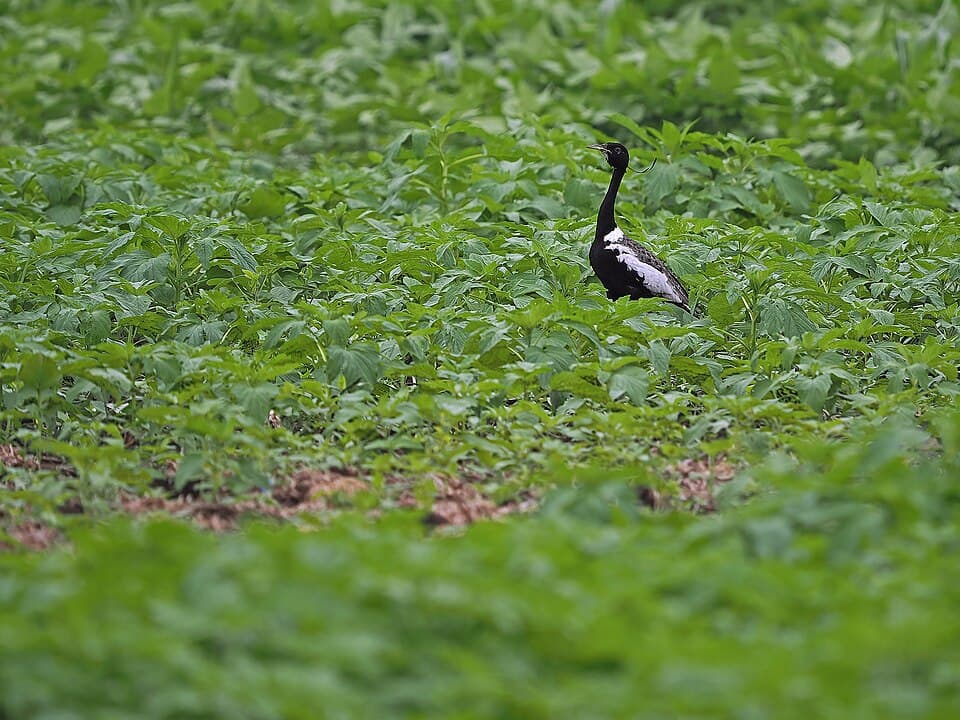
Photo: James Eaton · CC0 · Wikimedia Commons Bengal FloricanHoubaropsis bengalensis
Bird
Alluvial grassland of the Terai and the Brahmaputra floodplain. Strongholds at Manas and Kaziranga.
Males perform a spectacular leaping display. The Indian population is the largest remaining anywhere.
Assam · Uttar Pradesh · Arunachal Pradesh · West Bengal
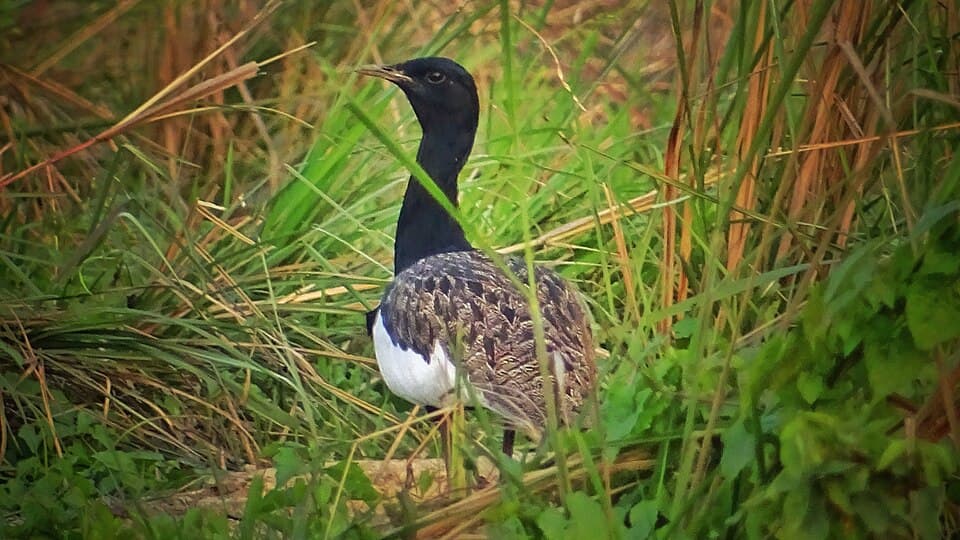
Photo: Daudabdullah · CC BY-SA 4.0 · Wikimedia Commons Baer's PochardAythya baeri
Bird
Deep freshwater lakes and marshes in winter, notably Loktak Lake and the Assam beels.
A migratory diving duck that breeds in eastern Russia and north east China.
Assam · Manipur · Bihar · Uttar Pradesh · West Bengal
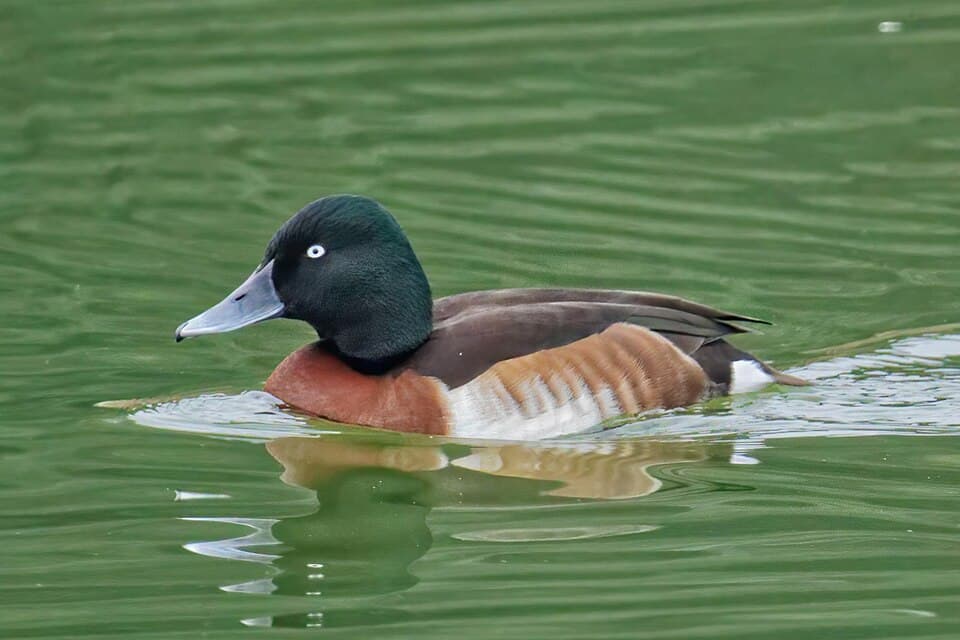
Photo: Sun Jiao (Interaccoonale) · CC BY 4.0 · Wikimedia Commons Siberian CraneLeucogeranus leucogeranus
Bird
Shallow freshwater marshes. Formerly wintered at Keoladeo Ghana National Park, Bharatpur.
The western population that came to India has not been recorded since 2002 and is effectively lost. Its decline is the standard illustration of flyway-level conservation failure.
Rajasthan
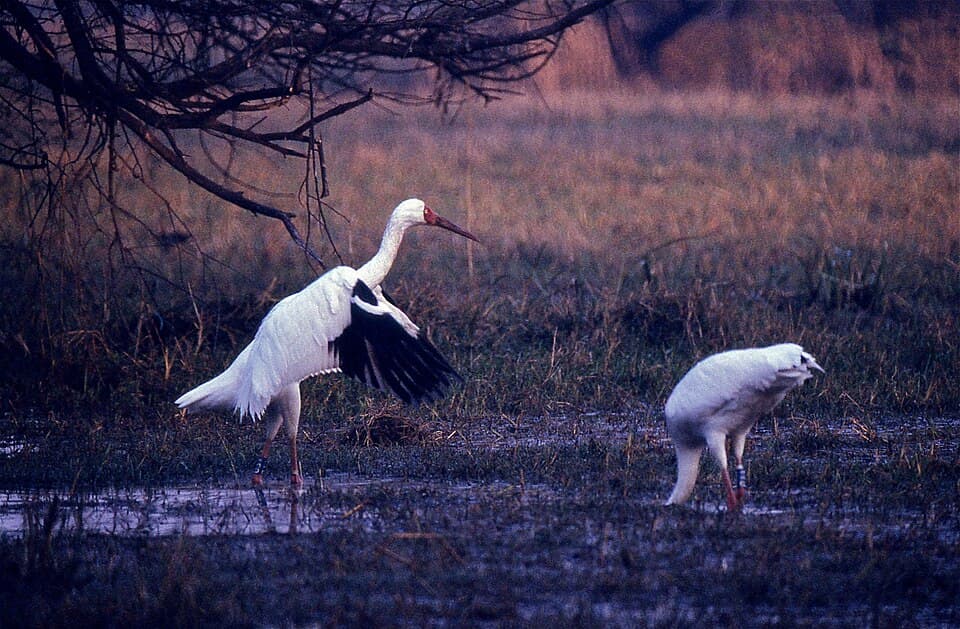
Photo: Bernard DUPONT from FRANCE · CC BY-SA 2.0 · Wikimedia Commons Sociable LapwingVanellus gregarius
Bird
Dry short grassland, fallow fields and the margins of wetlands in winter.
Breeds in the Central Asian steppe. Recorded at Sultanpur, Nalsarovar and the Banni grasslands.
Rajasthan · Gujarat · Haryana · Punjab · Maharashtra
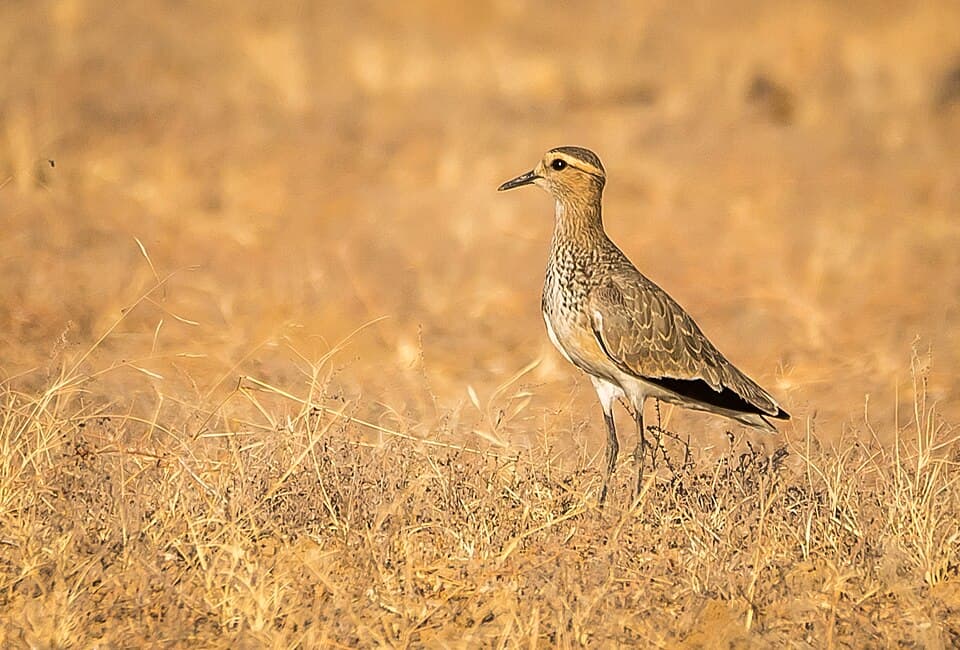
Photo: Sanjeev Kumar Goyal · CC BY-SA 4.0 · Wikimedia Commons Spoon-billed SandpiperCalidris pygmaea
Bird
Intertidal mudflats and saltpans of the east coast, notably Chilika Lake and Point Calimere.
Named for its unique spatulate bill, used with a side to side sweeping action. Breeds only in north east Russia.
Odisha · West Bengal · Tamil Nadu · Andhra Pradesh
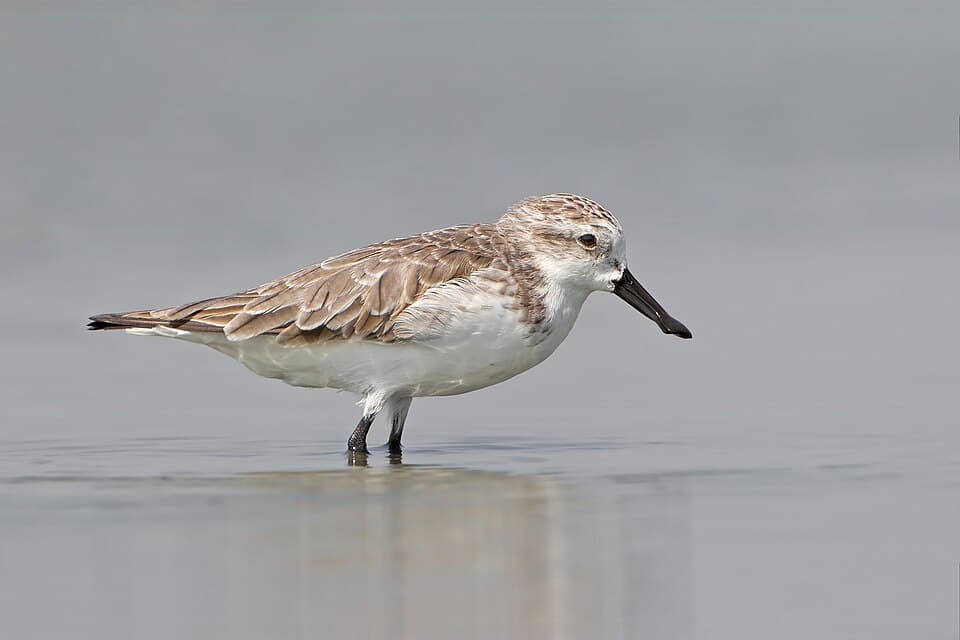
Photo: JJ Harrison (https://www.jjharrison.com.au/) · CC BY-SA 3.0 · Wikimedia Commons White-bellied HeronArdea insignis
Bird
Undisturbed rivers and riverine wetland in the eastern Himalayan foothills. Recorded at Namdapha and, since 2026, at Glaw Lake in the Kamlang Tiger Reserve.
One of the largest and rarest herons in the world, with perhaps 60 birds left globally.
Arunachal Pradesh · Assam
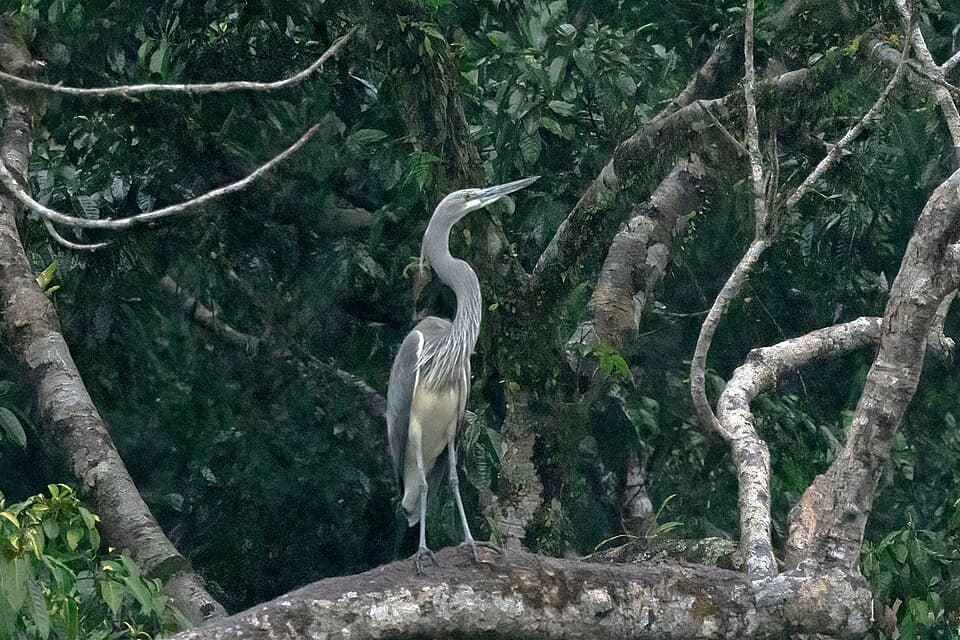
Photo: Rajkimar99 · CC BY-SA 4.0 · Wikimedia Commons Yellow-breasted BuntingEmberiza aureola
Bird
Reedbeds, paddy stubble and tall grassland in winter.
Once one of the most abundant birds in Eurasia. Mass trapping for food in East Asia drove a collapse of about 90 per cent, taking it from Least Concern to Critically Endangered in under twenty years.
Assam · West Bengal · Manipur · Nagaland · Bihar
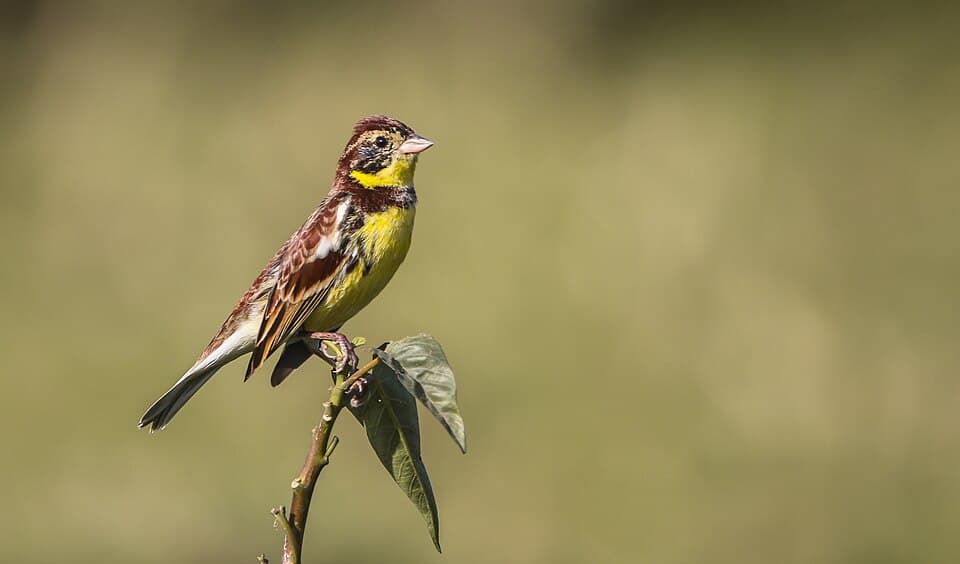
Photo: Manshanta Ghimire · CC BY-SA 4.0 · Wikimedia Commons Bugun LiocichlaLiocichla bugunorum
BirdEndemic · Eaglenest, Arunachal Pradesh
Dense scrub and secondary growth between 2,000 and 2,350 m in and around Eaglenest Wildlife Sanctuary.
Described only in 2006, the first new bird species described from India in over half a century. Named after the Bugun community, whose community reserve protects it. Fewer than 20 birds known.
Arunachal Pradesh
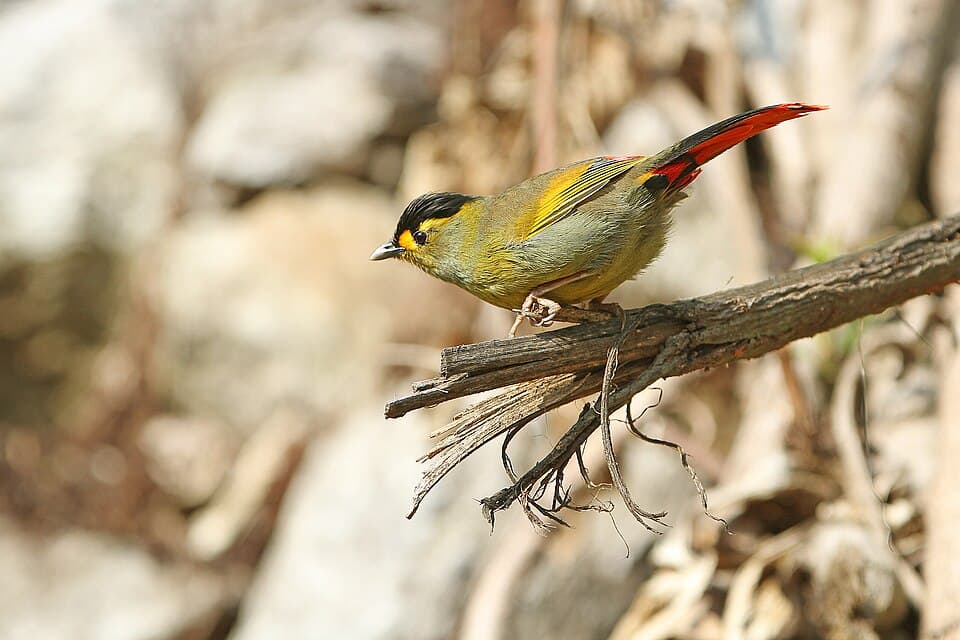
Photo: James Eaton · CC0 · Wikimedia Commons Jerdon's CourserRhinoptilus bitorquatus
BirdEndemic · Eastern Ghats, Andhra Pradesh
Sparse scrub jungle with bare ground in the Sri Lankamalleswara Wildlife Sanctuary and the Penna valley.
A nocturnal courser rediscovered in 1986 by Bharat Bhushan using traditional trapper knowledge, after being presumed extinct for 86 years. Not confirmed since 2009.
Andhra Pradesh
Himalayan QuailOphrysia superciliosa
BirdEndemic · Western Himalaya
Tall grass and scrub on steep slopes around Mussoorie and Nainital, 1,600 to 2,400 m.
Possibly Extinct. The last confirmed record is from 1876.
Uttarakhand
Pink-headed DuckRhodonessa caryophyllacea
Bird
Secluded pools and elephant grass swamps of the Ganga and Brahmaputra floodplains.
Possibly Extinct; last certain Indian record 1949. The male's pink head was unique among ducks.
Bihar · West Bengal · Assam · Uttar Pradesh
White-rumped VultureGyps bengalensis
Bird
Open country, village outskirts and forest edge across the plains.
Once possibly the most abundant large raptor in the world. Populations fell by more than 99 per cent in the 1990s from diclofenac poisoning acquired at cattle carcasses. Veterinary diclofenac was banned in 2006 and meloxicam promoted as the safe substitute.
Assam · Madhya Pradesh · Rajasthan · Gujarat · Haryana · Punjab · Uttar Pradesh · Bihar · Maharashtra · Karnataka · West Bengal
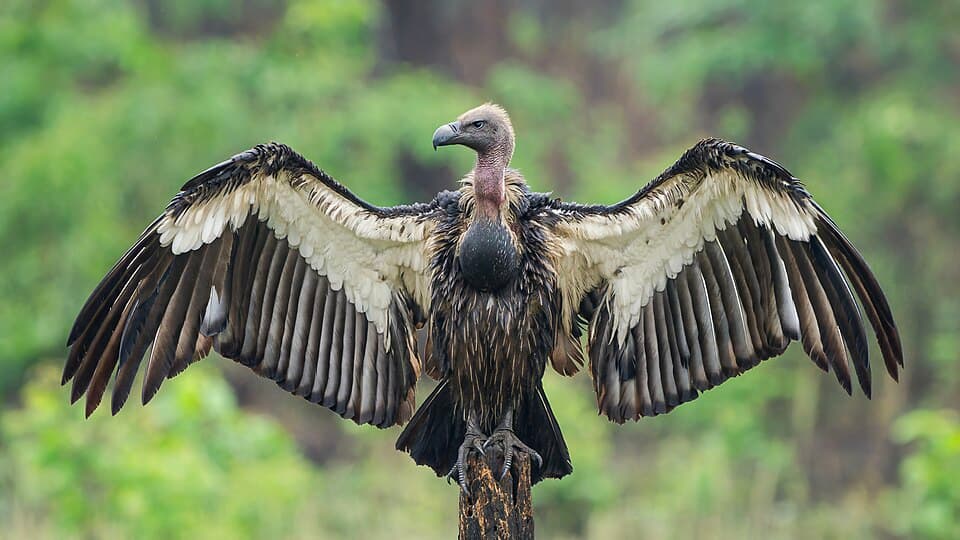
Photo: Prasan Shrestha · CC BY-SA 4.0 · Wikimedia Commons Indian Vulture or Long-billed VultureGyps indicus
BirdEndemic · Indian subcontinent
Cliffs, gorges and ruins in the Deccan and central India. Nests colonially on rock faces.
One of the three Gyps vultures devastated by diclofenac. Vulture Safe Zones and the Jatayu conservation breeding centres at Pinjore, Rajabhatkhawa and Rani are the recovery programme.
Rajasthan · Madhya Pradesh · Maharashtra · Karnataka · Gujarat · Andhra Pradesh · Telangana
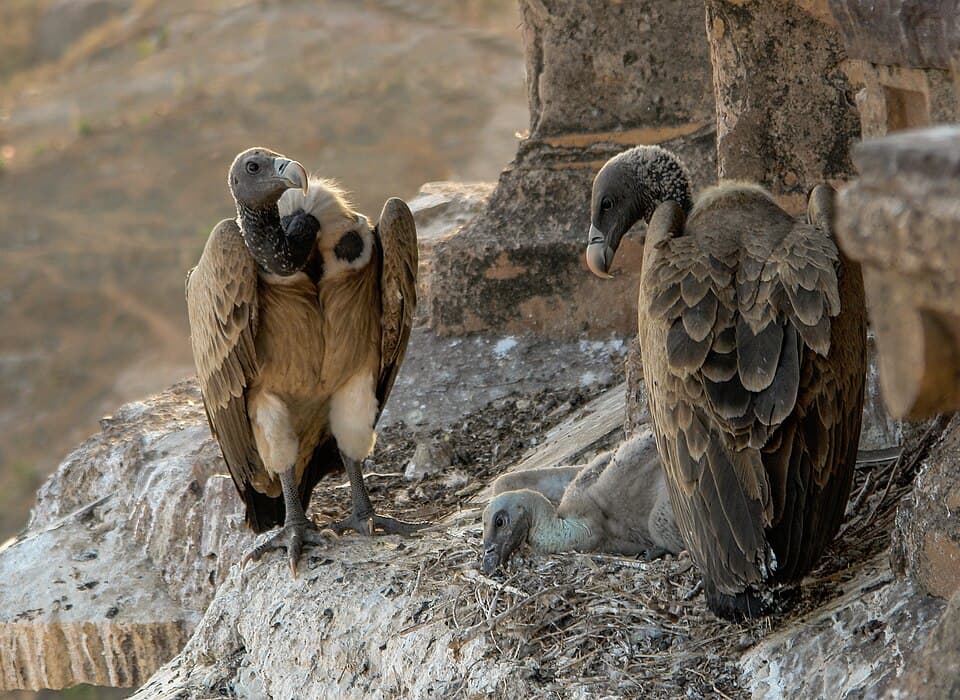
Photo: Yann (talk) · CC BY-SA 4.0 · Wikimedia Commons Slender-billed VultureGyps tenuirostris
Bird
Terai and Brahmaputra floodplain, nesting in tall trees rather than on cliffs.
The rarest of the Indian Gyps vultures, separated from the Indian vulture as a full species in 2001.
Assam · West Bengal · Bihar · Uttar Pradesh · Arunachal Pradesh
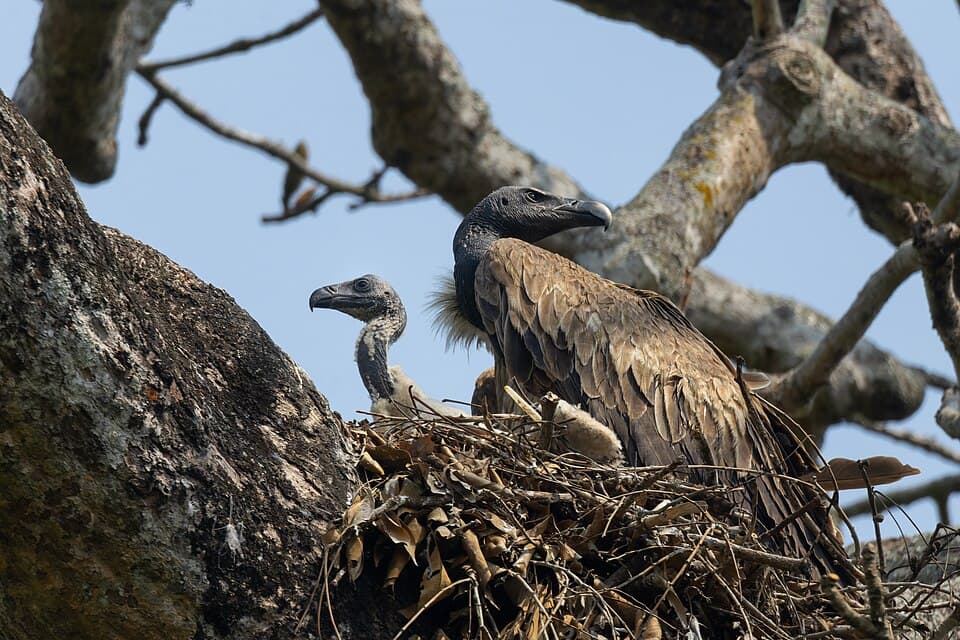
Photo: Tisha Mukherjee · CC BY-SA 4.0 · Wikimedia Commons Red-headed VultureSarcogyps calvus
Bird
Open wooded country and dry deciduous forest, generally away from towns.
Also called the king vulture for the bare red head and neck. Solitary rather than colonial, and usually first at a carcass.
Madhya Pradesh · Rajasthan · Maharashtra · Assam · Uttar Pradesh · Karnataka · Bihar
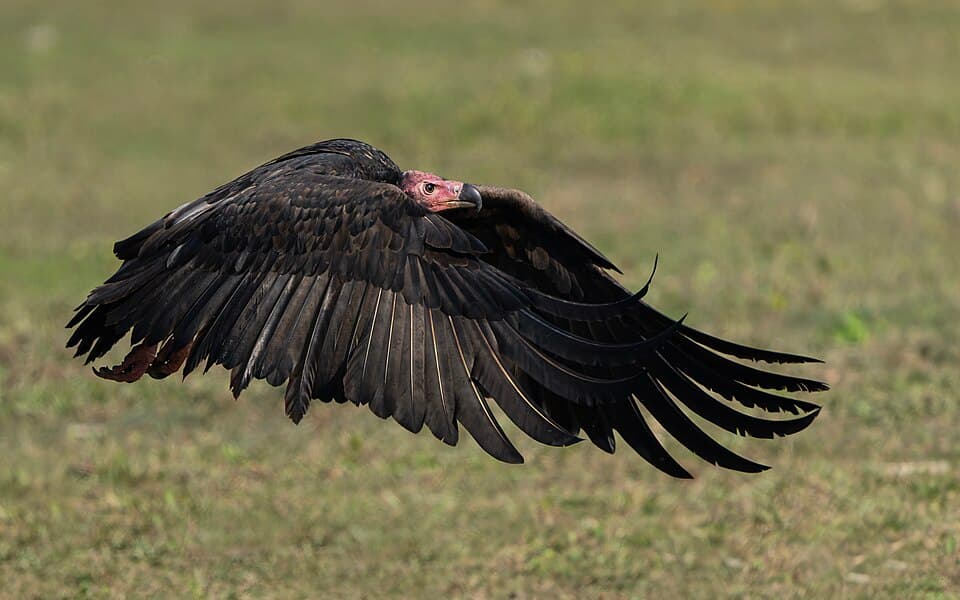
Photo: Prasan Shrestha · CC BY-SA 4.0 · Wikimedia Commons Masked FinfootHeliopais personatus
Bird
Shaded, slow-moving forest streams and mangrove creeks, including the Sundarbans.
An extremely secretive waterbird with lobed toes. Possibly no longer resident in India.
Assam · West Bengal
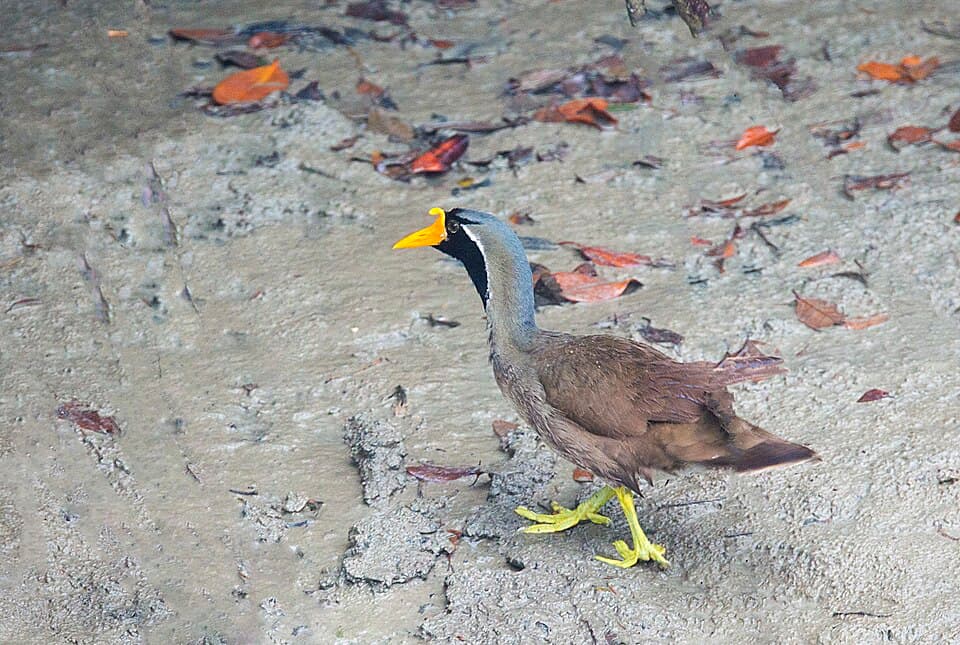
Photo: Touhid biplob · CC BY-SA 4.0 · Wikimedia Commons GharialGavialis gangeticus
Reptile
Deep, fast-flowing rivers with sandbanks for nesting and basking. The National Chambal Sanctuary holds the bulk of the world population.
The only surviving member of its family and instantly recognised by the male's bulbous nasal 'ghara'. Fish-eating and almost helpless on land. Reintroduced into the Beas Conservation Reserve in Punjab from 2017.
Uttar Pradesh · Madhya Pradesh · Rajasthan · Bihar · Odisha · Punjab
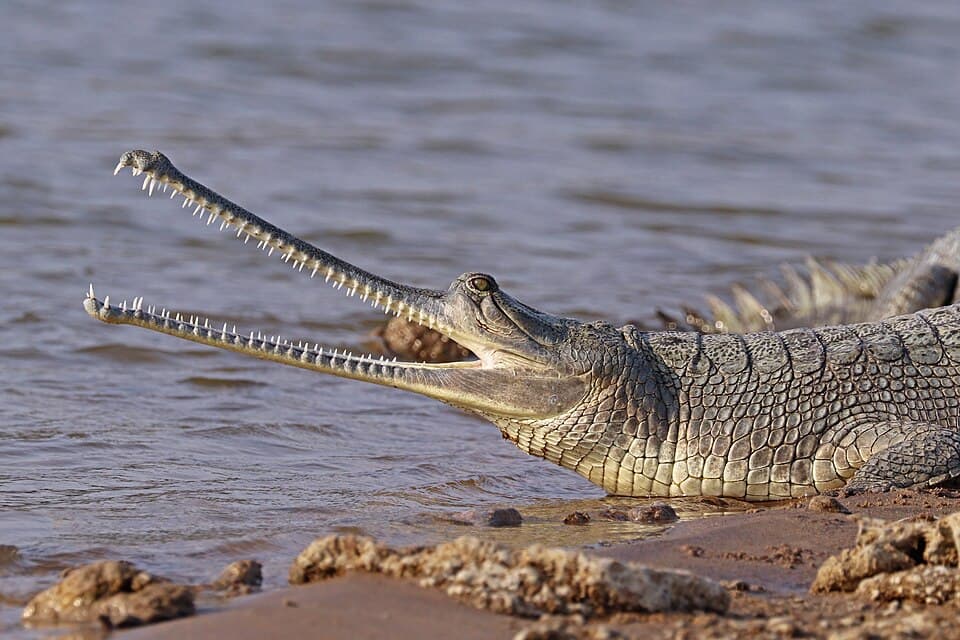
Photo: Charles J. Sharp · CC BY-SA 4.0 · Wikimedia Commons Red-crowned Roofed TurtleBatagur kachuga
Reptile
Deep flowing rivers with sandy nesting banks. Effectively confined to the Chambal.
The 'jewel of the Ganga'. Breeding males flush red, blue, yellow and white on the head and neck. Fewer than 500 adult females survive.
Uttar Pradesh · Madhya Pradesh · Rajasthan
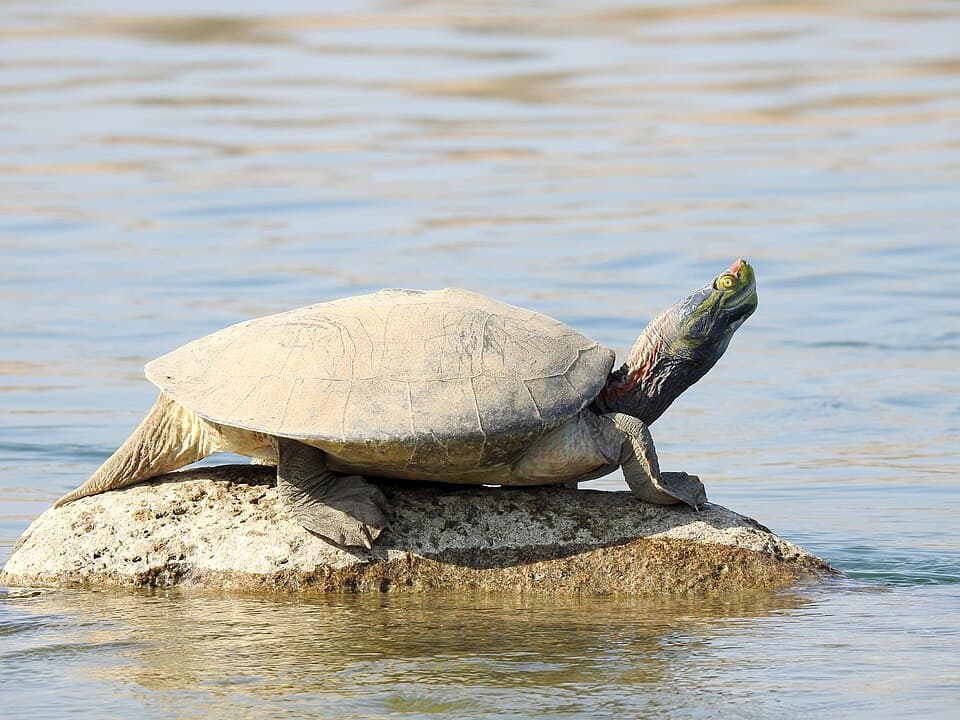
Photo: Hari arcw · CC BY-SA 4.0 · Wikimedia Commons Three-striped Roofed TurtleBatagur dhongoka
Reptile
Large rivers of the Ganga and Brahmaputra basins, notably the Chambal.
Uplisted to Critically Endangered in 2019. Recorded from Rudrasagar Lake in Tripura, a Ramsar site.
Uttar Pradesh · Madhya Pradesh · Rajasthan · Bihar · Assam
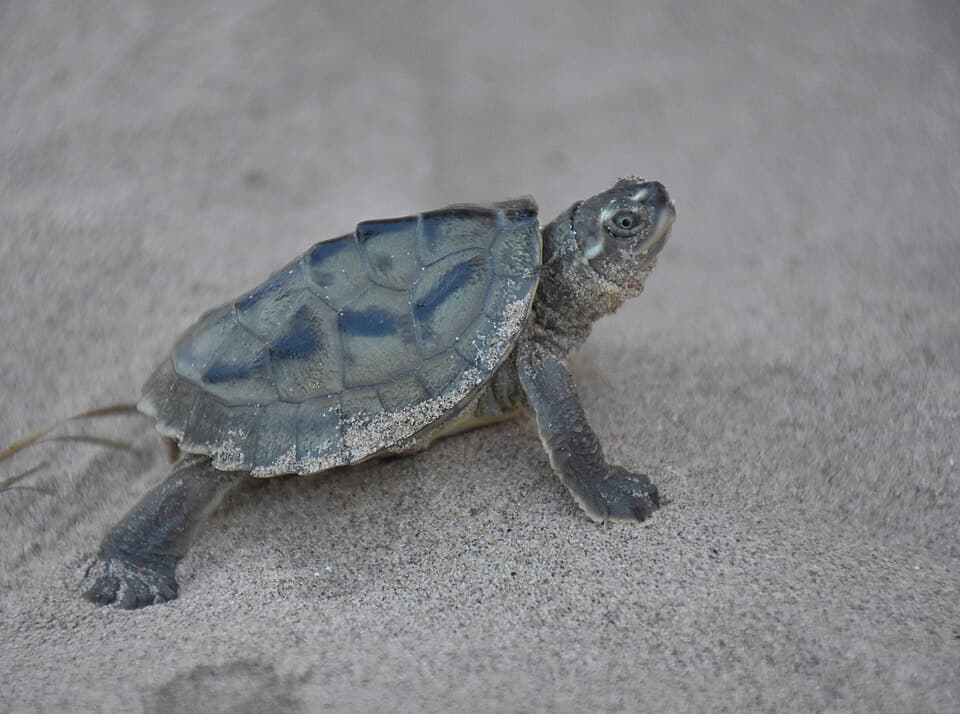
Photo: Hari arcw · CC BY-SA 4.0 · Wikimedia Commons Northern River TerrapinBatagur baska
Reptile
Tidal estuaries and mangrove creeks of the Sundarbans and Bhitarkanika.
Almost extinct in the wild in India; survives largely through assisted breeding at Sajnekhali.
West Bengal · Odisha
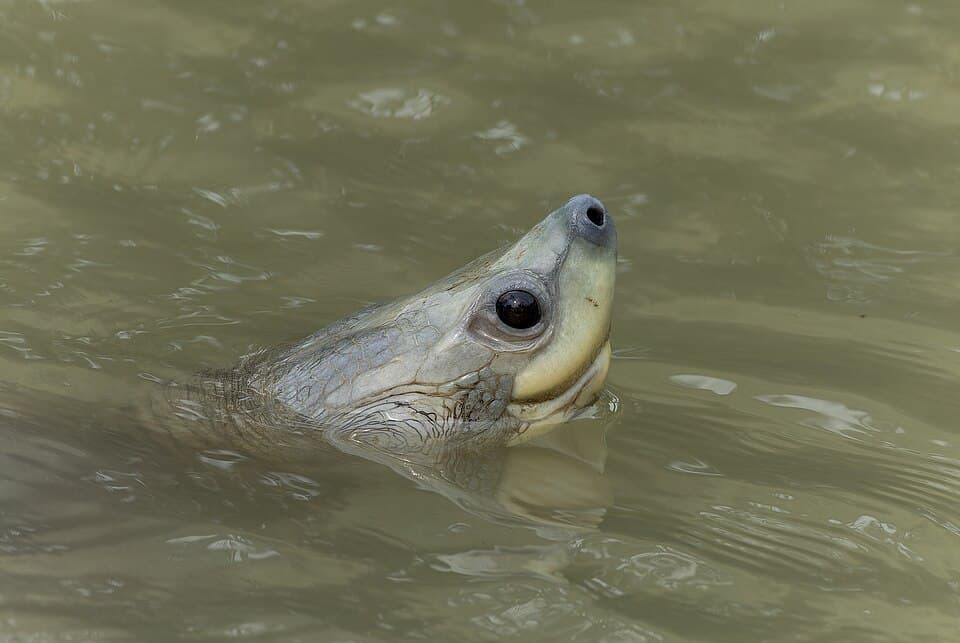
Photo: Tisha Mukherjee · CC BY-SA 4.0 · Wikimedia Commons Hawksbill TurtleEretmochelys imbricata
Reptile
Coral reefs and rocky coasts. Nests on island beaches in the Andamans and Lakshadweep.
The source of 'tortoiseshell'. It feeds largely on sponges, which helps maintain reef structure.
Andaman & Nicobar Islands · Lakshadweep · Tamil Nadu · Gujarat · Odisha
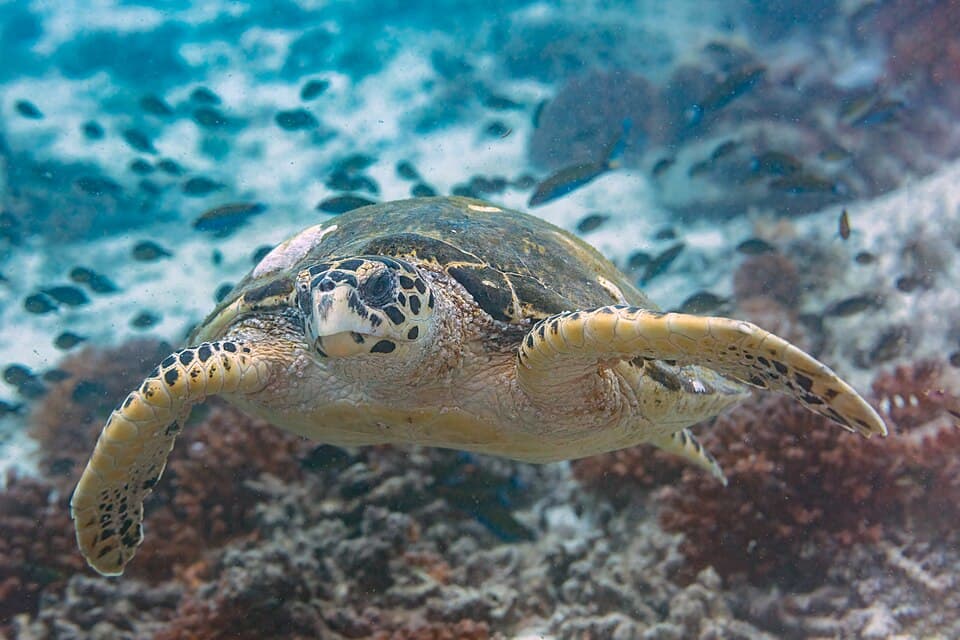
Photo: Diego Delso · CC BY-SA 4.0 · Wikimedia Commons Cantor's Giant Softshell TurtlePelochelys cantorii
Reptile
Sandy or muddy beds of large rivers and estuaries, notably the Chandragiri river in Kerala.
Spends nearly all its life buried in sand with only the eyes and mouth exposed, surfacing about twice a day to breathe.
Kerala · Odisha · West Bengal · Andhra Pradesh
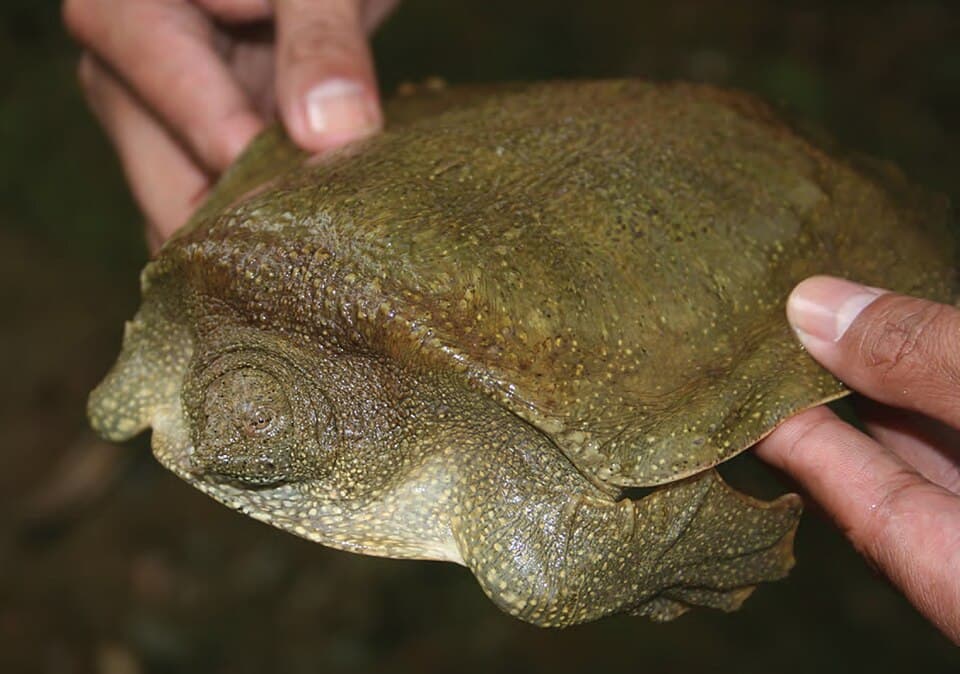
Photo: Brown R, Siler C, Oliveros C, Welton L, Rock A, Swab J, Van Weerd M, van Beijnen J, Rodriguez D, Jose E, Diesmos A · CC BY 3.0 · Wikimedia Commons Leith's Softshell TurtleNilssonia leithii
ReptileEndemic · Peninsular India
Rivers and reservoirs of the Deccan, including the Cauvery, Krishna and Godavari.
Uplisted from Vulnerable to Critically Endangered in 2019 after heavy harvesting for the meat trade.
Karnataka · Tamil Nadu · Kerala · Maharashtra · Andhra Pradesh
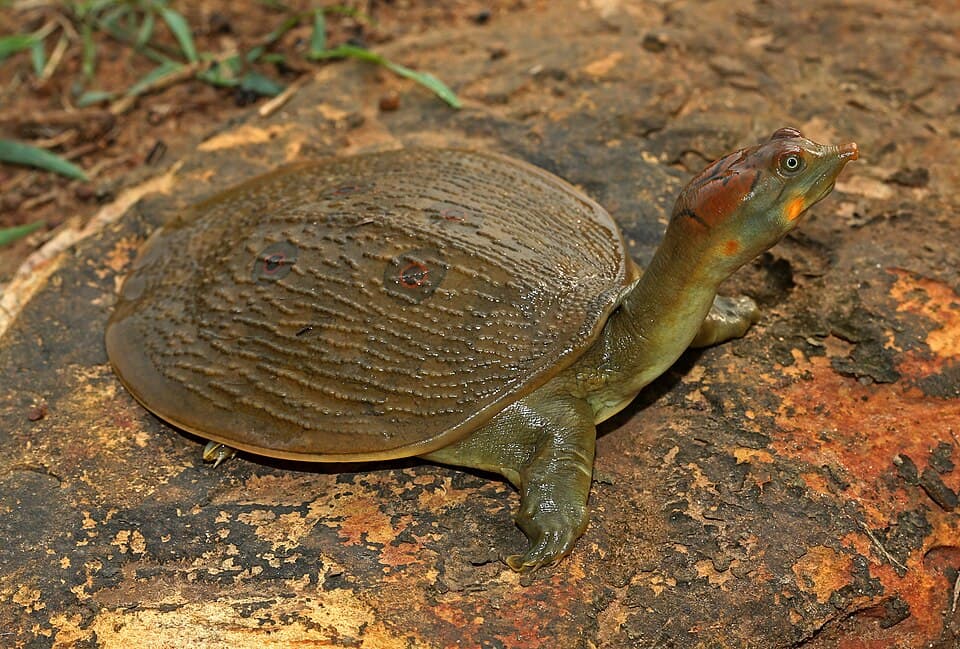
Photo: Davidvraju · CC BY-SA 4.0 · Wikimedia Commons Black Softshell TurtleNilssonia nigricans
Reptile
Temple ponds and the Brahmaputra floodplain. The Hayagriva Madhava temple pond at Hajo is the best known site.
Was once classified Extinct in the Wild, surviving only in temple ponds where it is fed by devotees. Wild populations have since been confirmed.
Assam · Tripura
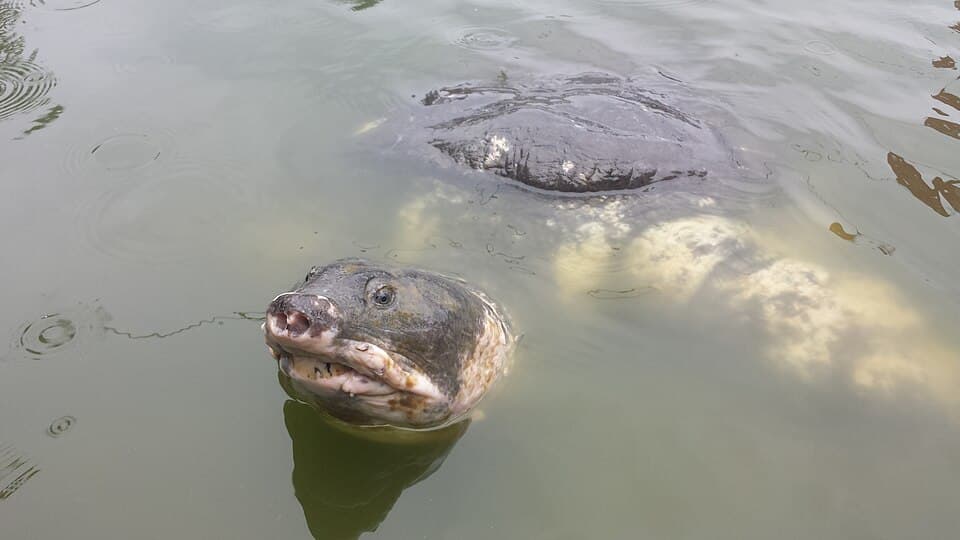
Photo: Mar11 · CC BY 4.0 · Wikimedia Commons Ganges SharkGlyphis gangeticus
Fish
Turbid, freshwater and brackish stretches of the Ganga, Hooghly and Mahanadi.
One of very few true river sharks in the world. Its tiny eyes point upwards, an adaptation to hunting in muddy water. Often confused with the bull shark.
West Bengal · Bihar · Uttar Pradesh · Odisha · Maharashtra · Gujarat
Pondicherry SharkCarcharhinus hemiodon
Fish
Inshore coastal waters and river mouths of the Bay of Bengal.
Rediscovered after decades with no confirmed record. Listed in Schedule I of the Wild Life (Protection) Act.
Tamil Nadu · Andhra Pradesh · Odisha · West Bengal
Largetooth SawfishPristis pristis
Fish
Shallow coastal waters, estuaries and the lower reaches of large rivers.
The toothed rostrum is used to slash through shoals of fish. Sawfishes are among the most threatened marine fish in the world.
Gujarat · Maharashtra · Odisha · West Bengal · Tamil Nadu
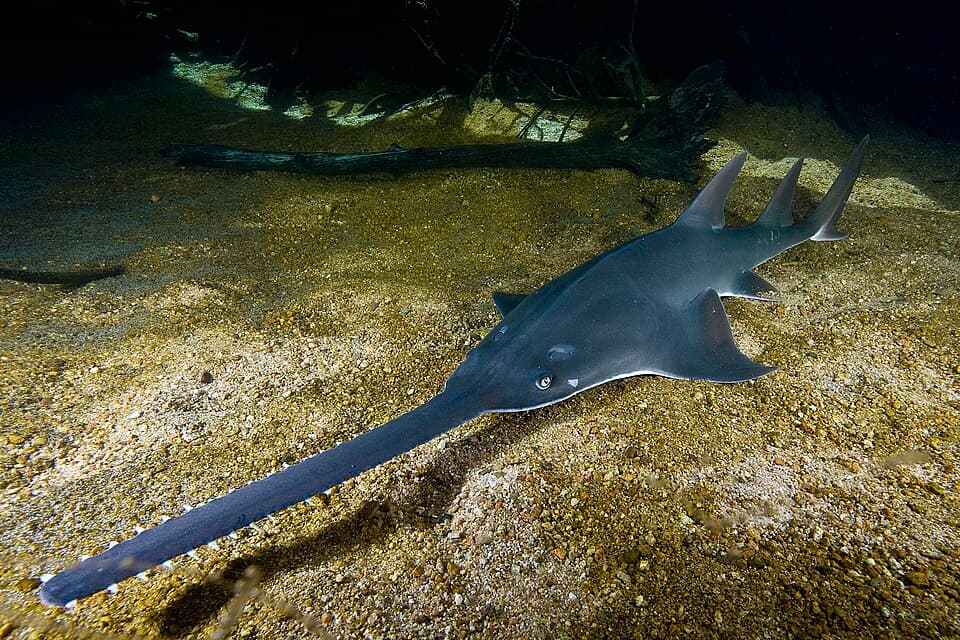
Photo: Simon Fraser University - University Communications · CC BY 2.0 · Wikimedia Commons Green SawfishPristis zijsron
Fish
Shallow inshore waters and mangrove estuaries.
Extremely vulnerable to entanglement because the rostrum snags in almost any net.
Gujarat · Tamil Nadu · Odisha · Andhra Pradesh

Photo: Superchilum · CC BY-SA 4.0 · Wikimedia Commons Hump-backed MahseerTor remadevii
FishEndemic · Cauvery basin
Fast-flowing pools and rapids of the Cauvery and its tributaries, especially around Bhavani and the Moyar.
The 'tiger of the water', a legendary angling fish. Formally described only in 2018 and assessed as Critically Endangered the same year. Threatened by introduced mahseer stocked from other basins.
Karnataka · Tamil Nadu · Kerala
Anamalai Flying FrogRhacophorus pseudomalabaricus
AmphibianEndemic · Anamalai Hills, Western Ghats
Canopy of evergreen forest in the Anamalai and Cardamom hills, 1,000 to 1,400 m.
Glides between trees using extensive webbing between the toes. Breeds in tree holes and foam nests over water.
Kerala · Tamil Nadu
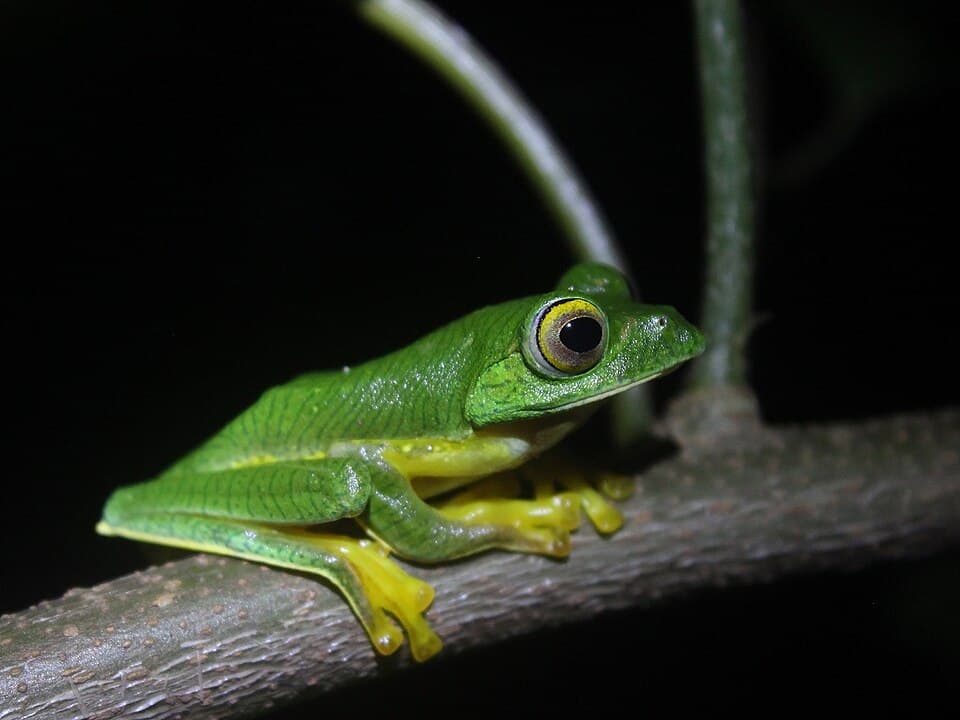
Photo: Vijay Karthick · CC BY-SA 4.0 · Wikimedia Commons Resplendent Shrub FrogRaorchestes resplendens
AmphibianEndemic · Anamudi summit
Restricted to about three square kilometres of grassland on the summit of Anamudi in Eravikulam National Park.
A stout orange-red frog with one of the smallest ranges of any vertebrate. Develops directly from egg to froglet with no tadpole stage.
Kerala
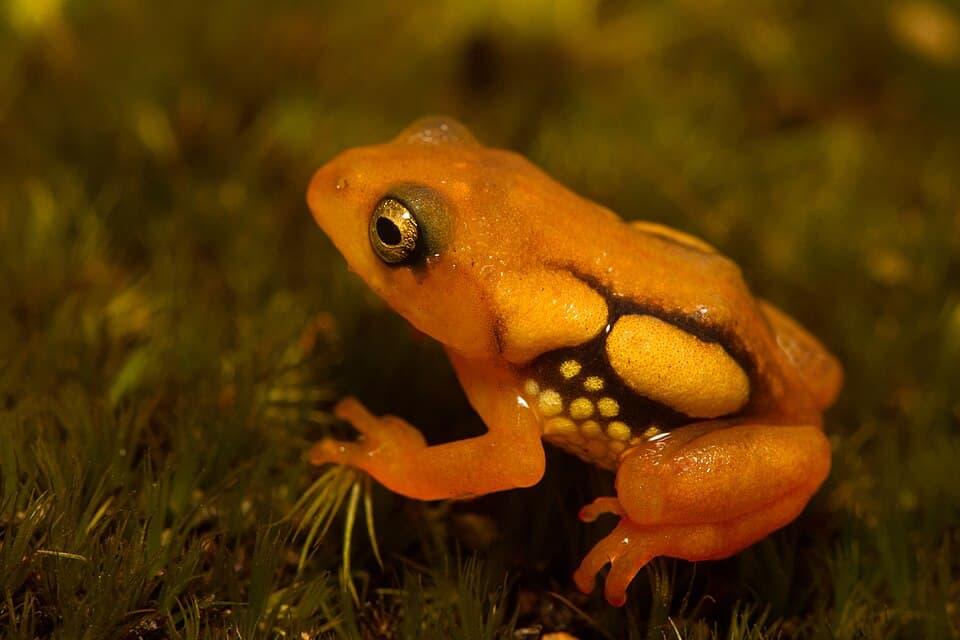
Photo: David V. Raju · CC BY-SA 4.0 · Wikimedia Commons Peacock Tarantula or Gooty SapphirePoecilotheria metallica
InvertebrateEndemic · Eastern Ghats
A single reserve forest patch of dry deciduous woodland near Gooty in the Nandyal and Giddalur belt.
Brilliant metallic blue, arboreal and highly sought in the illegal pet trade. Known from an area of well under 100 square kilometres.
Andhra Pradesh
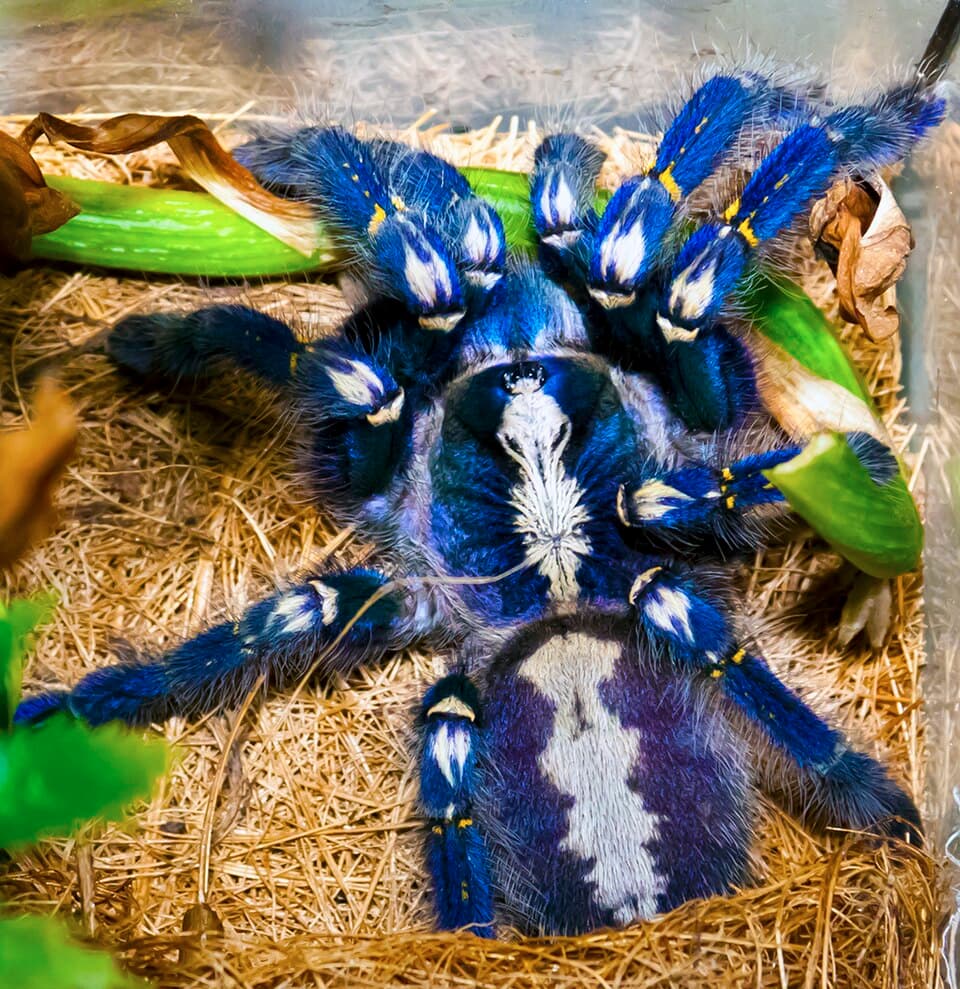
Photo: MLursus · CC BY-SA 2.0 · Wikimedia Commons Guggul or Indian Bdellium TreeCommiphora wightii
Plant
Arid rocky tracts and sand dunes of the Thar and the Kachchh, and dry scrub in the Deccan.
Yields guggul, an oleo-gum resin tapped from the bark and used in Ayurveda for arthritis, obesity and lipid disorders. Destructive tapping plus very slow growth drives the decline.
Rajasthan · Gujarat · Madhya Pradesh · Maharashtra · Karnataka
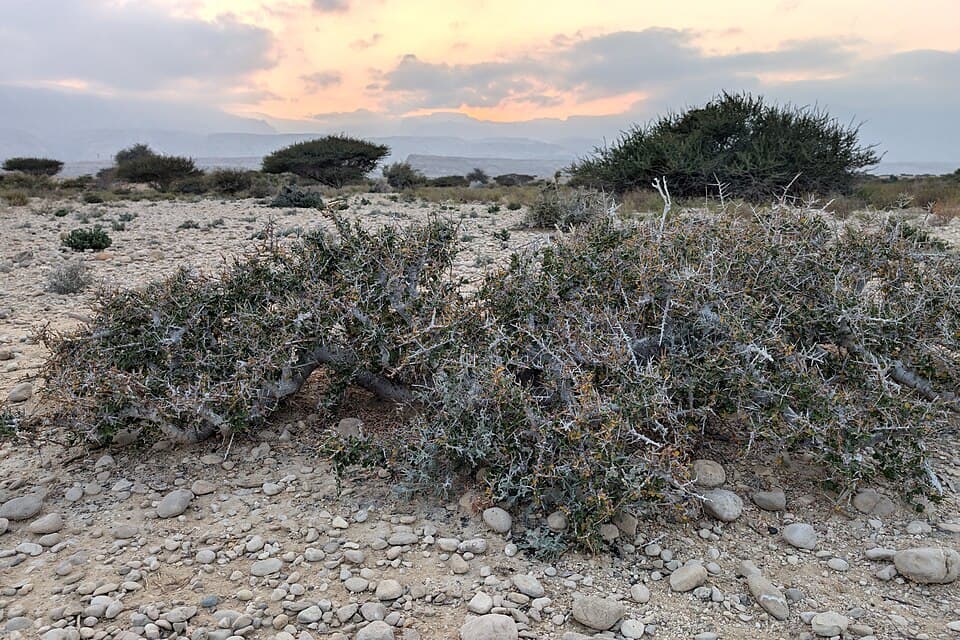
Photo: Krzysztof Ziarnek, Kenraiz · CC BY-SA 4.0 · Wikimedia Commons Eulophia obtusaEulophia obtusa
Plant
Moist grassland and sal forest edges in the Terai, notably near Dudhwa and the Pilibhit belt.
A terrestrial orchid rediscovered in India in 2008 after more than a century. Depends on specific soil fungi, which makes transplanting almost impossible.
Uttar Pradesh · West Bengal · Assam
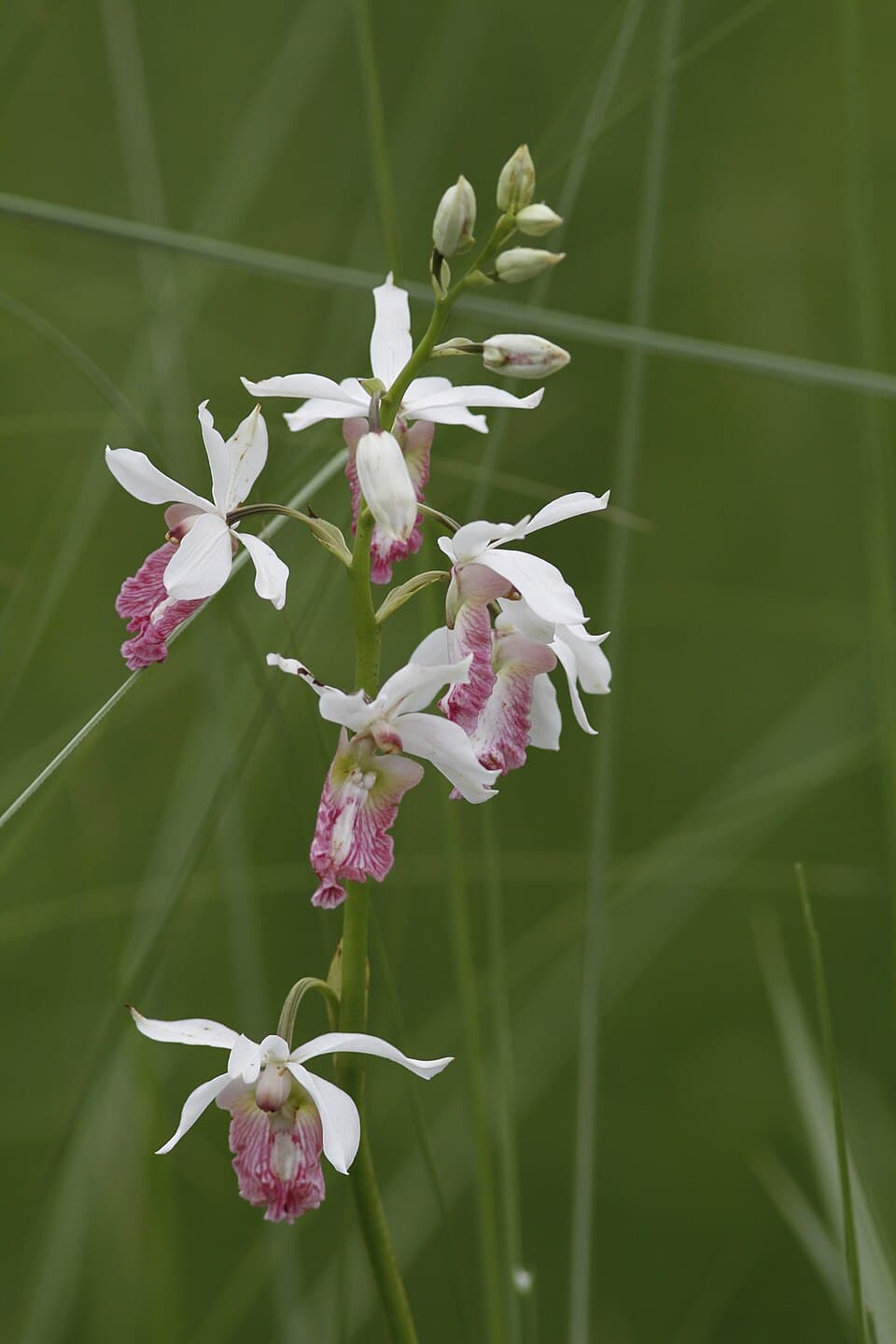
Photo: MSH Sourav · CC BY-SA 4.0 · Wikimedia Commons Pyrostria laljiiPyrostria laljii
PlantEndemic · Andaman Islands
Semi-evergreen forest of South Andaman, in the Wandoor and Jarawa reserve belt.
Described in 2019 and the first Indian record of its genus, a member of the coffee family Rubiaceae. Named after the botanist Lal Ji Singh. A slender tree with a distinctive hollow-based trunk.
Andaman & Nicobar Islands
Dipterocarpus bourdilloniiDipterocarpus bourdillonii
PlantEndemic · Western Ghats
Lowland wet evergreen forest below 800 m.
A giant emergent timber tree of the dipterocarp family. Regeneration is poor because the winged fruit needs closed canopy to germinate.
Kerala · Tamil Nadu · Karnataka
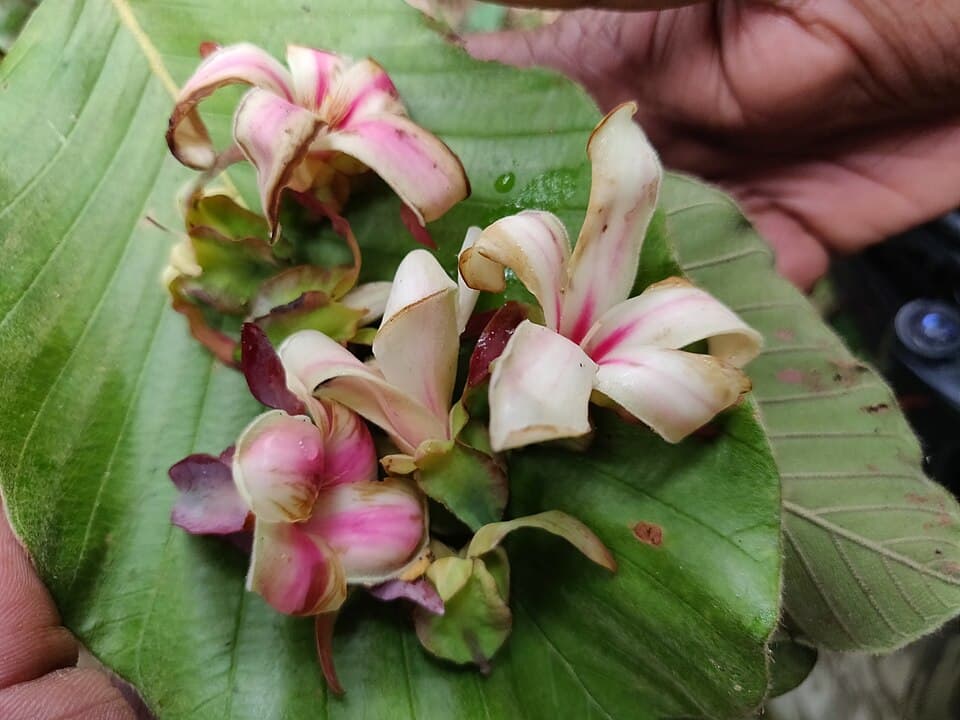
Photo: T R Shankar Raman · CC BY 4.0 · Wikimedia Commons Madhuca insignisMadhuca insignis
PlantEndemic · Western Ghats, Karnataka
Riparian evergreen forest along the Kumaradhara and Netravati rivers.
Rediscovered in 2000 after being presumed extinct for over a century. Threatened by hydroelectric projects on its river banks.
Karnataka
Syzygium travancoricumSyzygium travancoricum
PlantEndemic · Western Ghats, Kerala
Fragments of Myristica swamp forest in Travancore and the Kollam belt.
Survives largely in sacred groves. Myristica swamps are among the most threatened freshwater swamp systems in India.
Kerala
Photo: Vijayanrajapuram · CC BY-SA 4.0 · Wikimedia Commons Kolar Leaf-nosed BatHipposideros hypophyllus
MammalEndemic · Kolar district, Karnataka
One cave at Hanumanahalli.
Known from a single roost, which Karnataka notified as the Kolar Leaf-nosed Bat Conservation Reserve in 2019.
Karnataka


_(20243040418).jpg)
.jpg)


_female_head.jpg)


,_islas_Ad_Dimaniyat,_Om%C3%A1n,_2024-08-13,_DD_69.jpg)


Endangered
47 speciesTigerPanthera tigris
Mammal
Almost every forest type from the mangroves of the Sundarbans and the shola grasslands of the Western Ghats to the terai and the cold forests of Arunachal.
India holds roughly 75 per cent of the world's wild tigers, about 3,682 at the last estimate, across 58 tiger reserves. An apex predator and umbrella species: protecting its range protects entire landscapes. National animal of India.
Madhya Pradesh · Karnataka · Uttarakhand · Maharashtra · Tamil Nadu · Assam · Kerala · Uttar Pradesh · Rajasthan · West Bengal · Bihar · Chhattisgarh · Odisha · Jharkhand · Andhra Pradesh · Telangana · Arunachal Pradesh · Mizoram · Goa
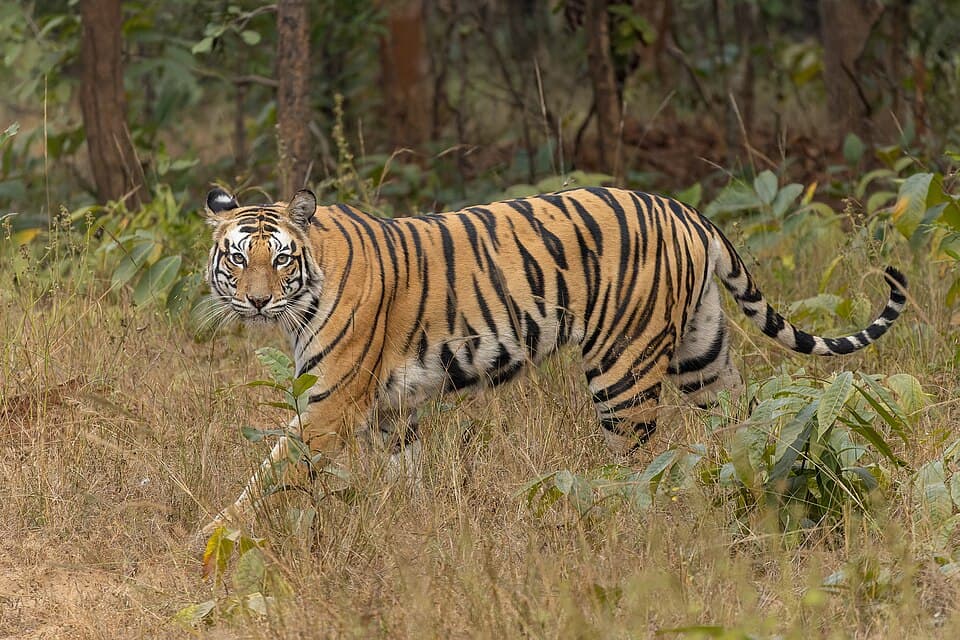
Photo: Tisha Mukherjee · CC BY-SA 4.0 · Wikimedia Commons Asiatic LionPanthera leo persica
MammalEndemic · Gir landscape, Gujarat
Dry deciduous teak forest, thorn scrub and adjoining farmland and coastal tracts of the Saurashtra peninsula.
The only wild lions outside Africa, about 891 animals in the 2025 census. Smaller than African lions, with a distinctive longitudinal fold of skin along the belly and a sparser mane that leaves the ears visible. Note the assessment nuance: the subspecies is Endangered, while the species Panthera leo is Vulnerable.
Gujarat
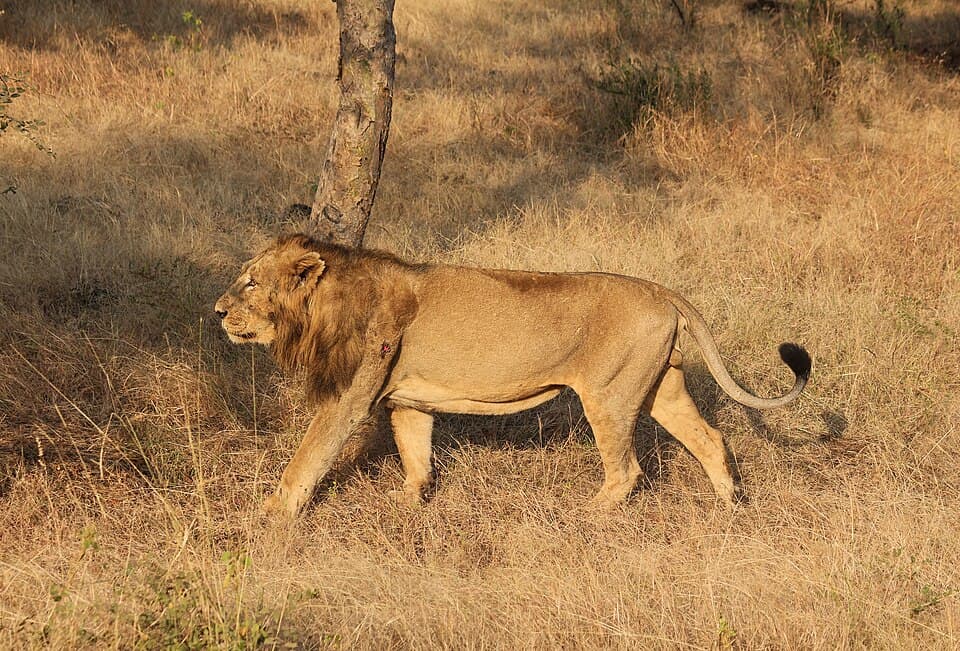
Photo: Bernard Gagnon · CC BY-SA 3.0 · Wikimedia Commons Asian ElephantElephas maximus
Mammal
Moist and dry deciduous forest, grassland and plantations across four population blocks: the Western Ghats, the north east, central India and the northern Himalayan foothills.
National Heritage Animal of India. A keystone species that opens forest canopy, disperses large seeds and creates water holes. About 30,000 animals, some 60 per cent of the world population. Project Elephant was launched in 1992.
Karnataka · Kerala · Tamil Nadu · Assam · Uttarakhand · Odisha · West Bengal · Jharkhand · Chhattisgarh · Meghalaya · Arunachal Pradesh · Nagaland · Uttar Pradesh
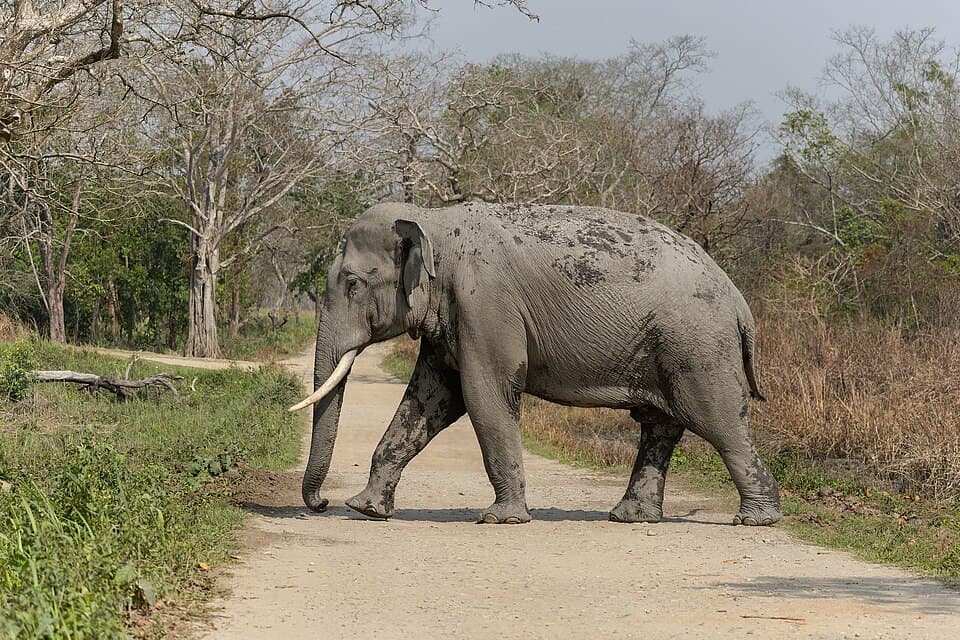
Photo: Tisha Mukherjee · CC BY-SA 4.0 · Wikimedia Commons Dhole or Indian Wild DogCuon alpinus
Mammal
Dense to open forest in the Western Ghats, central Indian highlands and the north east. Strongholds at Nagarhole, Bandipur and Periyar.
Hunts in packs and communicates with a distinctive whistle. Unusually among canids it has one fewer molar on each side of the lower jaw and lets pups eat first at a kill.
Karnataka · Kerala · Tamil Nadu · Maharashtra · Madhya Pradesh · Chhattisgarh · Odisha · Arunachal Pradesh · Assam · Andhra Pradesh
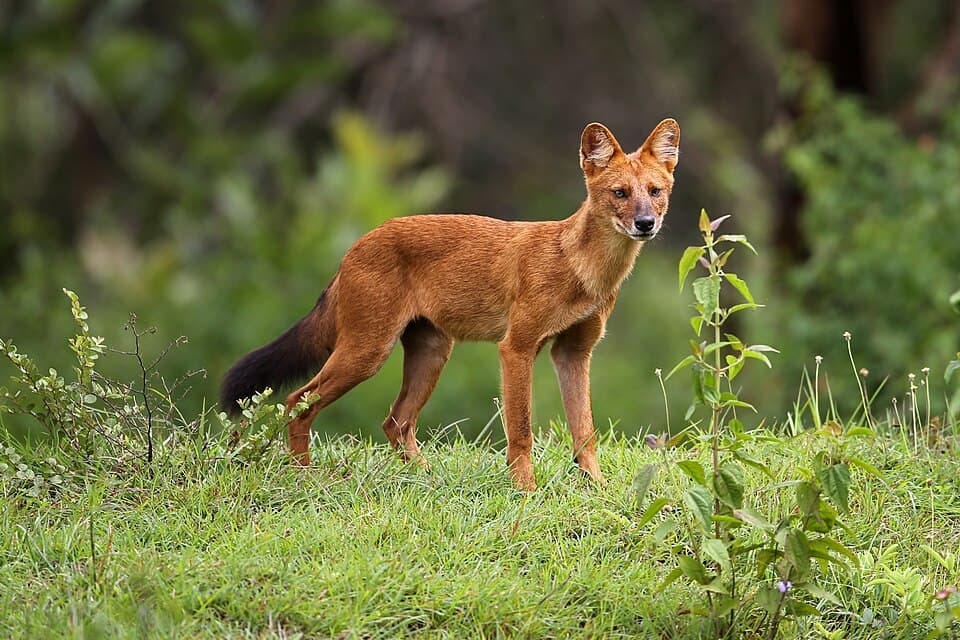
Photo: Davidvraju · CC BY-SA 4.0 · Wikimedia Commons Red PandaAilurus fulgens
Mammal
Temperate broadleaf and conifer forest with a dense bamboo understorey, 2,200 to 4,800 m. Singalila and Neora Valley are the key Indian sites.
State animal of Sikkim. The only living member of its family, Ailuridae. Feeds almost entirely on bamboo despite being a carnivore, and has a false thumb, an enlarged wrist bone, for gripping stems. Singalila runs India's conservation breeding and release programme.
Sikkim · West Bengal · Arunachal Pradesh · Meghalaya · Nagaland
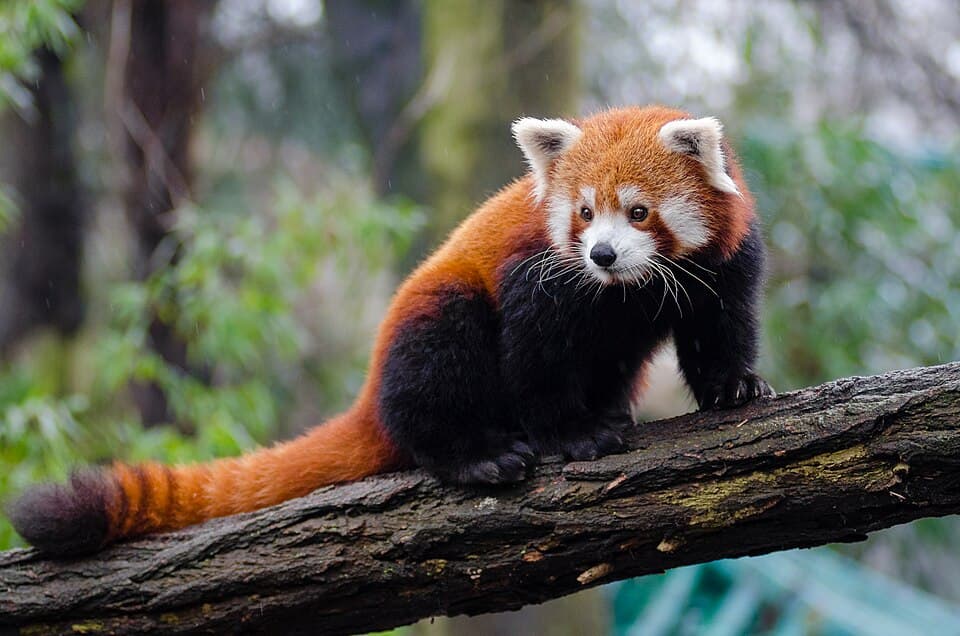
Photo: Mathias Appel · CC0 · Wikimedia Commons Golden LangurTrachypithecus geei
Mammal
Moist evergreen and riverine forest between the Sankosh and Manas rivers in western Assam. Manas, Chirang and Raimona hold the Indian population.
Described only in 1953. Regarded as sacred by local communities. The Indian range is bounded by rivers on three sides and Bhutan on the fourth, making it one of the most sharply delimited primate ranges anywhere.
Assam
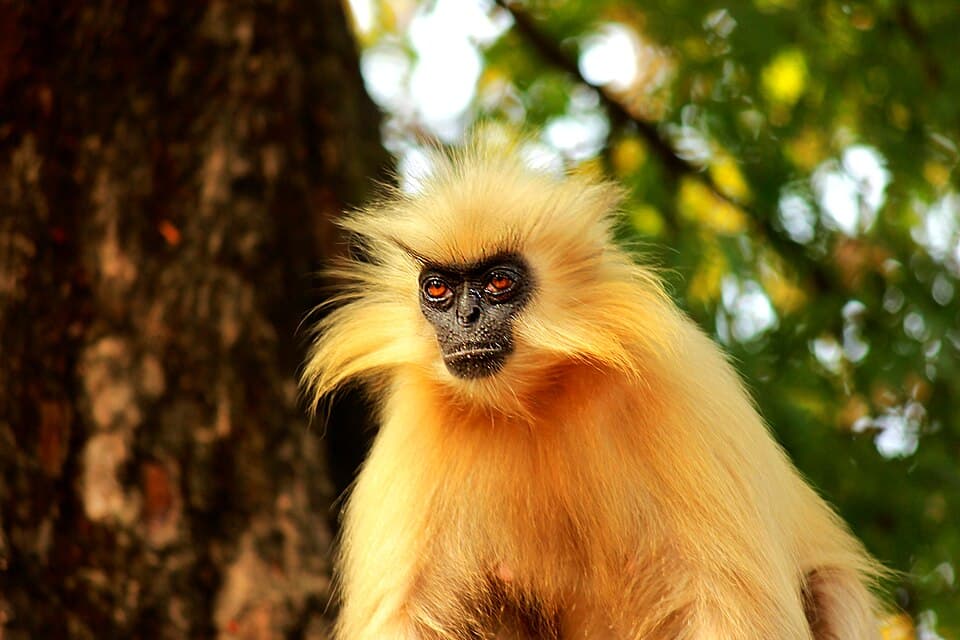
Photo: M.Swarnali · CC BY-SA 4.0 · Wikimedia Commons Western Hoolock GibbonHoolock hoolock
Mammal
Closed-canopy tropical evergreen and semi-evergreen forest south of the Brahmaputra and east of the Dibang.
India's only ape. Moves by brachiation and almost never comes to the ground, which makes canopy gaps caused by roads and tea gardens a fatal barrier. Mated pairs sing loud duets at dawn. Hoollongapar Gibbon Sanctuary is the flagship site.
Assam · Arunachal Pradesh · Meghalaya · Nagaland · Manipur · Mizoram · Tripura
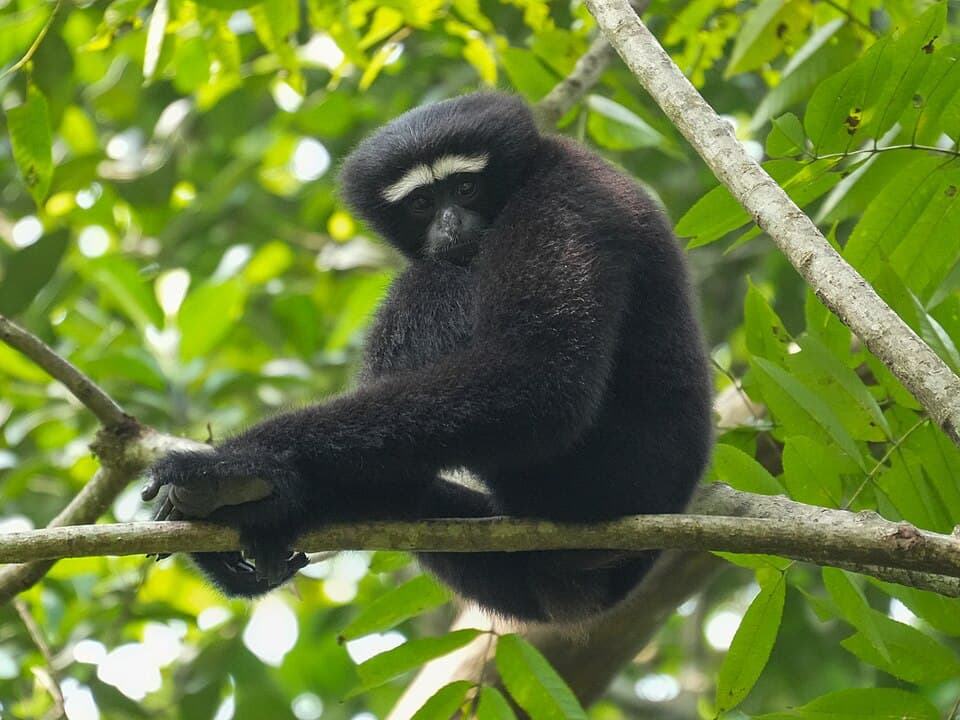
Photo: Timothy A. Gonsalves · CC BY-SA 4.0 · Wikimedia Commons Lion-tailed MacaqueMacaca silenus
MammalEndemic · Western Ghats
Upper canopy of wet evergreen rainforest, 600 to 1,400 m. Silent Valley, Anamalai and Kudremukh are the strongholds.
Named for the tufted tail. The silver-white mane around a black face is unmistakable. One of the most arboreal macaques, rarely descending to the ground, which makes it exceptionally sensitive to forest fragmentation by plantations.
Kerala · Tamil Nadu · Karnataka
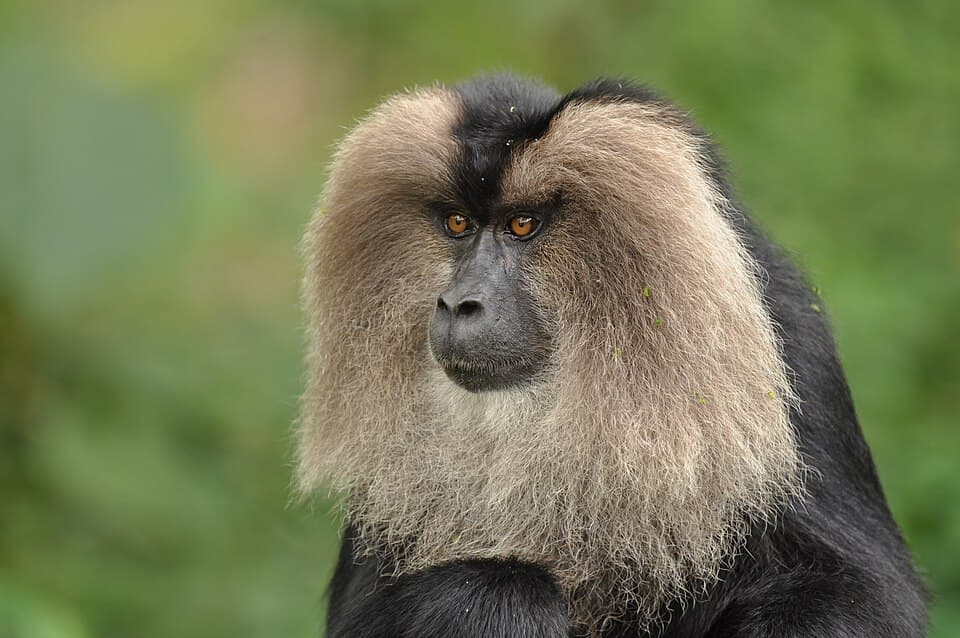
Photo: T. R. Shankar Raman · CC BY 3.0 · Wikimedia Commons Nilgiri TahrNilgiritragus hylocrius
MammalEndemic · Western Ghats
Shola grassland mosaic and steep rocky slopes, 1,200 to 2,600 m. Eravikulam National Park holds the largest single population.
State animal of Tamil Nadu and the only mountain ungulate in southern India. The sole species of its genus. Adult males, called saddlebacks, develop a pale grey saddle. The 2025 synchronised census counted 2,668 animals. Project Nilgiri Tahr began in 2023.
Tamil Nadu · Kerala
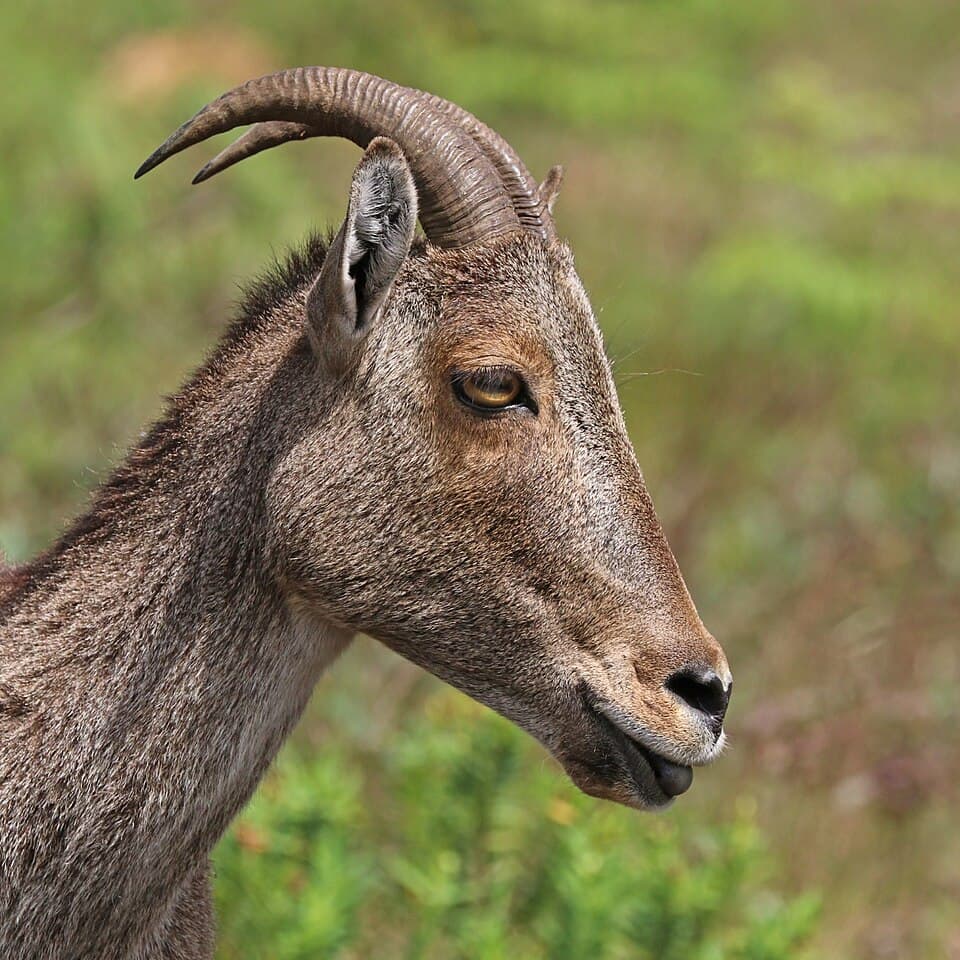
Photo: Charles J. Sharp · CC BY-SA 4.0 · Wikimedia Commons Sangai or Manipur Brow-antlered DeerRucervus eldii eldii
MammalEndemic · Loktak Lake, Manipur
Phumdis, the floating mats of vegetation on Loktak Lake, inside Keibul Lamjao National Park.
State animal of Manipur and the flagship of the only floating national park in the world. Called the dancing deer for its springy gait on the unstable phumdi surface, an adaptation of the hooves to spongy ground. Distinct from the Barasingha, which is a different species.
Manipur
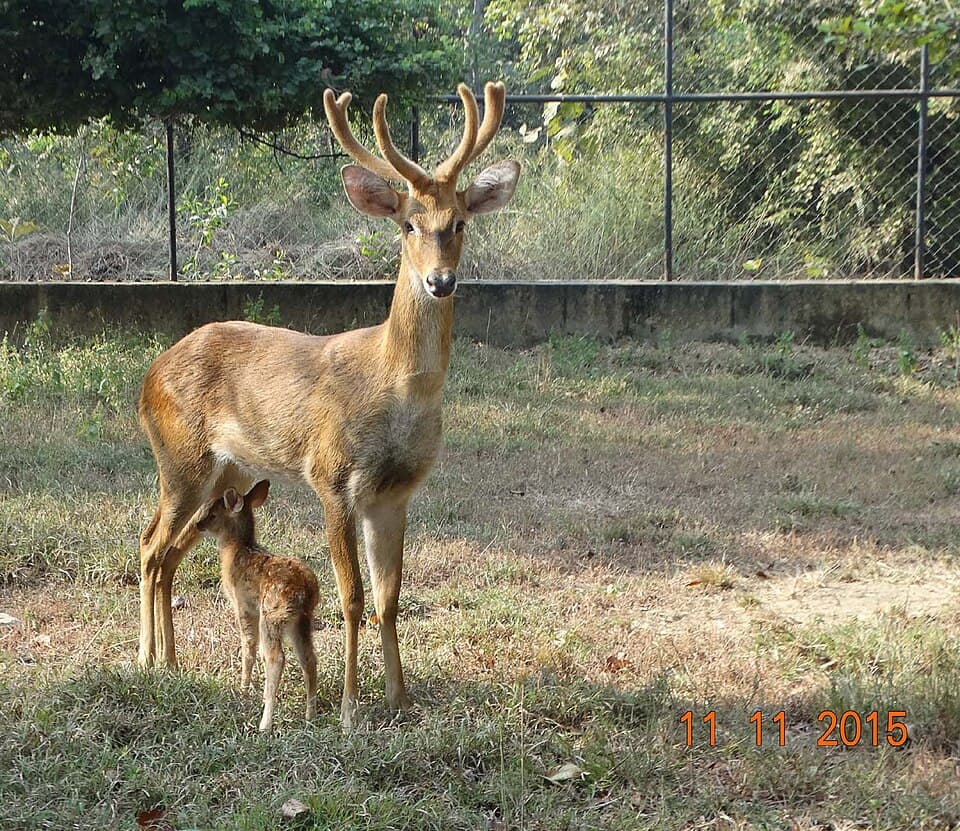
Photo: Sonampalli · CC BY-SA 4.0 · Wikimedia Commons Pygmy HogPorcula salvania
MammalEndemic · Assam grasslands
Dense, tall, dry alluvial grassland of the Manas landscape.
The smallest wild pig in the world, about 25 cm at the shoulder. The only suid that builds a roofed nest. Once thought extinct, it was rediscovered in 1971. The Pygmy Hog Conservation Programme has reintroduced captive-bred animals into Manas, Orang, Barnadi and Bornadi.
Assam

Photo: A. J. T. Johnsingh, WWF-India and NCF · CC BY-SA 3.0 · Wikimedia Commons Wild Water BuffaloBubalus arnee
Mammal
Alluvial grassland, swamps and river floodplains. Kaziranga and Manas hold the bulk of the world population; a small relict herd survives in Indravati.
State animal of Chhattisgarh. The ancestor of the domestic buffalo and the bearer of the widest horn spread of any living bovid. Genetic swamping by hybridisation with feral domestic buffalo is now a leading threat.
Assam · Chhattisgarh · Arunachal Pradesh · Meghalaya · Madhya Pradesh
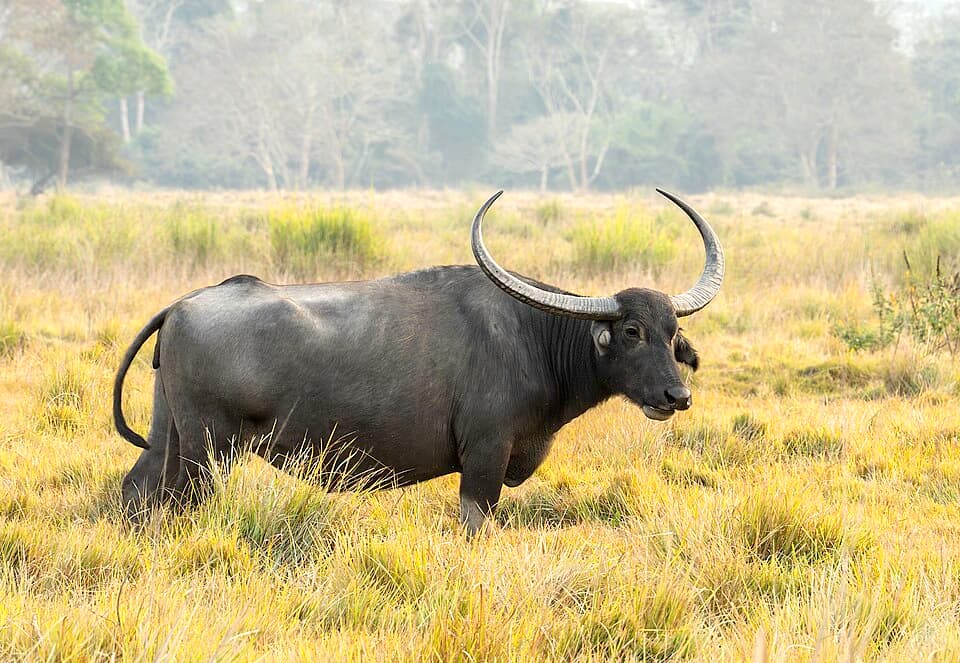
Photo: Joydeep Chakraborty · CC BY-SA 4.0 · Wikimedia Commons Himalayan Musk DeerMoschus leucogaster
Mammal
Subalpine birch, fir and rhododendron forest, 2,500 to 4,000 m. Kedarnath, Askot and the Valley of Flowers are key sites.
Has no antlers. The male carries downward-pointing tusk-like canines and a musk pod, one of the most valuable animal products in the world by weight, which drives relentless poaching. The pod is present only in males, but snaring kills both sexes.
Uttarakhand · Himachal Pradesh · Sikkim · Arunachal Pradesh · Jammu & Kashmir
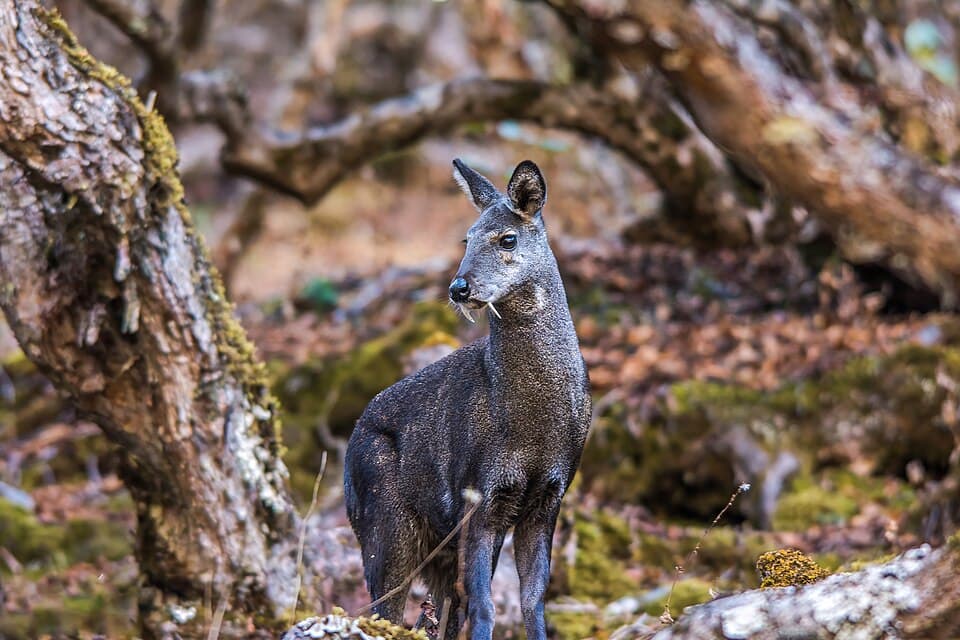
Photo: Gurung pratap · CC BY-SA 4.0 · Wikimedia Commons Hispid HareCaprolagus hispidus
Mammal
Dense tall grassland of the terai and Brahmaputra floodplain, especially early successional thatch grass.
The 'bristly rabbit', named for its coarse, dark, bristle-like fur. Unlike most hares it digs no burrow and depends on undisturbed grassland, so annual grassland burning is a direct threat.
Assam · West Bengal · Uttar Pradesh · Bihar · Uttarakhand
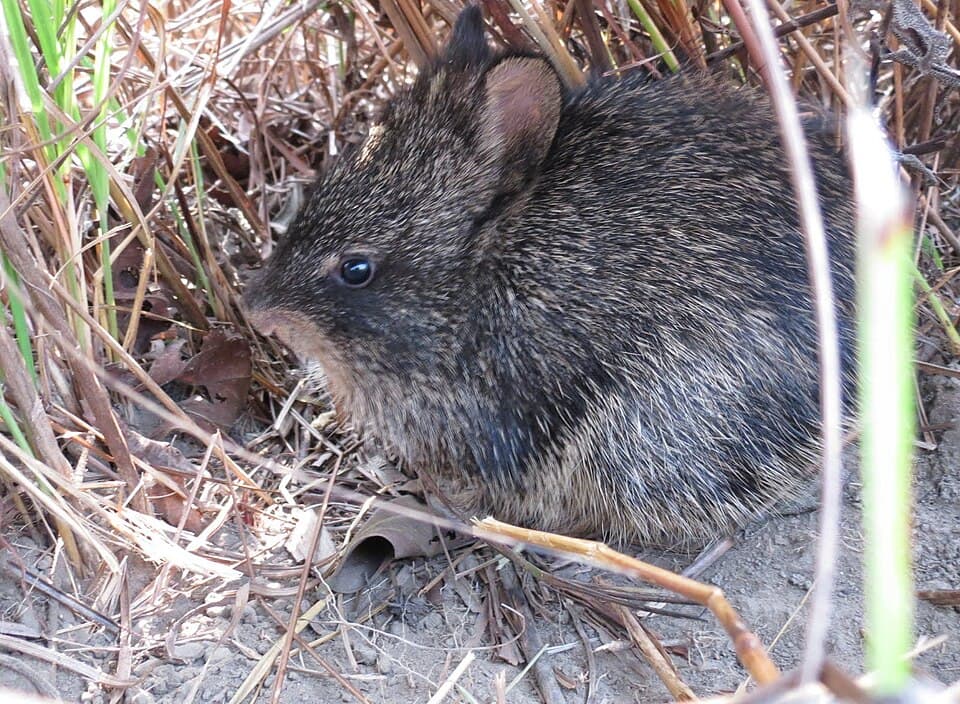
Photo: Bed Bahadur Khadka · CC BY 4.0 · Wikimedia Commons Indian Hog DeerAxis porcinus
Mammal
Tall, wet floodplain grassland. Kaziranga, Dudhwa and Jaldapara are strongholds.
Runs with the head held low, pushing through grass rather than leaping over it, which is the source of its name. Unusually for deer it is largely solitary.
Assam · Uttar Pradesh · Uttarakhand · West Bengal · Arunachal Pradesh · Punjab
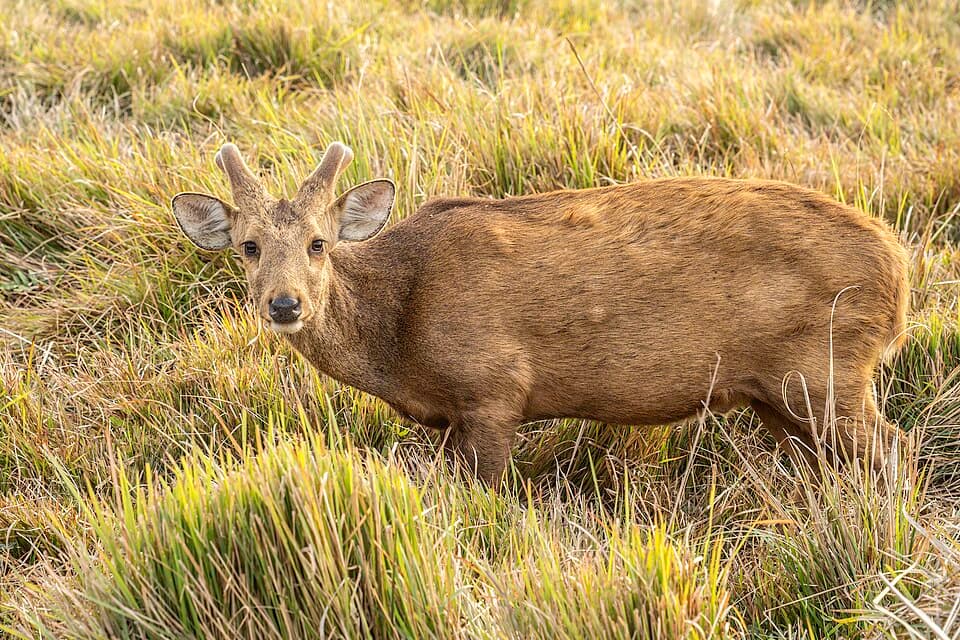
Photo: Joydeep Chakraborty · CC BY-SA 4.0 · Wikimedia Commons Bengal Slow LorisNycticebus bengalensis
Mammal
Tropical evergreen and semi-evergreen forest of the north east.
The only venomous primate in India. A gland on the inner elbow produces a secretion that becomes toxic when mixed with saliva. Nocturnal, extremely slow-moving, and heavily trafficked for the pet and medicine trade.
Assam · Arunachal Pradesh · Meghalaya · Nagaland · Manipur · Mizoram · Tripura

Photo: Helena Snyder · CC BY-SA 3.0 · Wikimedia Commons Phayre's Leaf MonkeyTrachypithecus phayrei
Mammal
Semi-evergreen and bamboo forest of the north east. Sepahijala and the Trishna landscape are key sites.
State animal of Tripura, known there as the spectacled langur for the white rings around the eyes.
Tripura · Assam · Mizoram · Manipur
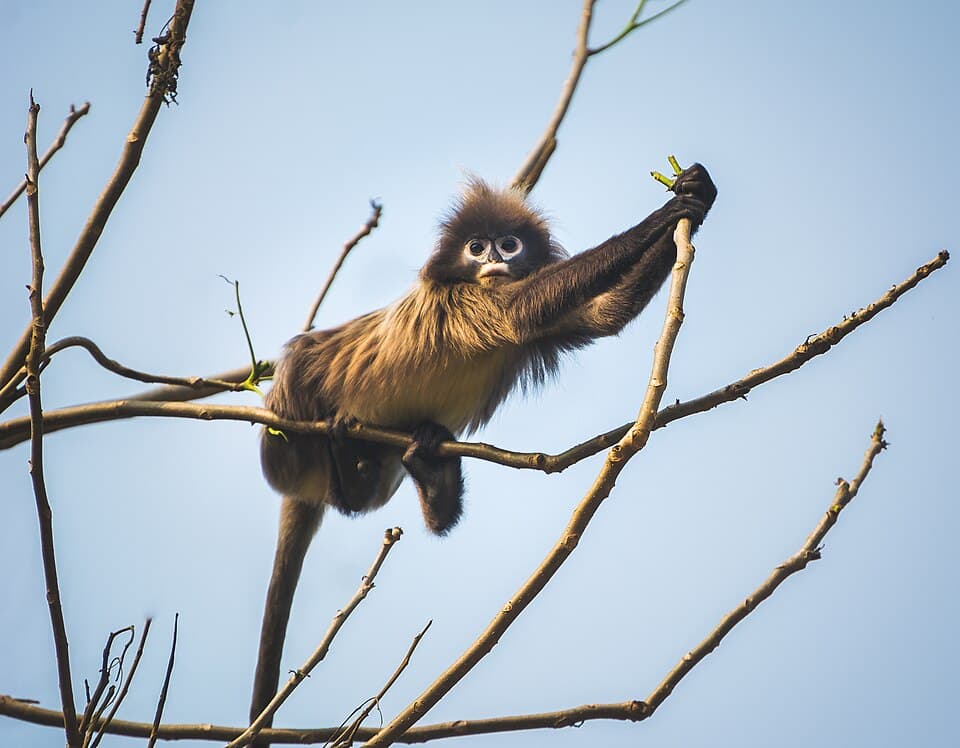
Photo: Md. Tareq Aziz Touhid · CC BY-SA 4.0 · Wikimedia Commons Arunachal MacaqueMacaca munzala
MammalEndemic · Western Arunachal Pradesh
High-altitude temperate forest and cultivated valleys of Tawang and West Kameng, 2,000 to 3,500 m.
Described in 2005, one of the very few primates discovered anywhere in recent decades. The name means 'monkey of the deep forest' in the local Monpa language. Lives at an unusually high elevation for a macaque.
Arunachal Pradesh
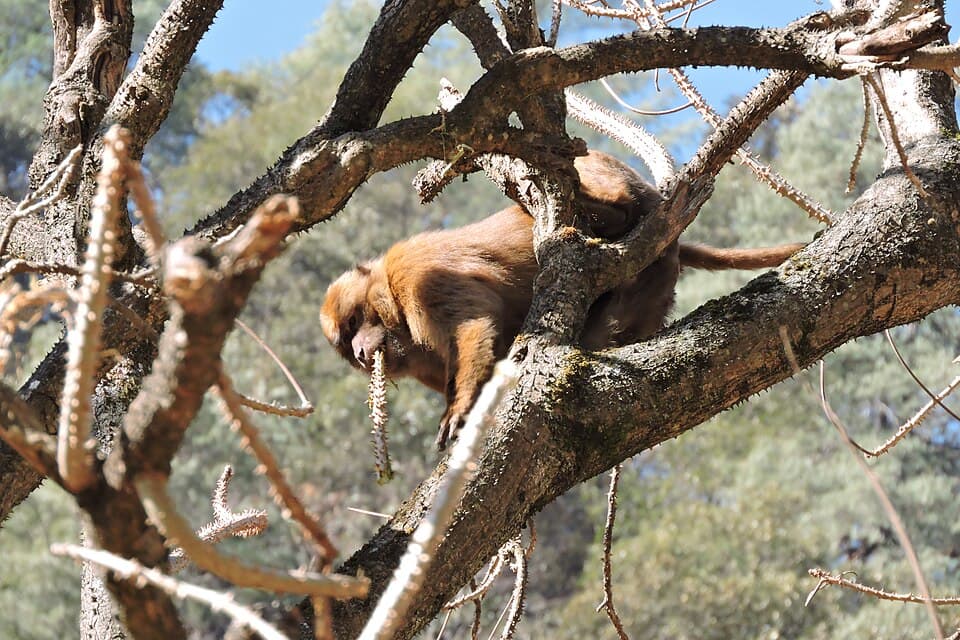
Photo: Kingshuk Mondal · CC BY 4.0 · Wikimedia Commons Indian PangolinManis crassicaudata
Mammal
Dry and moist deciduous forest, scrub and even farmland across peninsular and northern India.
The only mammal covered in keratin scales. Rolls into an impenetrable ball when threatened, a defence that works against leopards but makes it trivially easy for poachers to pick up. Eats ants and termites with a tongue longer than its body.
Madhya Pradesh · Maharashtra · Rajasthan · Gujarat · Odisha · Karnataka · Tamil Nadu · Andhra Pradesh · Telangana · Chhattisgarh · Bihar · Jharkhand · Punjab
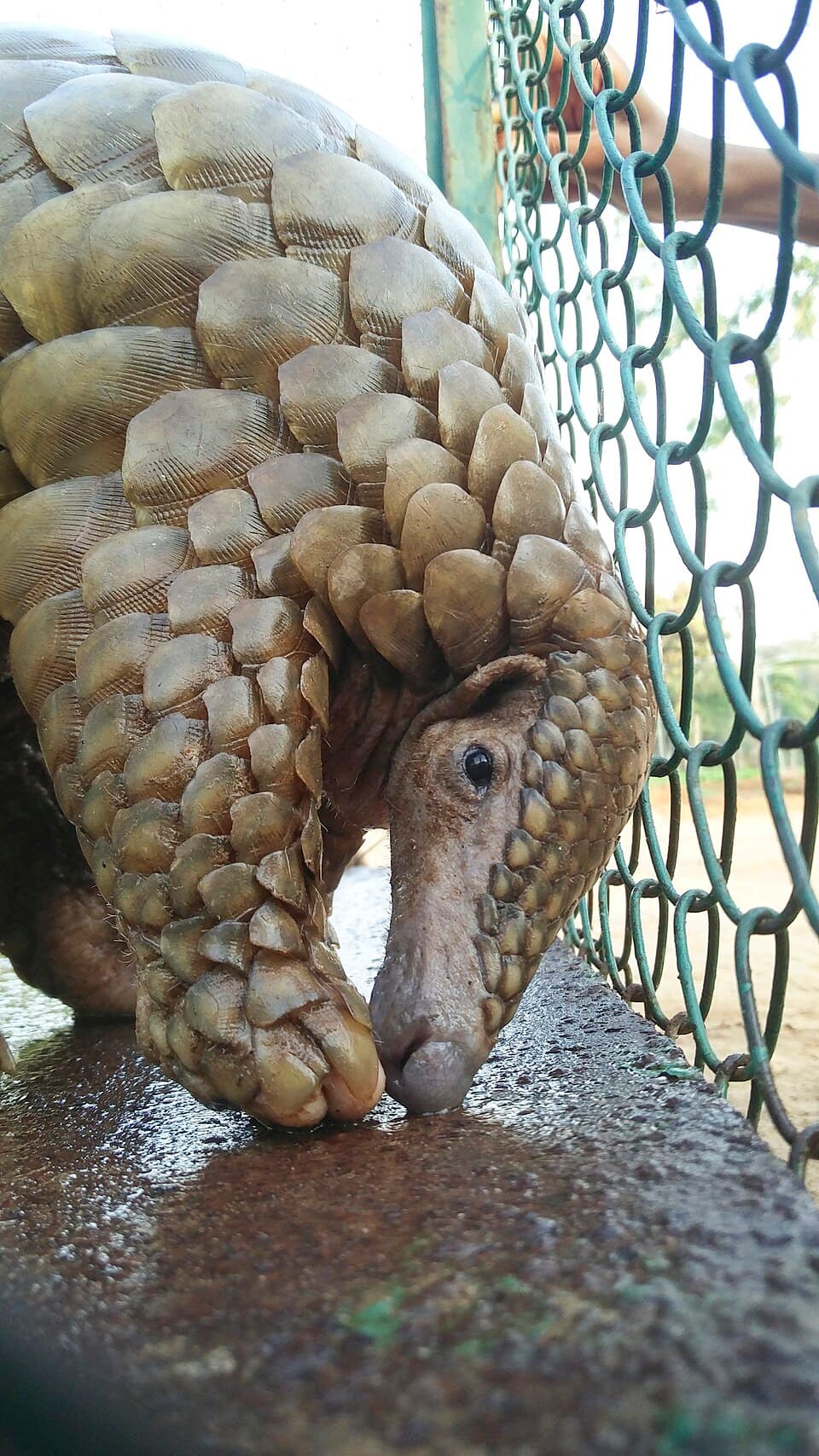
Photo: Vickey Chauhan · CC BY-SA 4.0 · Wikimedia Commons Ganges River DolphinPlatanista gangetica
Mammal
Deep pools and confluences of the Ganga, Brahmaputra, Meghna and their tributaries, including the Chambal and Kulsi.
National Aquatic Animal of India. Functionally blind: it has no crystalline lens and navigates entirely by echolocation, swimming on its side with a flipper trailing the bottom. Vikramshila in Bihar is the dedicated sanctuary. Project Dolphin was announced in 2020.
Uttar Pradesh · Bihar · West Bengal · Assam · Jharkhand · Madhya Pradesh · Rajasthan
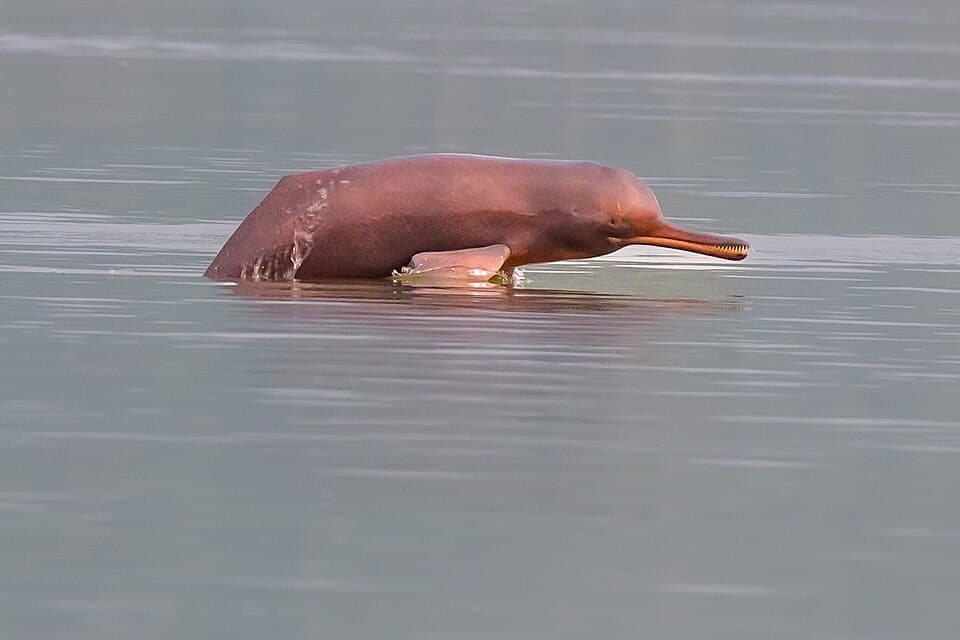
Photo: Munshi Abul Barakat · CC BY 4.0 · Wikimedia Commons Indus River DolphinPlatanista minor
Mammal
The Beas river between Talwara and Harike, the only Indian population.
Rediscovered in the Beas in 2007 after being presumed locally extinct. The Beas Conservation Reserve, a Ramsar site, exists largely to protect it. State aquatic animal of Punjab.
Punjab
Irrawaddy DolphinOrcaella brevirostris
Mammal
Brackish lagoons and estuaries. Chilika Lake holds one of the largest single populations in the world.
Has a rounded head with no beak and can spit jets of water. Known to cooperate with fishermen by driving fish towards their nets.
Odisha · West Bengal
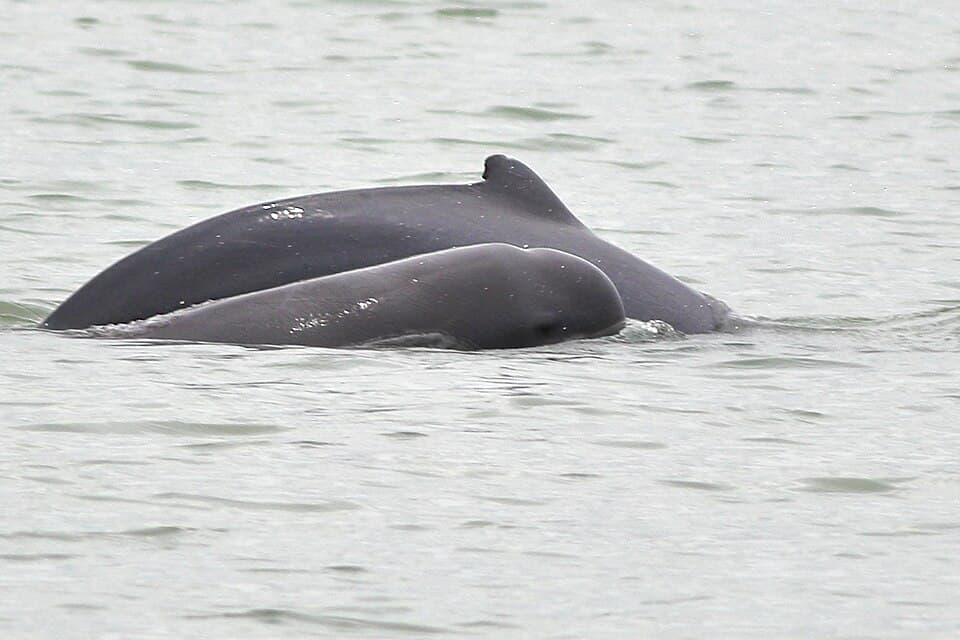
Photo: Dibyendu Ash · CC BY 4.0 · Wikimedia Commons Blue WhaleBalaenoptera musculus
Mammal
Deep offshore waters of the Arabian Sea and Bay of Bengal, with a distinct northern Indian Ocean population.
The largest animal that has ever lived. The Arabian Sea population is non-migratory and genetically distinct, which is unusual for the species.
Kerala · Tamil Nadu · Maharashtra · Gujarat · Andaman & Nicobar Islands · Lakshadweep
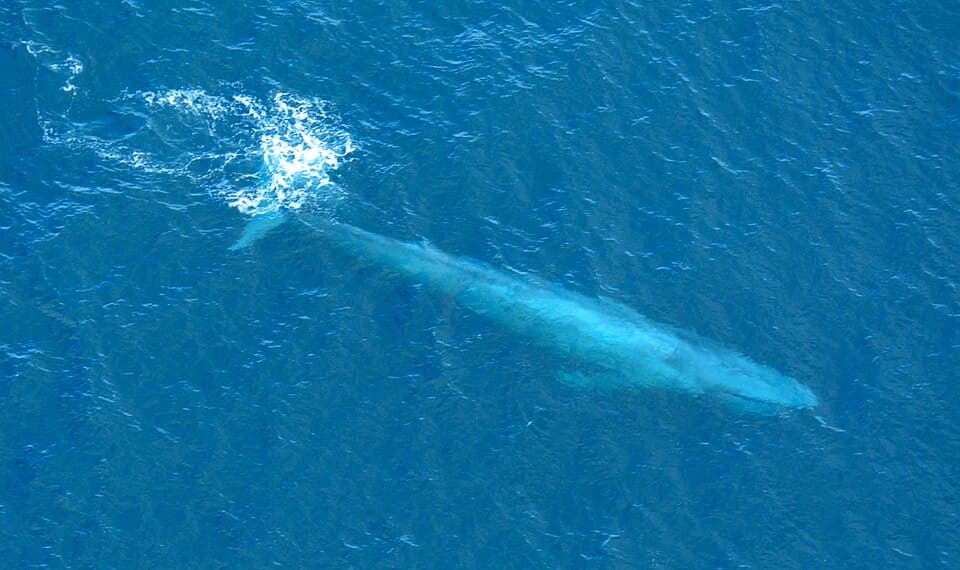
Photo: Don Ramey Logan · CC BY-SA 3.0 · Wikimedia Commons Woolly Flying SquirrelEupetaurus cinereus
Mammal
Steep cliffs and caves in arid conifer zones of the north western Himalaya, 2,400 to 3,600 m.
The largest gliding mammal in the world, rediscovered in 1994 after 70 years without a record. Feeds largely on pine needles, a very unusual diet for a mammal.
Jammu & Kashmir · Himachal Pradesh
Egyptian VultureNeophron percnopterus
Bird
Open arid country, village edges, rubbish tips and cliffs for nesting.
One of very few birds known to use tools: it throws stones to break open ostrich and other large eggs. The smallest of the Indian vultures and largely resident.
Rajasthan · Gujarat · Haryana · Madhya Pradesh · Maharashtra · Uttar Pradesh · Punjab · Karnataka · Bihar
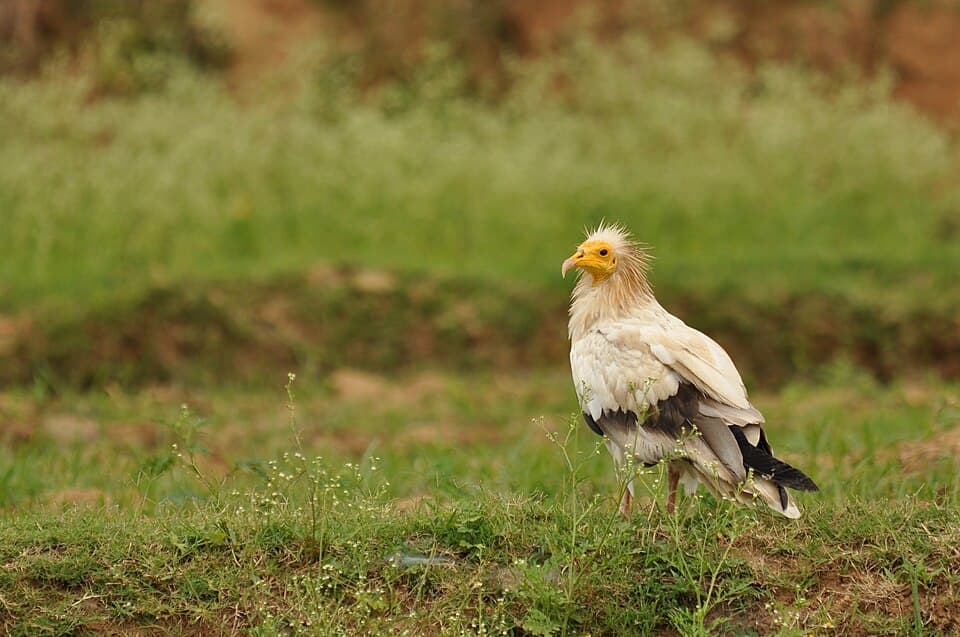
Photo: T. R. Shankar Raman · CC BY-SA 4.0 · Wikimedia Commons Steppe EagleAquila nipalensis
Bird
Open grassland, agricultural fields, wetland margins and rubbish dumps in winter. Large congregations at Jorbeer near Bikaner and in the Rann of Kutch.
A long-distance migrant breeding in the Central Asian steppe. India is one of its most important wintering grounds; secondary poisoning at carcass dumps is an emerging threat.
Gujarat · Rajasthan · Ladakh · Madhya Pradesh · Haryana · Uttar Pradesh · Bihar
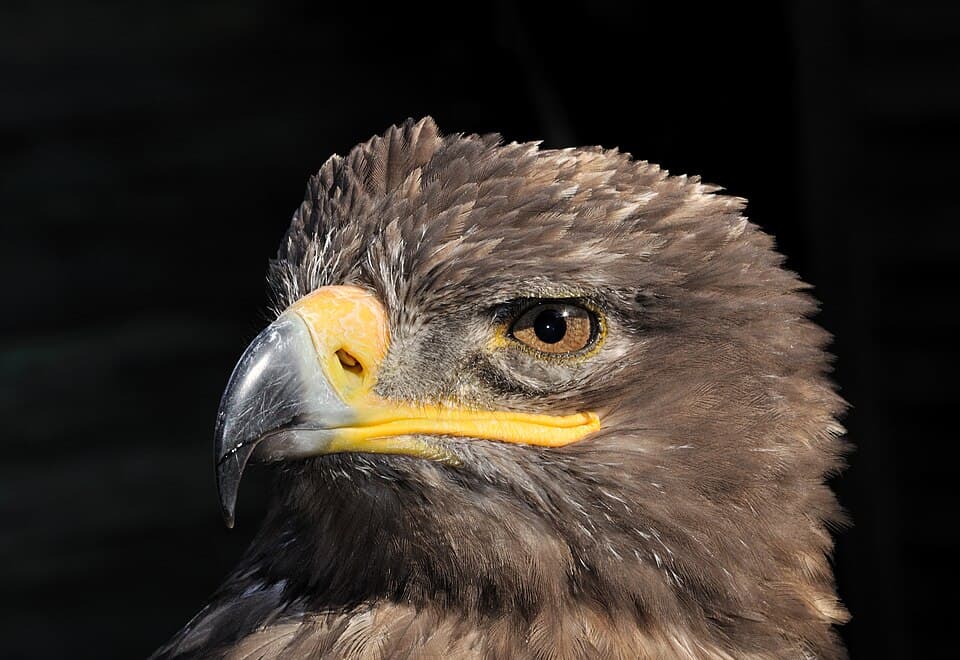
Photo: Quartl · CC BY-SA 3.0 · Wikimedia Commons Indian SkimmerRynchops albicollis
Bird
Sandbars and mid-river islands of large rivers. Chambal is the global stronghold; winters at Chilika and Bhitarkanika.
The lower mandible is markedly longer than the upper. It feeds by flying low with the lower bill slicing the water surface, snapping shut on contact with a fish. Uplisted from Vulnerable in 2020.
Madhya Pradesh · Uttar Pradesh · Rajasthan · Odisha · Andhra Pradesh · Assam · Bihar
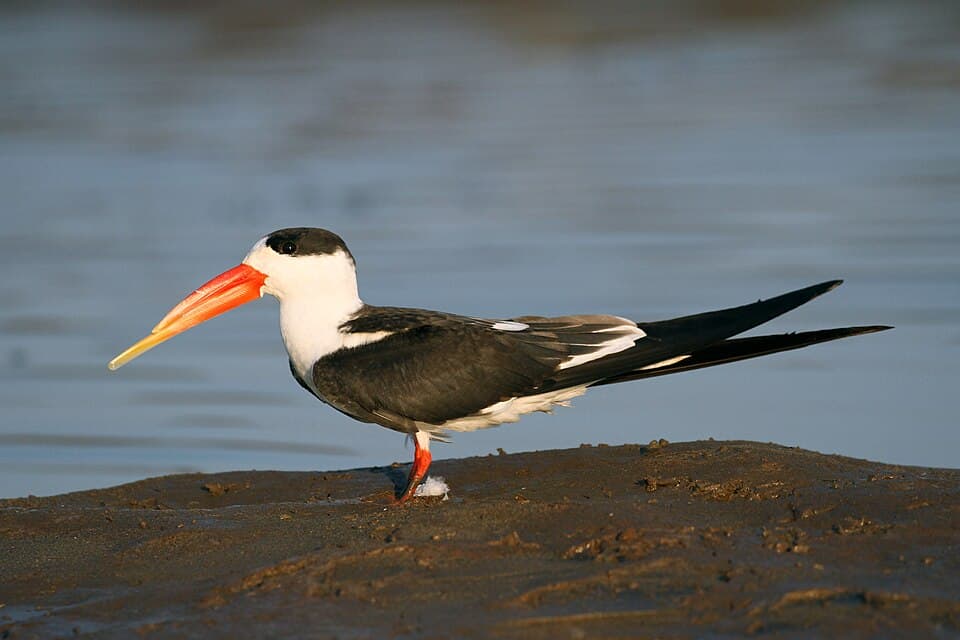
Photo: Davidvraju · CC BY-SA 4.0 · Wikimedia Commons Black-bellied TernSterna acuticauda
Bird
Sandbanks and shingle islands of large rivers such as the Ganga, Chambal and Brahmaputra.
Nests directly on open river sand, which makes it extremely vulnerable to sand mining, dam-driven flow changes and dogs.
Madhya Pradesh · Uttar Pradesh · Assam · Odisha · Bihar · Rajasthan
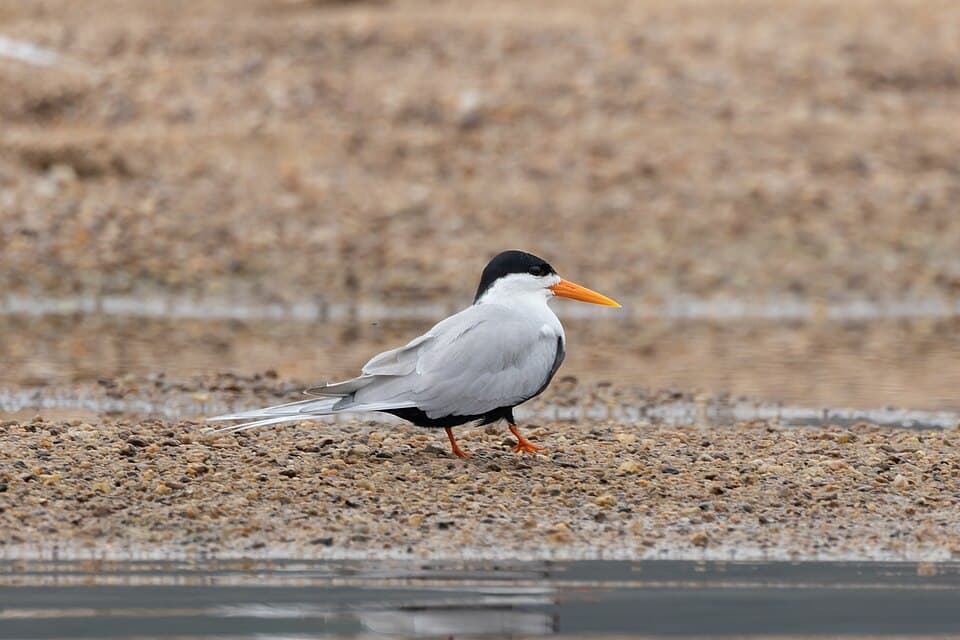
Photo: Tisha Mukherjee · CC BY-SA 4.0 · Wikimedia Commons Pallas's Fish EagleHaliaeetus leucoryphus
Bird
Large lakes, rivers and wetlands with tall nesting trees. Recorded from many Ramsar sites including Bhindawas, Haiderpur and Wadhvana.
Breeds in winter, unusually for a raptor, timing chick rearing to the dry-season concentration of fish.
Assam · Arunachal Pradesh · Uttar Pradesh · Bihar · West Bengal · Haryana · Punjab
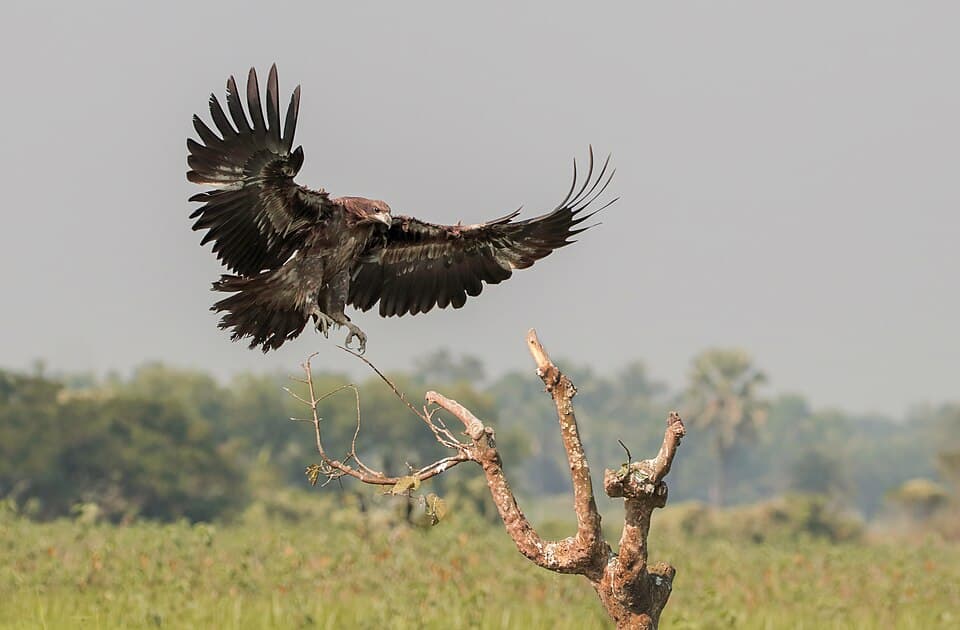
Photo: Tareq Uddin Ahmed from chittagon, Bangladesh · CC BY 2.0 · Wikimedia Commons Forest OwletAthene blewitti
BirdEndemic · Central India
Dry deciduous teak forest with open glades. Melghat, Tansa and the Toranmal belt are key sites.
Rediscovered in 1997 after 113 years, in a rediscovery that also exposed a famous nineteenth century specimen fraud. Diurnal, unusually for an owl, and hunts lizards from an exposed perch.
Maharashtra · Madhya Pradesh · Gujarat · Odisha
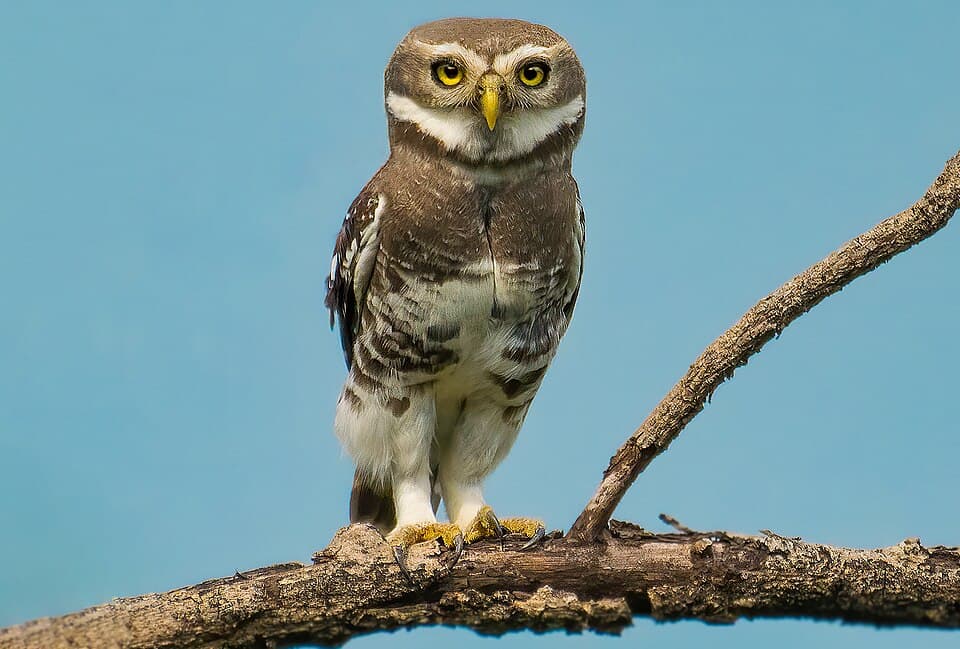
Photo: Saswat Mishra · CC BY-SA 4.0 · Wikimedia Commons Nordmann's or Spotted GreenshankTringa guttifer
Bird
Coastal mudflats, saltpans and estuarine lagoons in winter, including Chilika and Point Calimere.
One of the rarest shorebirds in Asia, breeding only on the Sea of Okhotsk coast, where it nests in larch trees rather than on the ground.
Odisha · West Bengal · Tamil Nadu · Andhra Pradesh
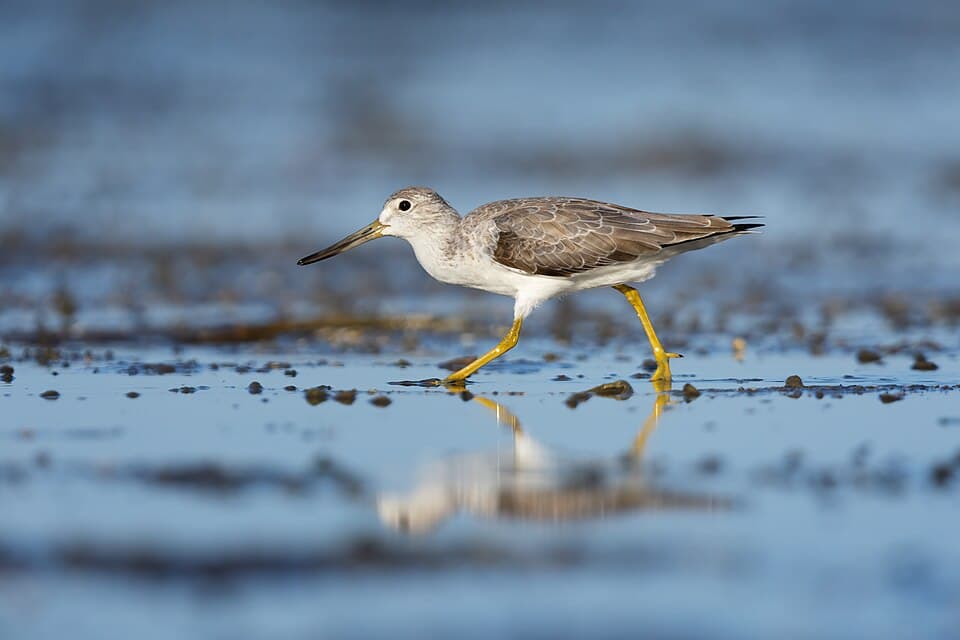
Photo: JJ Harrison · CC BY-SA 3.0 · Wikimedia Commons White-winged Wood DuckAsarcornis scutulata
Bird
Secluded pools and swampy clearings inside dense tropical evergreen forest. Namdapha and Dihing Patkai are strongholds.
State bird of Assam, known locally as deo hanh, the spirit duck, for its ghostly nocturnal calls. Nests in tree hollows.
Assam · Arunachal Pradesh · Nagaland · Meghalaya
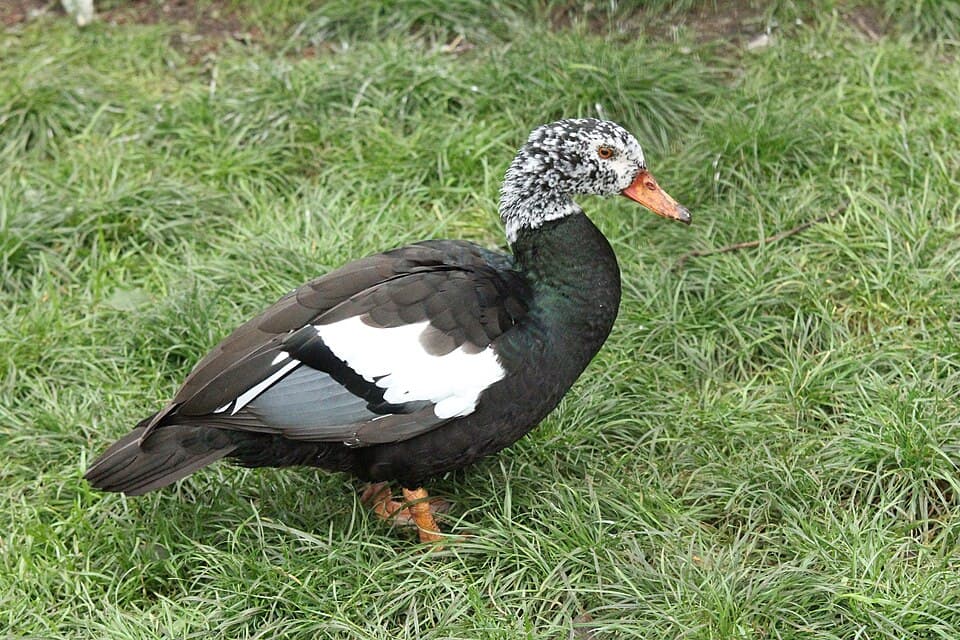
Photo: Christiaan Luttenberg Burgers' Zoo · CC BY-SA 4.0 · Wikimedia Commons Great KnotCalidris tenuirostris
Bird
Intertidal mudflats of both coasts, notably the Gulf of Kachchh and Point Calimere.
Undertakes one of the longest non-stop flights of any shorebird. Its decline is driven almost entirely by reclamation of Yellow Sea staging mudflats.
Gujarat · Odisha · Tamil Nadu · Andhra Pradesh · Maharashtra · West Bengal
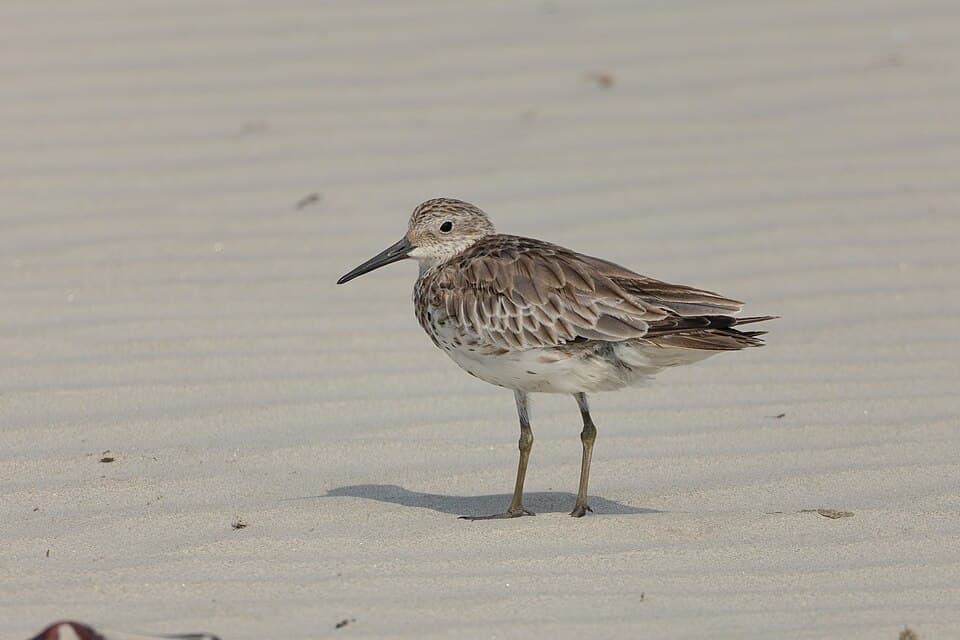
Photo: Tisha Mukherjee · CC BY-SA 4.0 · Wikimedia Commons Finn's WeaverPloceus megarhynchus
BirdEndemic · Terai belt
Tall wet grassland and sugarcane in the terai, nesting colonially in isolated trees.
Also called the yellow weaver. Unlike the common baya weaver it builds an untidy globular nest high in a solitary tree and is far more dependent on intact grassland.
Uttarakhand · Uttar Pradesh · Assam · West Bengal
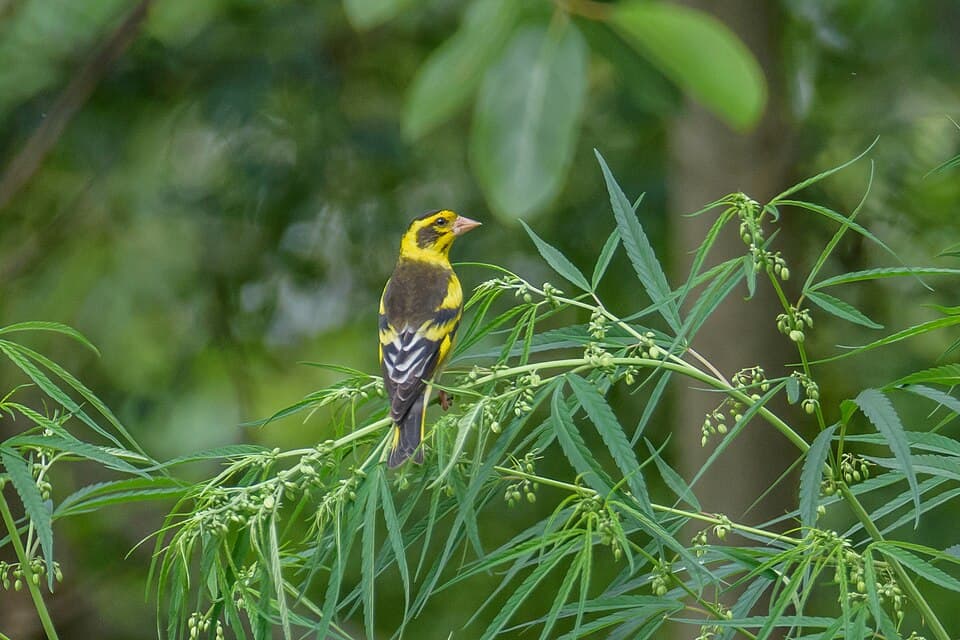
Photo: Creepanta · CC BY-SA 4.0 · Wikimedia Commons Manipur Bush QuailPerdicula manipurensis
Bird
Dense wet grassland and reedbeds of the Manipur valley and the Brahmaputra plain.
Extremely secretive, with almost no confirmed recent records outside a few Assam grasslands.
Manipur · Assam · Nagaland · Meghalaya
Green Sea TurtleChelonia mydas
Reptile
Seagrass meadows and coral reefs; nests on beaches in Gujarat, Lakshadweep and the Andamans.
The only largely herbivorous sea turtle as an adult. Its grazing keeps seagrass meadows healthy, which in turn supports dugong and fisheries.
Gujarat · Tamil Nadu · Lakshadweep · Andaman & Nicobar Islands · Odisha · Kerala · Maharashtra
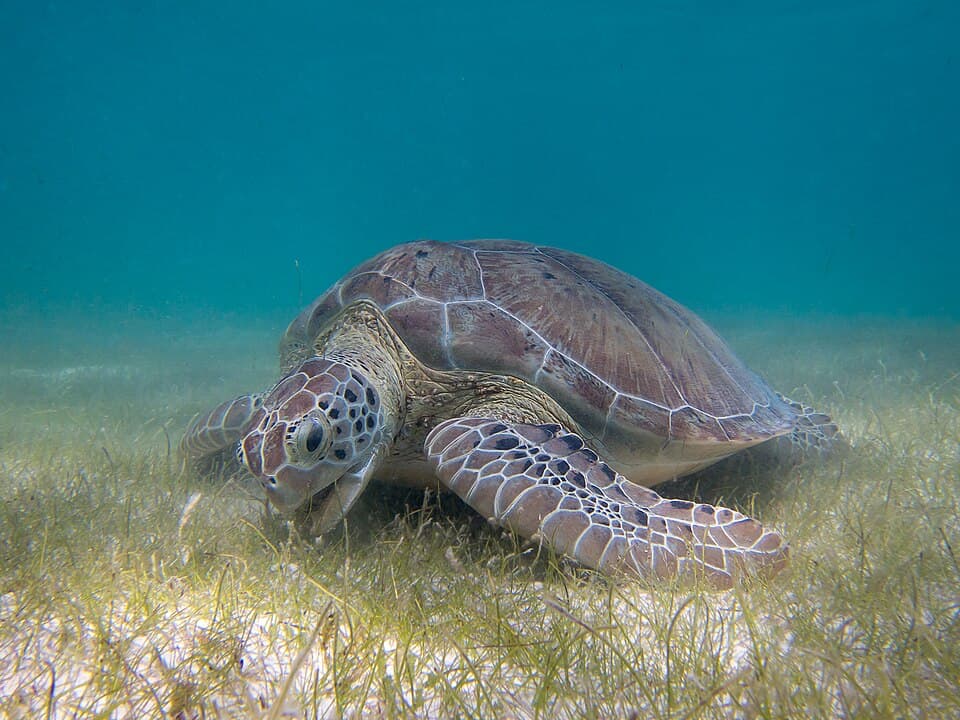
Photo: P.Lindgren · CC BY-SA 3.0 · Wikimedia Commons Indian Narrow-headed Softshell TurtleChitra indica
Reptile
Sandy beds of large rivers in the Ganga, Indus and Mahanadi systems.
One of the largest freshwater turtles in the world, exceeding a metre in shell length. Ambushes fish from beneath the sand with a strike of its very narrow head.
Uttar Pradesh · Madhya Pradesh · Bihar · Rajasthan · West Bengal · Odisha
Assam Roofed TurtlePangshura sylhetensis
ReptileEndemic · Brahmaputra basin
Small forest streams and hill rivers of the Brahmaputra drainage.
The smallest of the roofed turtles and the only Pangshura species with a strongly serrated rear shell margin.
Assam · Arunachal Pradesh · Meghalaya · Nagaland
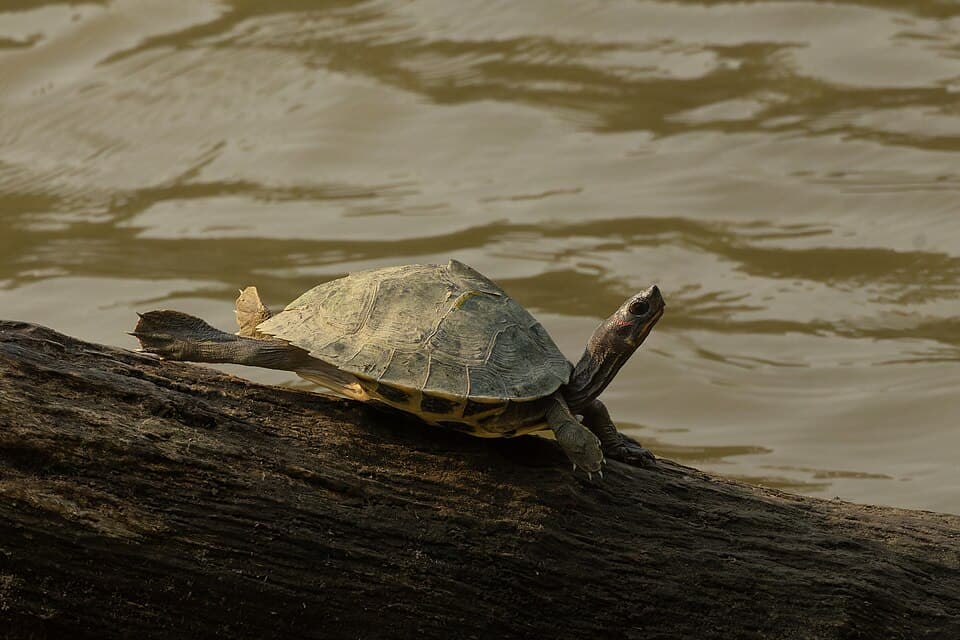
Photo: Tisha Mukherjee · CC BY-SA 4.0 · Wikimedia Commons Purple Frog or Pig-nosed FrogNasikabatrachus sahyadrensis
AmphibianEndemic · Western Ghats
Spends almost its entire life underground in moist soil of the southern Western Ghats, surfacing for only a few days a year.
Described in 2003 and placed in its own family, with its closest relatives in the Seychelles. It is a living record of the break-up of Gondwana, having diverged over 100 million years ago. Feeds on termites through a fluted tongue pushed into their tunnels. State amphibian of Kerala.
Kerala · Tamil Nadu
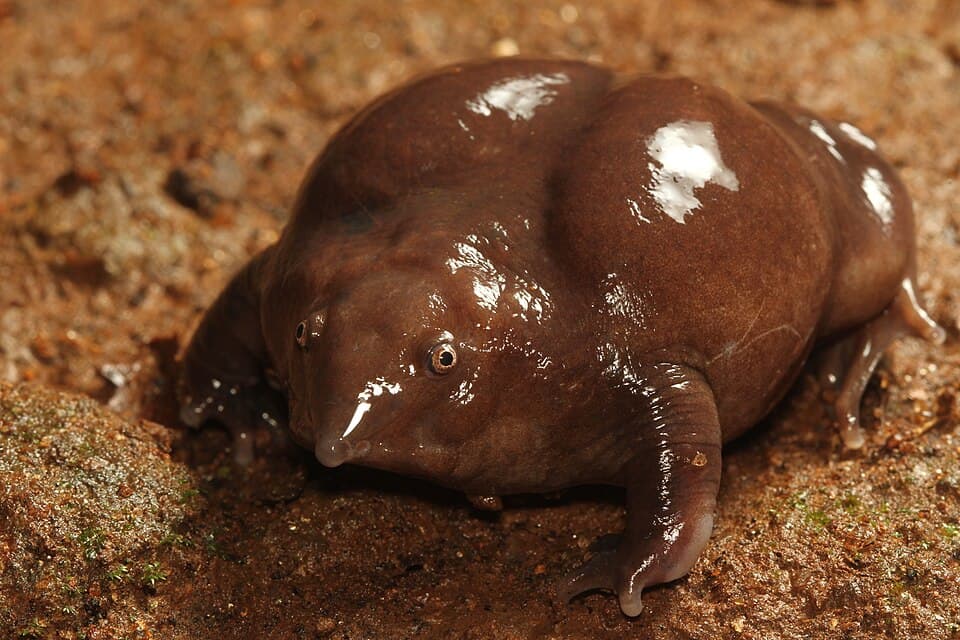
Photo: David V. Raju · CC BY-SA 4.0 · Wikimedia Commons Whale SharkRhincodon typus
Fish
Warm coastal and offshore waters. The Saurashtra coast off Gujarat is a globally important aggregation site.
The largest fish in the world, reaching 12 metres or more, and a filter feeder on plankton. Each individual carries a unique spot pattern used like a fingerprint. It became the first fish protected under Schedule I of the Wild Life (Protection) Act, in 2001, after a campaign in Gujarat.
Gujarat · Kerala · Tamil Nadu · Maharashtra · Goa · Lakshadweep · Andaman & Nicobar Islands
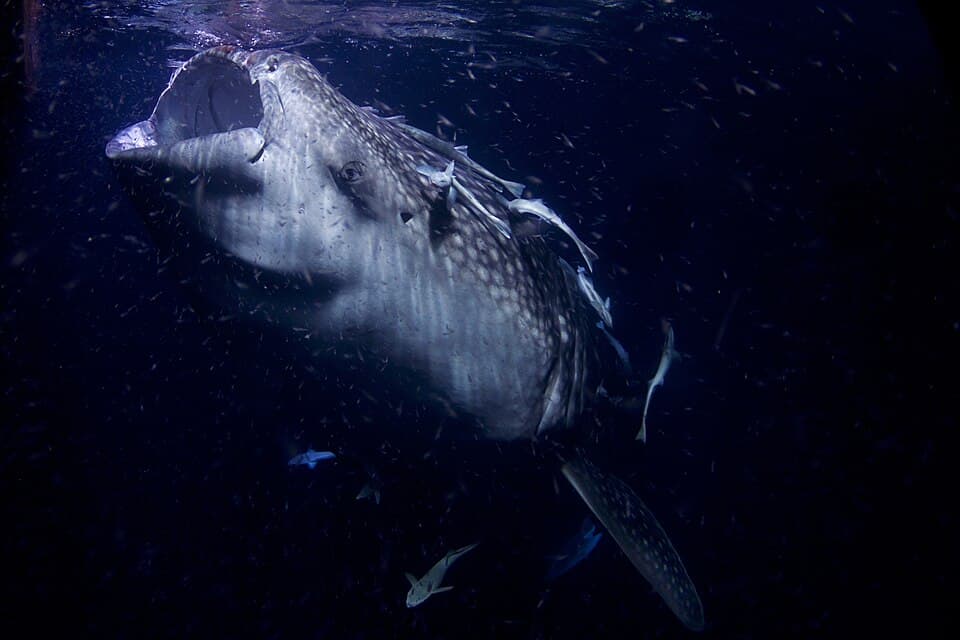
Photo: Arturo de Frias Marques · CC BY-SA 4.0 · Wikimedia Commons Golden MahseerTor putitora
Fish
Fast-flowing, cold, well-oxygenated Himalayan rivers such as the Ganga, Beas, Kosi and Ramganga.
A long-distance migratory carp that moves upstream to spawn, so barrages and dams cut its life cycle. Prized as a sport fish and an indicator of river health.
Uttarakhand · Himachal Pradesh · Jammu & Kashmir · Uttar Pradesh · Bihar · West Bengal · Assam · Arunachal Pradesh
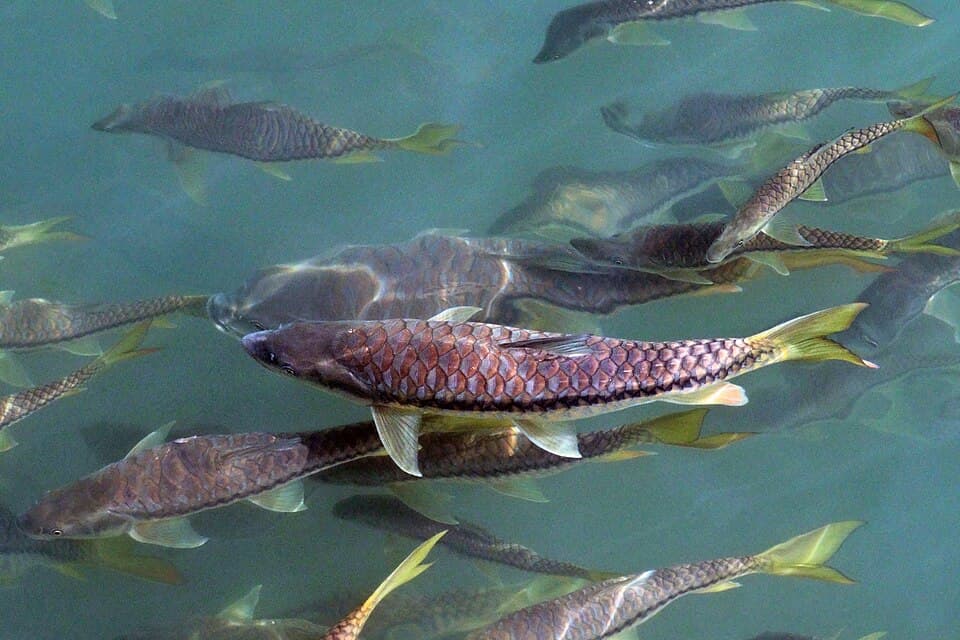
Photo: Charles J. Sharp · CC BY-SA 4.0 · Wikimedia Commons Knifetooth SawfishAnoxypristis cuspidata
Fish
Shallow coastal waters and estuaries.
Differs from the Pristis sawfishes in having a rostrum without teeth on the basal quarter.
Gujarat · Maharashtra · Tamil Nadu · Odisha · West Bengal
Nepenthes khasiana or Khasi Pitcher PlantNepenthes khasiana
PlantEndemic · Meghalaya
Nutrient-poor, humid slopes and sandstone ledges of the Khasi and Jaintia hills.
The only pitcher plant native to India. Leaves are modified into pitchers that trap and digest insects, an adaptation to soils very poor in nitrogen. Known locally as memang-koksi, the devil's flower basket. Threatened by collection and by limestone quarrying.
Meghalaya
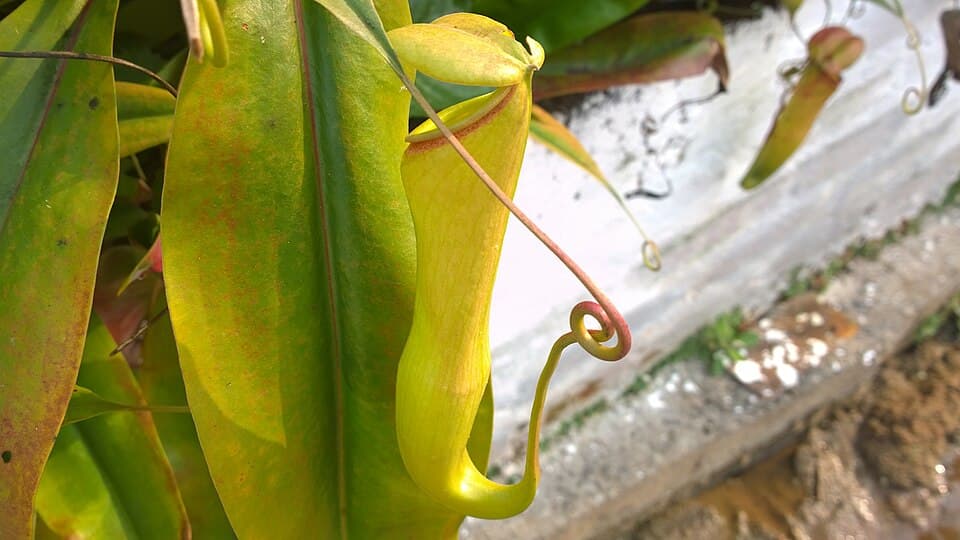
Photo: Hgm2016 · CC BY-SA 4.0 · Wikimedia Commons Globba andersoniiGlobba andersonii
PlantEndemic · Eastern Himalaya
Moist, shaded rocky slopes and stream banks in the Teesta valley, near Sikkim's border with Darjeeling.
A wild ginger known as the dancing ladies. Rediscovered in 2015 after nearly 130 years. Recognised by white flowers with a hooded orange-yellow lip and pendulous inflorescences.
Sikkim · West Bengal
SundariHeritiera fomes
Plant
The Sundarbans, which take their name from it.
Top dying disease and rising salinity are the threats.
West Bengal
Cycas beddomeiCycas beddomei
PlantEndemic · Tirumala hills
The Tirumala hills of Andhra Pradesh.
The only cycad on CITES Appendix I.
Andhra Pradesh
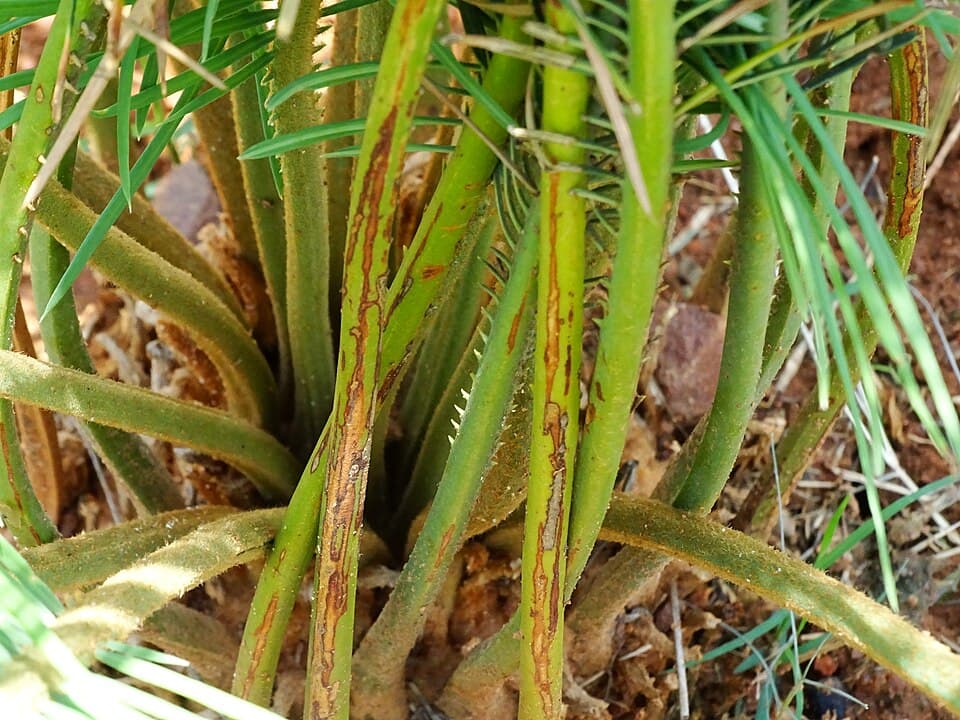
Photo: Forestowlet · CC0 · Wikimedia Commons Red SandersPterocarpus santalinus
PlantEndemic · Seshachalam and Palakonda hills, Andhra Pradesh
Dry deciduous forest on the rocky slopes of the Seshachalam and Palakonda hills of the southern Eastern Ghats.
Reassessed as Endangered in 2021, three years after it was downlisted to Near Threatened, for the poaching of its heartwood. On CITES Appendix II.
Andhra Pradesh
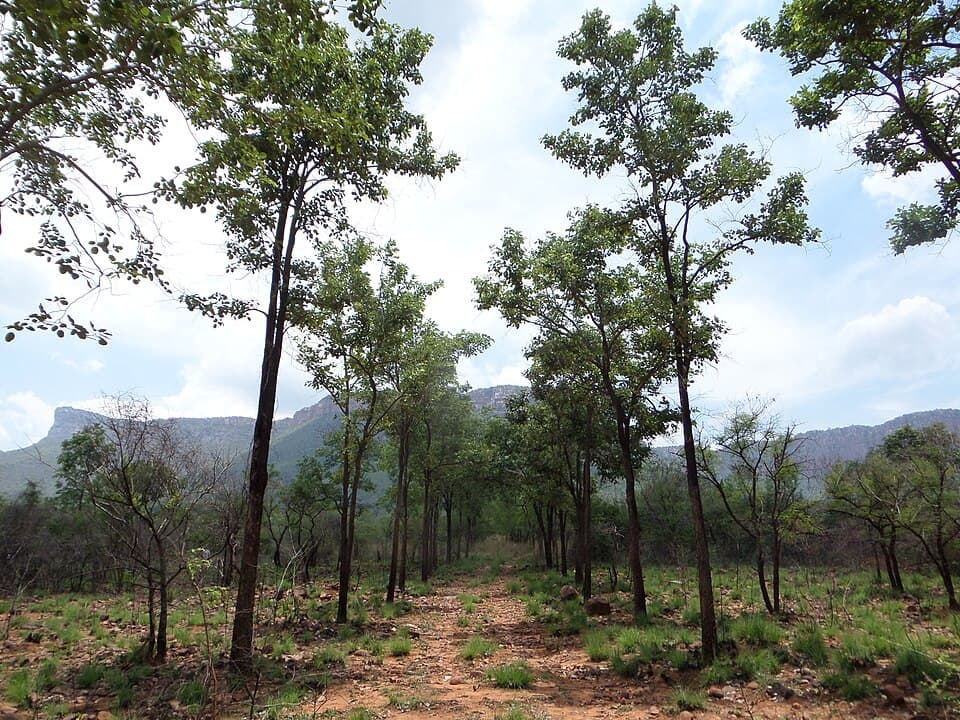
Photo: rajaraman sundaram · CC BY 3.0 · Wikimedia Commons


.jpg)
.jpg)


_female_head.jpg)


_at_Kaziranga_National_Park,_Assam,_India_1.jpg)


_at_Kaziranga_National_Park,_Assam,_India_2.jpg)


_1361.jpg)

.jpg)
_by_Saswat_Mishra.jpg)

.jpg)

_39.jpg)


_Babai_River.jpg)


Vulnerable
45 speciesSnow LeopardPanthera uncia
Mammal
Alpine and subalpine rocky steppe above the treeline, 3,000 to 5,400 m. Hemis is the flagship site.
The 'ghost of the mountains'. It cannot roar: the hyoid structure differs from other big cats. The very long tail stores fat and is wrapped around the body for warmth. Downlisted from Endangered to Vulnerable in 2017. The Snow Leopard Population Assessment in India put the number at 718. State animal of Ladakh and Himachal Pradesh.
Ladakh · Himachal Pradesh · Uttarakhand · Sikkim · Arunachal Pradesh · Jammu & Kashmir
Indian Rhinoceros or Greater One-horned RhinocerosRhinoceros unicornis
Mammal
Alluvial floodplain grassland and swamps. Kaziranga holds about 70 per cent of the world population; also Orang, Pobitora, Manas, Jaldapara, Gorumara and Dudhwa.
State animal of Assam. Has a single horn of compacted keratin, not bone, and armour-like skin folds. Pobitora has the highest density of rhinos anywhere in the world. A conservation success story: numbers rose from around 200 in the early twentieth century to over 4,000.
Assam · West Bengal · Uttar Pradesh · Bihar
Gaur or Indian BisonBos gaurus
Mammal
Moist and dry deciduous forest with grassy glades, up to about 2,800 m in the Western Ghats and the north east.
The largest wild cattle in the world and the tallest bovid. Distinguished by white 'stockings' on all four legs and a prominent dorsal ridge. State animal of Goa and Bihar. Successfully reintroduced to Bandhavgarh from Kanha in 2011.
Karnataka · Kerala · Tamil Nadu · Maharashtra · Madhya Pradesh · Chhattisgarh · Odisha · Assam · Meghalaya · Goa · Jharkhand · Bihar · Tripura
Sloth BearMelursus ursinus
Mammal
Dry and moist deciduous forest, scrub and rocky outcrops with termite mounds and caves.
Specialised for eating termites: it lacks the two upper incisors, leaving a gap through which it vacuums insects with an audible sound heard 100 metres away. Carries its cubs on its back, uniquely among bears. The species behind the historic 'dancing bear' trade, ended in 2009. Daroji in Karnataka is a dedicated sanctuary.
Madhya Pradesh · Chhattisgarh · Maharashtra · Karnataka · Odisha · Rajasthan · Gujarat · Andhra Pradesh · Telangana · Jharkhand · Tamil Nadu · Kerala · Bihar · Uttar Pradesh
Asiatic Black BearUrsus thibetanus
Mammal
Temperate broadleaf and conifer forest of the Himalaya and north east, 1,200 to 3,300 m.
The white or cream V-shaped crescent on the chest gives it the name moon bear. A major driver of human-wildlife conflict in Kashmir and Himachal, where orchards draw bears to villages.
Jammu & Kashmir · Himachal Pradesh · Uttarakhand · Arunachal Pradesh · Sikkim · Assam · Manipur · Nagaland · Meghalaya · West Bengal
Clouded LeopardNeofelis nebulosa
Mammal
Dense tropical and subtropical evergreen forest of the north east and eastern Himalaya.
Has the longest canine teeth relative to skull size of any living cat, often compared with the extinct sabre-tooths. Its ankles rotate so far that it can climb down trunks head first and hang upside down from branches. State animal of Meghalaya. Tripura has a national park named after it.
Arunachal Pradesh · Assam · Meghalaya · Nagaland · Manipur · Mizoram · Tripura · Sikkim · West Bengal
Fishing CatPrionailurus viverrinus
Mammal
Mangroves, reedbeds, marshes and tidal creeks. The Sundarbans, Bhitarkanika, Chilika and the Coringa mangroves are strongholds.
State animal of West Bengal. Partially webbed feet and a double-layered coat make it a strong swimmer; it taps the water surface to mimic insects and lure fish. Downlisted from Endangered to Vulnerable in 2016. Almost entirely dependent on wetlands, so it is the natural flagship for wetland conservation.
West Bengal · Odisha · Andhra Pradesh · Assam · Bihar · Uttar Pradesh · Tamil Nadu
DugongDugong dugon
Mammal
Shallow seagrass meadows. The Gulf of Mannar and Palk Bay hold the largest Indian population.
The only strictly herbivorous marine mammal and the sole surviving member of its family. State animal of the Andaman and Nicobar Islands. India notified a Dugong Conservation Reserve in Palk Bay in 2022, the first of its kind in the country.
Tamil Nadu · Andaman & Nicobar Islands · Gujarat · Lakshadweep
Barasingha or Swamp DeerRucervus duvaucelii
Mammal
Two distinct forms: hard-ground barasingha on the maidans of Kanha, and wetland forms in the terai at Dudhwa and in Assam.
State animal of Madhya Pradesh. The name means twelve-tined, from the branched antlers. The Kanha hard-ground subspecies recovered from about 66 animals in 1970 to over 800, one of India's best documented recoveries, and has been reintroduced to Satpura and Bandhavgarh.
Madhya Pradesh · Uttar Pradesh · Assam · Uttarakhand · West Bengal
Four-horned Antelope or ChousinghaTetracerus quadricornis
MammalEndemic · Indian subcontinent
Open dry deciduous forest with hills and grass, always near water.
The only wild bovid in the world with four horns. The rear pair is longer; the front pair is sometimes reduced to a stub. Solitary and largely restricted to India.
Madhya Pradesh · Maharashtra · Rajasthan · Gujarat · Odisha · Andhra Pradesh · Telangana · Karnataka · Chhattisgarh · Jharkhand · Uttar Pradesh · Bihar
Nilgiri LangurSemnopithecus johnii
MammalEndemic · Western Ghats
Evergreen shola forest and moist deciduous forest, 300 to 2,000 m.
Glossy black with a golden-brown head ruff. Poached for the supposed medicinal value of its flesh and organs, a threat unusual among Indian primates.
Kerala · Tamil Nadu · Karnataka
Capped LangurTrachypithecus pileatus
Mammal
Tropical evergreen and moist deciduous forest north and east of the Brahmaputra.
Named for the dark cap of hair on the crown that contrasts sharply with a pale golden or orange belly.
Assam · Arunachal Pradesh · Meghalaya · Nagaland · Manipur · Tripura
Stump-tailed MacaqueMacaca arctoides
Mammal
Dense evergreen and semi-evergreen forest of the north east.
Also called the bear macaque for its shaggy coat and very short tail. The bright red face darkens with age and sun exposure.
Assam · Arunachal Pradesh · Meghalaya · Nagaland · Manipur · Mizoram · Tripura
Eastern Hoolock GibbonHoolock leuconedys
Mammal
Evergreen forest east of the Dibang river in Arunachal Pradesh, the only Indian range.
Separated from the western hoolock by the white brow patches, which are divided rather than joined, and by a pale genital tuft.
Arunachal Pradesh
Nilgiri MartenMartes gwatkinsii
MammalEndemic · Western Ghats
Shola forest, montane grassland and plantation edges above 1,000 m.
The only marten in peninsular India and the sole mustelid of the southern Western Ghats. Recognised by a bright yellow to orange throat patch. Very rarely seen and almost never studied in the wild.
Kerala · Tamil Nadu · Karnataka
Smooth-coated OtterLutrogale perspicillata
Mammal
Rivers, reservoirs, mangroves and estuaries. The Chambal, Cauvery, Ropar and Sundarbans hold good numbers.
The largest otter in South Asia and highly social, hunting in coordinated family groups that drive fish into the shallows.
Karnataka · Kerala · Tamil Nadu · Uttar Pradesh · Madhya Pradesh · Punjab · Odisha · West Bengal · Assam · Gujarat · Maharashtra
Asian Small-clawed OtterAonyx cinereus
Mammal
Hill streams, paddy fields and mangrove creeks in the Western Ghats and the north east.
The smallest otter in the world. Its claws are reduced to blunt spikes and the paws are highly dexterous, used to feel under stones for crabs and molluscs rather than to catch fish.
Kerala · Karnataka · Tamil Nadu · Assam · Arunachal Pradesh · Meghalaya · West Bengal · Sikkim
Himalayan SerowCapricornis thar
Mammal
Steep, forested and rocky slopes between 2,000 and 4,000 m in the Himalaya, and lower hills in the north east.
A goat-antelope, part goat and part antelope in appearance, with large mule-like ears. State animal of Mizoram. First recorded in Assam's Manas landscape and in Spiti at unusually high elevation in recent years.
Himachal Pradesh · Uttarakhand · Sikkim · Arunachal Pradesh · Jammu & Kashmir · West Bengal · Assam · Meghalaya · Mizoram · Nagaland
TakinBudorcas taxicolor
Mammal
Bamboo and rhododendron thickets and alpine meadow, 2,000 to 4,500 m, in the eastern Himalaya.
A heavy-set goat-antelope sometimes called the gnu goat. Secretes an oily substance over its coat that acts as a natural raincoat. The Mishmi takin occurs only in Arunachal Pradesh within India.
Arunachal Pradesh
Wild YakBos mutus
Mammal
Alpine tundra and cold desert steppe above 4,000 m, in eastern Ladakh and along the northern borders.
Far larger than the domestic yak. Dense two-layered fur and enlarged lungs and heart let it function at elevations where most large mammals cannot. Very few remain in India.
Ladakh · Sikkim · Arunachal Pradesh
Indo-Pacific Finless PorpoiseNeophocaena phocaenoides
Mammal
Shallow coastal waters, mangrove channels and lagoons, including Chilika and the Sundarbans.
Has no dorsal fin at all, only a low ridge of tubercles along the back. Frequently killed as bycatch in gillnets.
Odisha · West Bengal · Tamil Nadu · Gujarat · Maharashtra · Kerala
Sperm WhalePhyseter macrocephalus
Mammal
Deep offshore waters and submarine canyons of the Arabian Sea and Bay of Bengal.
The largest toothed predator on earth and the deepest-diving mammal, reaching beyond 2,000 m. Has the largest brain of any animal.
Kerala · Tamil Nadu · Andaman & Nicobar Islands · Lakshadweep · Maharashtra · Gujarat
Sarus CraneAntigone antigone
Bird
Shallow marshes, flooded paddy and village ponds, largely outside protected areas. The Etawah and Mainpuri belt of Uttar Pradesh holds the largest population.
The tallest flying bird in the world, standing up to 1.8 m. State bird of Uttar Pradesh. Pairs mate for life and are a folk symbol of marital devotion; the Ramayana tradition links the killing of a sarus to Valmiki's first verse. Sarsai Nawar Jheel, a Ramsar site, is named for it.
Uttar Pradesh · Madhya Pradesh · Rajasthan · Gujarat · Bihar · Haryana · Maharashtra · Assam
Great HornbillBuceros bicornis
Bird
Tall, closed-canopy evergreen and moist deciduous forest of the Western Ghats and the north east.
State bird of Kerala and Arunachal Pradesh. The hollow casque on the bill amplifies its calls. The female seals herself into a tree cavity with mud and droppings, leaving only a slit through which the male feeds her, so the loss of large nesting trees is fatal to breeding. A major seed disperser of large-fruited rainforest trees.
Kerala · Karnataka · Tamil Nadu · Maharashtra · Arunachal Pradesh · Assam · Meghalaya · Nagaland · Uttarakhand · West Bengal
Rufous-necked HornbillAceros nipalensis
Bird
Broadleaf evergreen hill forest of the eastern Himalaya, 600 to 2,200 m. Namdapha and Neora Valley are key sites.
The rarest of India's large hornbills, with the male showing a deep rufous head and neck. Hunted for its casque and tail feathers, used in traditional headgear.
Arunachal Pradesh · Assam · Sikkim · Nagaland · West Bengal
Narcondam HornbillRhyticeros narcondami
BirdEndemic · Narcondam Island
Evergreen forest on Narcondam, a single volcanic island of about 6.8 square kilometres.
Has one of the smallest ranges of any bird in the world, confined to a single island. About 1,000 birds. A proposed radar installation on the island became a well-known conservation controversy.
Andaman & Nicobar Islands
Nicobar MegapodeMegapodius nicobariensis
BirdEndemic · Nicobar Islands
Coastal forest just behind the beach on Great Nicobar and neighbouring islands.
Does not incubate its eggs with body heat. It builds a large mound of sand and rotting vegetation and lets fermentation and solar heat do the work, regulating temperature by adding or removing material. Badly hit by the 2004 tsunami and now exposed to the Great Nicobar development project.
Andaman & Nicobar Islands
Nilgiri Wood PigeonColumba elphinstonii
BirdEndemic · Western Ghats
Canopy of shola and wet evergreen forest, 800 to 2,000 m.
Recognised by a chequerboard pattern of black and white on the nape. An important disperser of large forest fruit seeds.
Kerala · Tamil Nadu · Karnataka · Maharashtra · Goa
Green AvadavatAmandava formosa
BirdEndemic · Central India
Tall grass, scrub and cropland on the Deccan plateau and around Mount Abu.
A small green and yellow finch trapped heavily for the cage bird trade, which is the main reason for its decline.
Madhya Pradesh · Rajasthan · Maharashtra · Chhattisgarh · Gujarat
Swamp FrancolinFrancolinus gularis
Bird
Tall wet grassland and reedbeds of the terai and Brahmaputra floodplain. Dudhwa, Jaldapara and Kaziranga hold good numbers.
Depends entirely on tall, wet grassland, so it is one of the sharpest indicators of terai grassland health.
Uttar Pradesh · Assam · Bihar · West Bengal · Uttarakhand
Marbled TealMarmaronetta angustirostris
Bird
Shallow brackish and freshwater wetlands in winter, including Nalsarovar and the Kachchh wetlands.
One of the most threatened ducks of the western Palearctic, with the Indian wintering population at the eastern edge of its range.
Gujarat · Rajasthan · Punjab · Haryana
Common PochardAythya ferina
Bird
Deep freshwater lakes and reservoirs in winter, recorded at most northern Indian Ramsar sites.
A common winter duck in India that was uplisted to Vulnerable in 2015 because of steep declines on its European breeding grounds, a useful example of a species that appears abundant locally but is threatened globally.
Rajasthan · Gujarat · Punjab · Haryana · Uttar Pradesh · Bihar · Assam · Madhya Pradesh
River TernSterna aurantia
Bird
Sandbars and rocky islets in large rivers and reservoirs. Nests colonially at Ranganathittu, the Chambal and Bhadra.
Uplisted from Least Concern to Vulnerable in 2020. Its ground nests on river sand are exposed to sand mining, altered flows and flooding from dam releases.
Madhya Pradesh · Uttar Pradesh · Karnataka · Odisha · Assam · Rajasthan · Maharashtra · Bihar
Wood SnipeGallinago nemoricola
Bird
Alpine and subalpine marshy meadows in summer; descends to Himalayan foothills and, rarely, the Western Ghats in winter.
Very poorly known and thought to have a small, declining population.
Uttarakhand · Himachal Pradesh · Sikkim · Arunachal Pradesh · Jammu & Kashmir · Kerala · Tamil Nadu
Mugger CrocodileCrocodylus palustris
Reptile
Rivers, lakes, village tanks and reservoirs. Notably the Chambal, Vishwamitri in Vadodara and Sakhya Sagar in Madhya Pradesh.
Also called the marsh crocodile. Broad-snouted and the most adaptable of India's three crocodilians, tolerating even man-made tanks. Digs burrows to survive dry seasons. The Vishwamitri river running through Vadodara city holds one of the densest urban crocodile populations anywhere.
Gujarat · Rajasthan · Madhya Pradesh · Odisha · Tamil Nadu · Kerala · Karnataka · Maharashtra · Uttar Pradesh · Bihar · Chhattisgarh
King CobraOphiophagus hannah
Reptile
Dense evergreen and moist deciduous forest, plantations and bamboo, in the Western Ghats, north east and the eastern Himalaya.
The longest venomous snake in the world, up to 5.5 m. The only snake that builds a nest for its eggs and guards them. The genus name means snake-eater: it feeds almost entirely on other snakes. Agumbe in Karnataka is the best-known study site.
Kerala · Karnataka · Tamil Nadu · Maharashtra · Goa · Odisha · Assam · Arunachal Pradesh · West Bengal · Uttarakhand · Meghalaya · Andaman & Nicobar Islands
Indian Star TortoiseGeochelone elegans
Reptile
Dry scrub, thorn forest and semi-arid grassland of the Deccan and the north west.
The radiating star pattern on the shell is camouflage in dry grass. One of the most heavily trafficked tortoises in the world for the pet trade; moved to CITES Appendix I in 2019.
Andhra Pradesh · Telangana · Tamil Nadu · Karnataka · Gujarat · Rajasthan · Odisha · Kerala
Travancore TortoiseIndotestudo travancorica
ReptileEndemic · Western Ghats
Moist deciduous and evergreen forest floor of the Western Ghats.
One of very few forest-dwelling tortoises in India, and locally hunted for meat.
Kerala · Tamil Nadu · Karnataka
Olive Ridley TurtleLepidochelys olivacea
Reptile
Coastal waters; mass nesting beaches at Gahirmatha, Rushikulya and Devi river mouth in Odisha.
Famous for the arribada, a synchronised mass nesting in which hundreds of thousands of females come ashore over a few nights. Gahirmatha is the largest known rookery in the world. Turtle excluder devices in trawl nets are the main mitigation.
Odisha · Andhra Pradesh · Tamil Nadu · Kerala · Goa · Maharashtra · West Bengal · Andaman & Nicobar Islands
Leatherback TurtleDermochelys coriacea
Reptile
Open ocean; the most important Indian nesting beaches are on Little Andaman and Great Nicobar, including Galathea Bay.
The largest turtle in the world and the only one without a hard shell, having instead a leathery, ridged carapace. It can regulate its body temperature above ambient, which lets it forage in cold water, and feeds almost entirely on jellyfish.
Andaman & Nicobar Islands · Tamil Nadu · Kerala
Loggerhead TurtleCaretta caretta
Reptile
Coastal and offshore waters; only occasional nesting on Indian beaches.
Has a very large head and powerful jaws for crushing hard-shelled prey such as crabs and molluscs.
Gujarat · Maharashtra · Tamil Nadu · Andaman & Nicobar Islands
Indian SandalwoodSantalum album
Plant
Dry deciduous and scrub forest of the Deccan, with the classic belt in southern Karnataka and northern Tamil Nadu.
A hemi-parasite: it draws water and nutrients through haustoria attached to the roots of neighbouring host plants, so it cannot be grown in isolation. The fragrant heartwood forms only after about fifteen years. State tree of Karnataka. Smuggling and spike disease are the principal threats.
Karnataka · Tamil Nadu · Kerala · Andhra Pradesh · Telangana · Maharashtra · Madhya Pradesh
Indian LeopardPanthera pardus fusca
Mammal
Every forest type and much farmland across India, the most adaptable of the big cats.
The species Panthera pardus is Vulnerable. The 2022 estimate is about 13,874, and it is the cat behind most human wildlife conflict in India.
Andhra Pradesh · Arunachal Pradesh · Assam · Bihar · Chhattisgarh · Goa · Gujarat · Haryana · Himachal Pradesh · Jammu & Kashmir · Jharkhand · Karnataka · Kerala · Madhya Pradesh · Maharashtra · Manipur · Meghalaya · Mizoram · Nagaland · Odisha · Punjab · Rajasthan · Sikkim · Tamil Nadu · Telangana · Tripura · Uttar Pradesh · Uttarakhand · West Bengal
Himalayan WolfCanis lupus chanco
Mammal
The trans Himalaya of Ladakh, Spiti, Uttarakhand and Sikkim above 3,500 metres.
Assessed as Vulnerable in 2023, the first assessment of the Himalayan lineage on its own.
Ladakh · Himachal Pradesh · Uttarakhand · Sikkim
Sun BearHelarctos malayanus
Mammal
Lowland forest of the north east, Assam, Arunachal, Manipur, Mizoram, Nagaland.
The smallest bear, and the least known of India's four.
Assam · Arunachal Pradesh · Manipur · Mizoram · Nagaland
What the categories mean
IUCN Red List- EXExtinctNo reasonable doubt the last individual has died.
- EWExtinct in the WildSurvives only in cultivation, captivity or as a naturalised population outside its range.
- CRCritically EndangeredFacing an extremely high risk of extinction in the wild.
- ENEndangeredFacing a very high risk of extinction in the wild.
- VUVulnerableFacing a high risk of extinction in the wild.
- NTNear ThreatenedClose to qualifying as threatened, or likely to qualify soon. Not itself a threatened category.
- LCLeast ConcernAssessed, and does not qualify for any category above. Widespread and abundant species sit here.
The three that mean threatened. This page lists those and nothing else.
Outside the scale
- DDData DeficientNot enough information to assess the risk. It is a statement about the evidence, not about the species.
- NENot EvaluatedHas not yet been assessed against the criteria.
Recent status changes
12 to knowAssessments that have moved. Some of these species are no longer threatened and so are not in the list above.
Greater Adjutant
Downlisted from Endangered to Near Threatened in the 2023 Red List update, after the Hargila Army community programme in Assam raised nests in Kamrup from 28 in 2010 to more than 250. It should no longer be taught as Endangered.
Lesser Adjutant
Downlisted from Vulnerable to Near Threatened in 2023.
Painted Stork
Downlisted from Near Threatened to Least Concern in 2023.
Snow Leopard
Downlisted from Endangered to Vulnerable in 2017. Many Indian study materials still say Endangered.
Fishing Cat
Downlisted from Endangered to Vulnerable in 2016.
Asiatic Lion
The subspecies Panthera leo persica is assessed Endangered; the species Panthera leo is assessed Vulnerable. Both statements appear in print, so specify which you mean.
Himalayan Brown Bear
Often listed as Endangered or Critically Endangered in Indian material. The IUCN assesses the species Ursus arctos as Least Concern and has not assessed the Himalayan subspecies separately. It is Schedule I under the Wild Life (Protection) Act, which is a different thing from an IUCN category.
Red Sanders
Uplisted from Near Threatened to Endangered; older materials, including the handout, still say Near Threatened.
Indian Wild Ass
The species Equus hemionus is Near Threatened, not Endangered. The khur population in the Rann of Kachchh has grown steadily.
Blackbuck
Least Concern since 2017, not Near Threatened. It remains Schedule I in India.
Black-necked Crane
Downlisted from Vulnerable to Near Threatened in 2020.
Indian Leopard
Often taught as Near Threatened from older lists; the species has been Vulnerable since 2016.
What is being done
Species Recovery ProgrammeThe Government of India runs targeted recovery programmes for 22 entries covering 32 species, under the Integrated Development of Wildlife Habitats scheme. Three of them are Least Concern on the Red List and are on the national list all the same, because a programme answers to what has happened in India rather than to the species everywhere.
The Species Recovery Programme →Related current affairs
The topics that keep up with the news on this.